 NihongoDoya
NihongoDoya
NihongoDoya
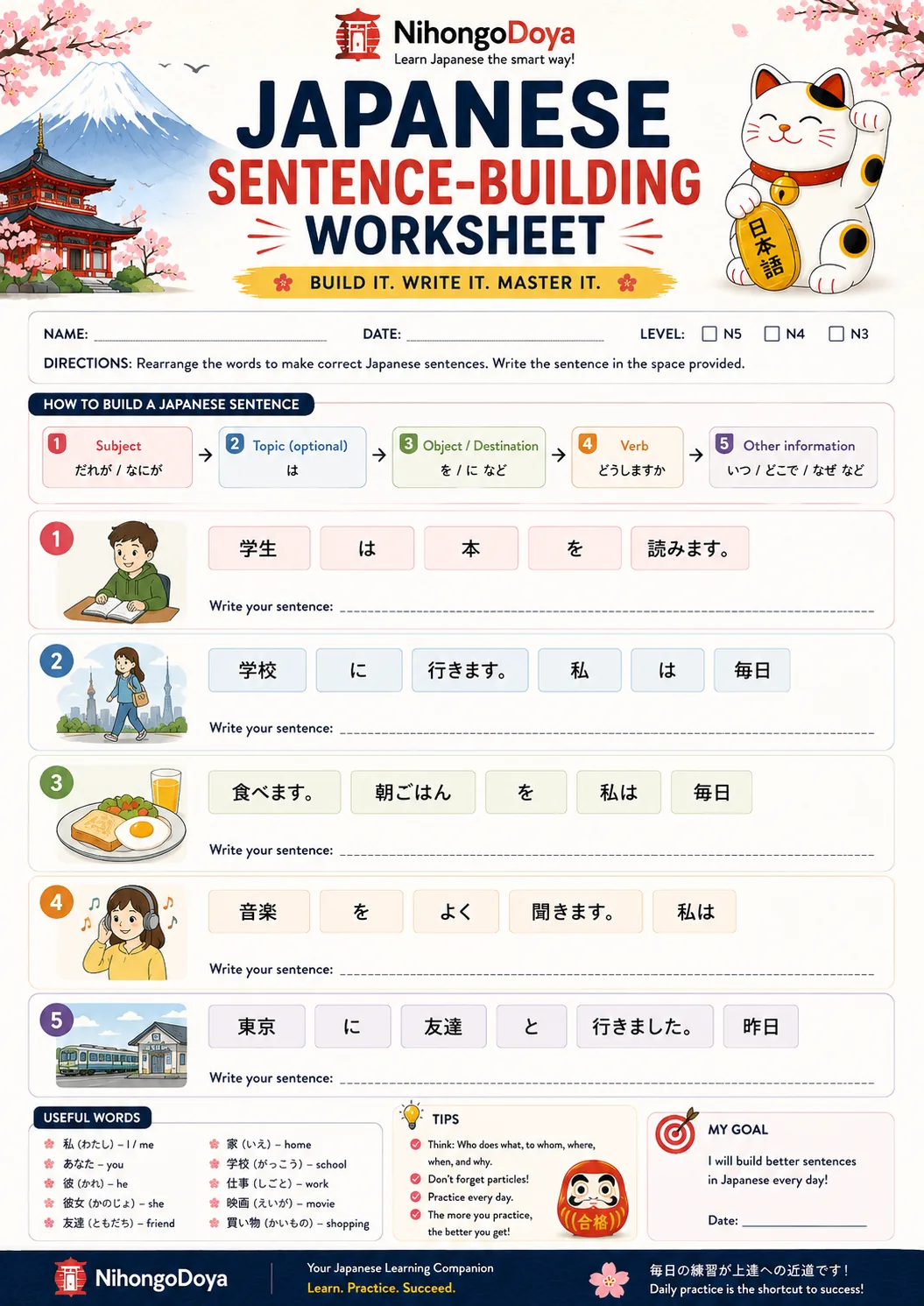
Ten sentences with a missing particle (は・が・を・に・で…), a word bank and an answer key — targeted practice for the mistakes beginners make most.
Particles are the small words that hold a Japanese sentence together — は marks the topic, を marks the object, に and で mark where things happen. They are also the single most common source of beginner mistakes, because English has no direct equivalent.
This worksheet drills particles the way that actually works: fill-in-the-blank sentences. You read ten natural sentences, each missing one particle, and choose the correct one from a word bank (は, が, を, に, で, へ, と, の). Each sentence has an English translation to give you context.
A full answer key lets you check yourself instantly, so you can practise alone and learn from every mistake. Reprint it whenever you want to re-test — spaced repetition of these patterns is what makes correct particle use automatic.
Here is what you will find inside the PDF to support your learning journey:
This resource is built with structured sections to target different aspects of your Japanese progress.
Practise the eight particles that appear in almost every N5 sentence.
Work through the classic topic-versus-subject distinction in real sentences.
English translations help you reason out the correct particle.
The answer key lets you self-check and fix mistakes immediately.
Targets the exact に/で and は/が confusions beginners struggle with.
Reprint and redo it until the right particle feels obvious.
Designed specifically to address the pain points of beginner and intermediate self-study learners.
Clean A4 layout with generous writing space — print as many copies as you need.
You write the answers yourself, which fixes the material in memory far better than reading.
Every worksheet comes with a full answer key so you can self-check without a teacher.
Vector PDF that stays sharp on phone, tablet or paper — study on the bus or at your desk.
Whether preparing for tests or building practical skills, this resource fits your study roadmap.
Particles are tested throughout N5 grammar and reading — this is focused drill practice.
Anyone who keeps mixing up は and が or に and で will benefit most.
The answer key means you can practise and correct yourself without a teacher.
Follow these step-by-step methods to get the maximum educational benefit from the materials.
Got questions about using or printing this resource? Check out our quick answers below.
Yes, available with no signup. Download and print as many copies as you like.
The eight core particles: は, が, を, に, で, へ, と and の.
Yes, a full answer key is printed on the sheet so you can self-check every answer.
Yes. Several sentences target the topic-versus-subject distinction that confuses most beginners.
Yes, all the possible particles are listed at the top so you choose rather than guess blindly.
It is aimed at JLPT N5 but is useful for anyone shaky on basic particle use.
Yes. Re-testing yourself after a few days is a great way to make correct particles automatic.
A little basic kanji appears, but the English translations mean you can still reason out every answer.
Improve your reading, writing and grammar reference. available for every learner.
Download PDF© 2026 NihongoDoya. All Rights Reserved. For personal educational use only.
Complement your studies with these free matching guides and worksheets from NihongoDoya.