 NihongoDoya
NihongoDoya
NihongoDoya
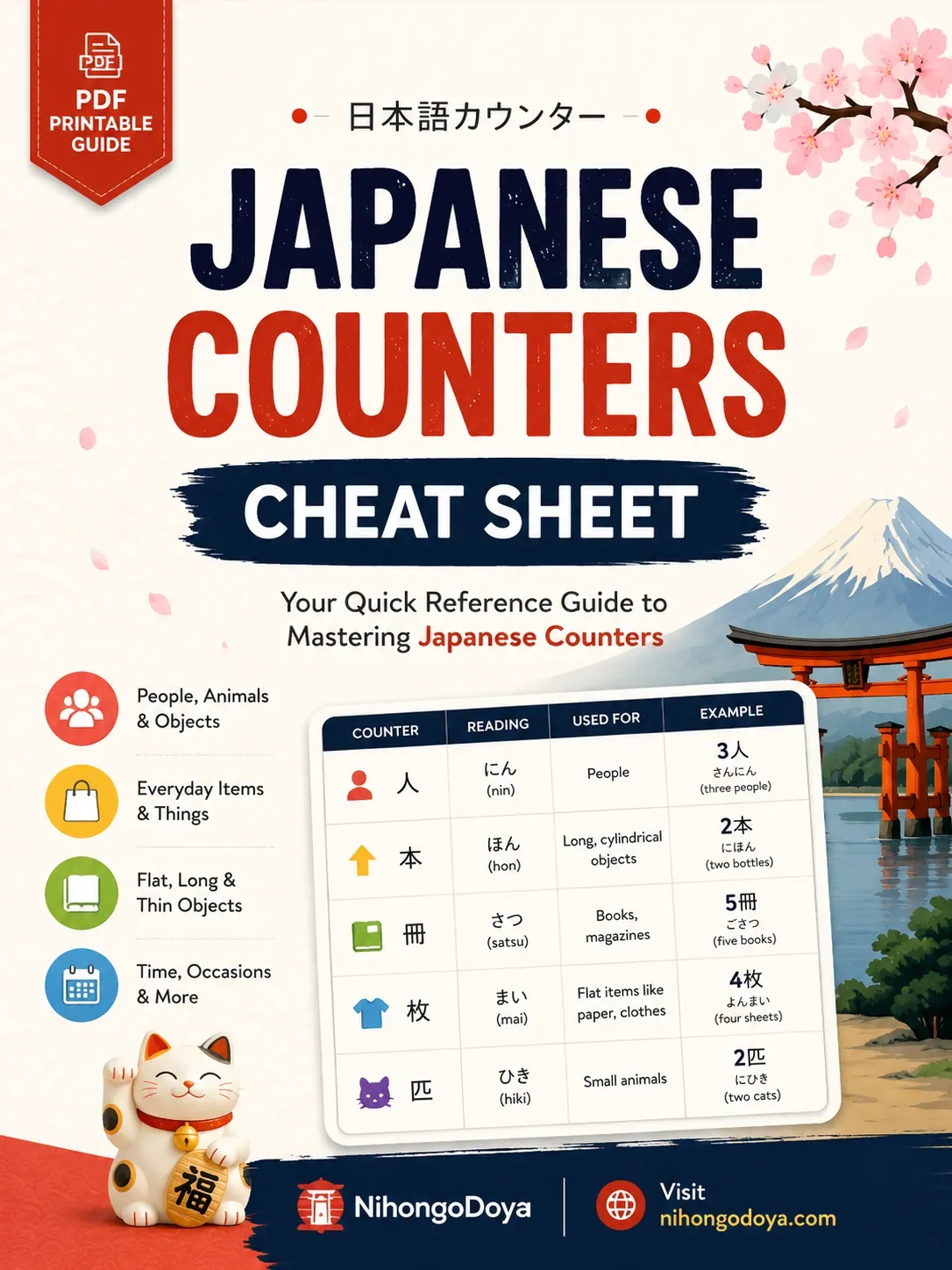
Accelerate your Japanese studies with this free, professional, and structured learning PDF. Designed for clear offline study and printable reference.
Particles (助詞 - joshi) are the critical grammatical joints of the Japanese language. Unlike English, which relies heavily on word order to convey relationships between nouns and verbs, Japanese grammar is entirely particle-driven. Particles are postpositional markers—short hiragana characters appended to nouns to mark them as subjects, objects, directions, locations, or topics. Without a solid understanding of particles, it is virtually impossible to form correct Japanese sentences, understand native speech, or progress past basic greetings.
Our Japanese Particles Cheat Sheet PDF is designed as a highly dense, easy-to-use visual guide summarizing the most essential particles you will encounter in beginner to intermediate study (covering JLPT N5, N4, and CEFR A1/A2 levels). This includes crucial particles such as は (wa), が (ga), を (o), に (ni), で (de), へ (e), と (to), も (mo), から (kara), and まで (made). Instead of reading through pages of theoretical linguistics, this sheet outlines the primary function of each particle in a clean, visual format, making it the perfect desktop companion for quick revision.
One of the biggest hurdles for Japanese students is the notorious distinction between the topic marker は (wa) and the subject marker が (ga). Beginner textbooks often explain this in confusing terms that leave students guessing. Our guide breaks down this distinction using simple, practical examples. We explain how は highlights the theme of the sentence (what you are talking about), while が draws focus to the specific subject itself. By studying these differences side-by-side on a single page, you will gain the clarity needed to choose the correct marker in your writing and speaking.
Furthermore, our cheat sheet focuses on particles that change meaning depending on context. For instance, the particle に (ni) can mark time, destination, or target, while で (de) can indicate the location of an action, a method, or a cause. We provide clear, authentic example sentences for each function to show you how they operate in daily life. This PDF is formatted on a single printable page, making it ideal to paste on your study wall, insert in a binder, or load on your smartphone for rapid lookup while doing exercises or practicing online grammar quizzes.
This study resource is built with structured sections to target different aspects of your Japanese grammar and vocabulary progress.
Learn the main grammatical particles including は, が, を, に, で, へ, and と.
Master the difference between the topic marker and subject marker with clear rules.
Understand how particles like に and で change function depending on the context.
Review natural example sentences showcasing correct particle application.
Learn how the particle の connects nouns to indicate ownership and descriptors.
Understand how final particles like ね and よ add emotion and emphasis to sentences.
Access a quick-reference guide immediately. No payment or account required.
Optimized to fit on a single page for physical printing or laminating for desk study.
Quickly verify particle functions during exercises without looking through textbook pages.
Designed with simple, high-frequency grammar patterns that make logical sense to beginners.
Learners struggling to understand basic sentence structures and noun-particle linkages.
Students preparing for exams who need to secure easy marks in the grammar selection sections.
Independent study enthusiasts looking for a simplified reference guide to support self-study textbooks.
Yes, this reference cheat sheet is available. You can download the high-quality PDF instantly by clicking the download buttons on this page. There are no hidden costs, subscriptions, or login requirements. We want to help learners master the core grammar of Japanese without financial barriers.
Yes! The PDF is specifically formatted to fit on a single A4 or US Letter page without losing clarity. It features crisp vector typography, clear dividers, and a compact grid layout, making it perfect to hang on a wall, laminate, or slip into a study binder for instant reference.
The は particle is the topic marker, introducing a general theme (what the sentence is about), while が is the subject marker, highlighting the specific noun performing the action. Our cheat sheet highlights this distinction with practical comparative examples, showing you when to use each marker correctly.
This sheet focus primarily on the core foundational particles required for JLPT N5 and N4 levels. These include は, が, を, に, で, へ, と, の, も, から, まで, and sentence ending particles like ね and よ. Mastering these core particles covers over 90% of the sentence junctions you will read in daily life.
This is a historical spelling convention in Japanese. When the characters は (ha) and へ (he) are used strictly as grammatical particle markers, their pronunciation changes to 'wa' and 'e' respectively. The cheat sheet includes romaji notes to remind beginners of these phonetic shifts.
Yes. Every particle is accompanied by multiple natural Japanese sentences, complete with hiragana readings (furigana) and English translations. Seeing particles in real sentences is crucial to understanding their syntax and location within a clause.
Yes, it serves as an excellent quick-refresher. Even advanced students occasionally make mistakes with topic-subject nuance or location markers. Having a visual, single-page summary helps you double-check your grammar during composition work.
Yes, it is fully compatible. The PDF is saved as vector text, so you can zoom in closely on any mobile screen or tablet without experiencing blurriness. It is optimized to open quickly in Safari, Chrome, or any default PDF viewer.
No registration or payment is needed — we just ask for your email address once, and the PDF saves to your downloads folder immediately. We use it only for occasional free study materials, and you can unsubscribe anytime.
Yes, you are free to share it for educational purposes. You can print copies for your classmates, share it in study forums, or send them the link to this official resources landing page. Commercial resale or rehosting the PDF file on other sites is prohibited.
Improve your vocabulary, readings, and grammar reference. available for every learner.
Download PDF© 2026 NihongoDoya. All Rights Reserved. For personal educational use only.