Trusted by Japanese learners worldwide

Japanese Counters Guide PDF

Accelerate your Japanese studies with this free, professional, and structured learning PDF. Designed for clear offline study and printable reference.

File Format PDF Document
Language English / Japanese
Level All Levels
Printable Yes
Mobile Friendly Yes
Cost 100% Free

Document Previews

Have a look inside this study guide. Every page is structured for clean reading and maximum visual focus.

Cover Page Preview

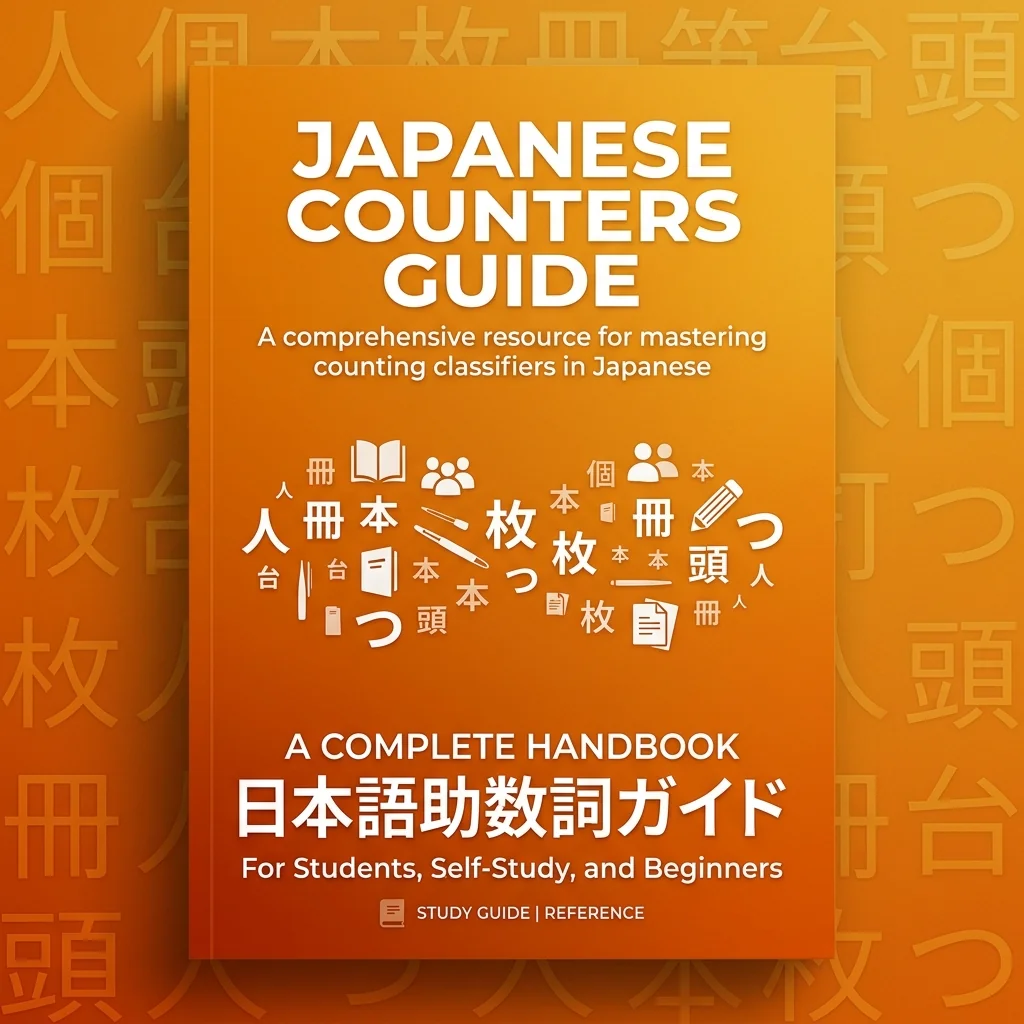
Cover Page

Minimalist Japanese-inspired cover page with clear guide metadata.

Sample Page Preview

Detailed Cards Section

Structured study items complete with meanings, readings, and example sentences.

Practice Page Preview

Review & Practice

Tracing practice worksheets, review tables, and checklists included.

About the Japanese Counters Study Guide

One of the most unique and initially frustrating aspects of learning Japanese is the counter system (助数詞 - josūshi). In English, we count most objects directly (one apple, two cars) or use basic containers (a cup of tea). In Japanese, however, you cannot simply pair a number with a noun. Instead, you must append a specific counter suffix to the number depending on the shape, size, or nature of the object you are counting. For example, flat objects like paper use 枚 (mai), long cylindrical objects like bottles use 本 (hon), and small round objects use 個 (ko).

Our Japanese Counters Guide PDF is a comprehensive, print-ready cheat sheet designed to simplify this complex system. It lists the most common counters used in daily life (covering JLPT N5, N4, and JFT-Basic exam scopes). It includes markers for people (人 - nin), animals (匹 - hiki), flat items (枚 - mai), books (冊 - satsu), vehicles/machines (台 - dai), and general objects (つ - tsu). With this guide, you will master not only which counter to use, but also the grammatical structure of how to position numbers and counters inside a Japanese sentence.

A major challenge for learners is the frequent phonetic sound changes (euphony) that occur when numbers combine with certain counters. For instance, counting long objects with 本 (hon) is not always standard: one bottle is 一本 (ippon), three bottles is 三本 (sanbon), and six bottles is 六本 (roppon). These sound shifts (from 'h' to 'pp' or 'b') are notoriously difficult to memorize. Our cheat sheet highlights these irregular phonetic changes using clean visual alerts and color-coding, so you can immediately see where the pronunciation deviates from standard numbers.

Furthermore, the guide explains the native Japanese number series (hitotsu, futatsu, mittsu...) versus the Sino-Japanese numbers (ichi, ni, san...). We explain how the native Japanese numbers serve as a universal 'generic' counter for items that do not have a specific counter classification. Formatted to print on a single high-contrast page, this study guide is an invaluable asset for your desk, study folder, or digital tablet, helping you build immediate confidence when ordering food, shopping, or taking official language proficiency tests.

Inside This Guide

Here is what you will find inside the PDF guide to support your learning journey:

  • Quick-reference comparison chart of 12 main counters
  • \n
  • Phonetic tables highlighting irregular sound changes
  • \n
  • Sino-Japanese vs Native Japanese counting guide
  • \n
  • Sentence pattern formulas showing correct word order
  • \n
  • Authentic dialogue examples for shopping and dining
  • \n
  • Cheat sheet for counting age, floors, and occurrences
  • \n
  • Single-page high-resolution print-optimized layout
  • \n

What You'll Learn

This study resource is built with structured sections to target different aspects of your Japanese grammar and vocabulary progress.

Core Counter Suffixes

Master high-frequency counters for people, flat sheets, long cylinders, and machines.

Universal Counting System

Learn the native Japanese numerical series (つ) for generic objects.

Phonetic Sound Shifts

Identify sound changes (rendaku) such as ippon, sanbon, roppon with visual tags.

Grammatical Word Order

Learn where to place numbers and counters relative to nouns and particles in sentences.

Animal Counting Suffixes

Differentiate between small animals (匹), large animals (頭), and birds (羽).

Time & Calendar Counters

Review key counters for days (日), months (月/ヶ月), years (年), and hours (時).

Why Choose This PDF?

Designed specifically to address the pain points of beginner and intermediate self-study learners.

Instant Direct Download

No registration, email collection, or subscription. Access your PDF guide immediately.

Compact Cheat Sheet

A single-page printable reference that avoids flipping through textbook chapters.

Visual Sound-Change Maps

Pronunciation changes are highlighted with bold styling to ensure correct spelling.

Perfect for Daily Life

Includes counters essential for restaurant ordering, travel, and shopping in Japan.

Who Is This For?

Whether preparing for tests or building practical speaking skills, this guide fits your study roadmap.

Survival Japanese Learners

Travelers or workers planning to visit Japan who need basic communication skills for shopping.

JLPT N5 & N4 Students

Students aiming to master counter grammar, a frequently tested topic in reading and listening sections.

Language School Candidates

Intermediate students looking to consolidate and verify numerical spelling before essays or tests.

How to Use This Study Resource

Follow these step-by-step methods to get the maximum educational benefit from the materials.

1
Download the PDF, print it out, or pin it to your desktop for easy viewing.
2
Review the universal generic counters (一つ to 十) first, as they are used daily.
3
Study the long-object (本) and animal (匹) counters, noting the bold sound changes.
4
Practice combining numbers with counters out loud to build natural speaking flow.
5
Observe the grammatical formulas to place counters correctly after particles.
6
Use the sheet as a reference when writing exercises, checking your spelling rules.
7
Quiz yourself on irregular counters (e.g. 1 person = hitori, 2 people = futari).

Frequently Asked Questions

Got questions about using or printing this guide? Check out our quick answers below.

Is the Japanese Counters Guide PDF free to download?

Yes, this PDF guide is completely free. You can download the file instantly by clicking the download buttons. We do not require you to register, sign up with an email, or create an account. Our resources are open and free for all students.

Can I print this counters reference guide on a single page?

Yes, the guide is designed to fit onto a single A4 or US Letter page. The high-resolution vector text ensures that all tables, characters, and phonetic guides print with perfect clarity, making it excellent for study folders or desk walls.

Why do counters change pronunciation (like ippon instead of ichi-hon)?

This is due to a phonetic phenomenon called euphony (音便 - onbin), which makes combinations easier to pronounce in fluid speech. Suffixes starting with 'h' or 'f' often change to double consonants ('pp') or voiced sounds ('b'). Our guide highlights these anomalies in bold.

What is the universal counter in Japanese?

The native Japanese number series ending in つ (tsu)—一つ (hitotsu), 二つ (futatsu), 三つ (mittsu)...—acts as the generic universal counter. You can use it to count most inanimate physical items if you do not know their specific shape-based counter.

How do you count people in Japanese?

People are counted using the suffix 人 (nin / mari). The first two numbers are highly irregular: 一人 (hitori - 1 person) and 二人 (futari - 2 people). From three onwards, you use the standard number + nin (e.g., 三人 - sannin). Our guide details this complete pattern.

Does this PDF include calendar counters (days, months, years)?

Yes, it includes a summary section for calendar and time counters. This covers hours (時 - ji), minutes (分 - fun/pun), days of the month (日 - ka/nichi, which has many N5 irregulars), months (月 - gatsu/kagetso), and years (年 - nen).

Is this guide useful for JFT-Basic test preparation?

Absolutely. Numerical expressions, shopping, and asking for quantities are heavily tested in the JFT-Basic listening and reading sections. Knowing counters is essential for passing the CEFR A2 level required for SSW work visas.

Can I read and zoom in on this PDF using my mobile phone?

Yes, the PDF is saved in vector format. You can open it in Chrome, Safari, or any mobile reader app and zoom in to read the smallest kana notes without any loss of image quality or pixellation.

Do I need to sign up for a newsletter to access this PDF?

No newsletter signup or personal data collection is required. We value your privacy and believe in seamless learning. The download is immediate and direct.

Can I share this counter sheet with my Japanese study group?

Yes, you are encouraged to share this guide. Feel free to print copies for group studies or share this landing page URL with your fellow students. Rehosting, editing, or selling the PDF file is strictly prohibited.

Download the PDF study material now

Improve your vocabulary, readings, and grammar reference. 100% free with no registration required.

Download PDF
File size: 112 KB Version: v1.1 Last updated: 2026-06-11

About NihongoDoya

NihongoDoya is a free Japanese learning platform providing detailed, structured study guides, grammar notes, vocabulary lists, character charts, and listening practice audio from Minna no Nihongo and Irodori tracks. We build clean, printable, and high-quality digital materials to support self-study learners and language school students worldwide on their path to fluency.

Copyright & Permitted Use Notice

© 2026 NihongoDoya. All Rights Reserved. For personal educational use only.

You are permitted to:

  • Download the PDF to your personal devices.
  • Print paper copies for your own personal studies.
  • Share links to this official landing page with friends.
  • Teachers may print copies as handouts in physical classrooms.

You are NOT allowed to:

  • Reupload the PDF file to other websites or drives.
  • Sell or bundle the guide for commercial gain.
  • Modify, cut, edit, or copy parts of the text design.
  • Distribute copies via file-sharing channels or online groups.

Related Reference Sheets

Complement your studies with these free matching guides and worksheets from NihongoDoya.