Trusted by Japanese learners worldwide

JLPT Grammar Cheat Sheets PDF

Accelerate your Japanese studies with this free, professional, and structured learning PDF. Designed for clear offline study and printable reference.

File Format PDF Document
Language English / Japanese
Level N5 to N3
Printable Yes
Mobile Friendly Yes
Cost 100% Free

Document Previews

Have a look inside this study guide. Every page is structured for clean reading and maximum visual focus.

Cover Page Preview

Cover Page

Minimalist Japanese-inspired cover page with clear guide metadata.

Sample Page Preview

Detailed Cards Section

Structured study items complete with meanings, readings, and example sentences.

Practice Page Preview

Review & Practice

Tracing practice worksheets, review tables, and checklists included.

About the JLPT Grammar Cheat Sheets Guide

Grammar is the skeleton of Japanese comprehension. For the Japanese Language Proficiency Test (JLPT), passing the grammar section requires you to recognize hundreds of distinct sentence patterns, conjunctive structures, adverbial helpers, and politeness variations. While textbooks cover these patterns across dozens of chapters, studying them in isolation can make it difficult to see how different structures connect. A comprehensive summary sheet that compiles these rules visually is the ultimate tool for final revision before entering the exam room.

Our JLPT Grammar Cheat Sheets PDF is a professional, high-density study guide that compiles essential grammar rules, sentence endings, particle configurations, and structural formulas for JLPT N5, N4, and N3 levels. Instead of flipping through heavy textbooks the night before the test, this document outlines key sentence structures in a clear, comparative layout. It acts as a comprehensive reference guide to verify conjunctive forms, review particle changes, and build immediate grammatical accuracy.

A major focus of this guide is the logic of clause structures. In Japanese, modifier clauses precede the noun they describe (e.g. 'the book I read' is literally 'I read book' - わたしが読んだ本). Understanding how plain form verbs, adjectives, and nouns join grammatically to create these relative clauses is crucial. Our sheet maps out these connection rules (e.g. Dictionary Form + Noun; Na-Adjective + na + Noun) with visual indicators, helping you eliminate simple syntax errors that cost vital marks in the reading section.

Additionally, the guide summarizes tricky grammar items that frequently appear in exams, such as conditional clauses (-tara, -ba, -to, nara), comparison patterns (hō ga ii, yori), and expression of desire/intention (tai, tsumori). Formatted as a multi-page, vector-text PDF guide, it is print-optimized for standard A4 paper, making it perfect for folder inserts, desk reference sheets, or mobile reading during commutes, helping you secure high marks in both the grammar and reading sections of the JLPT.
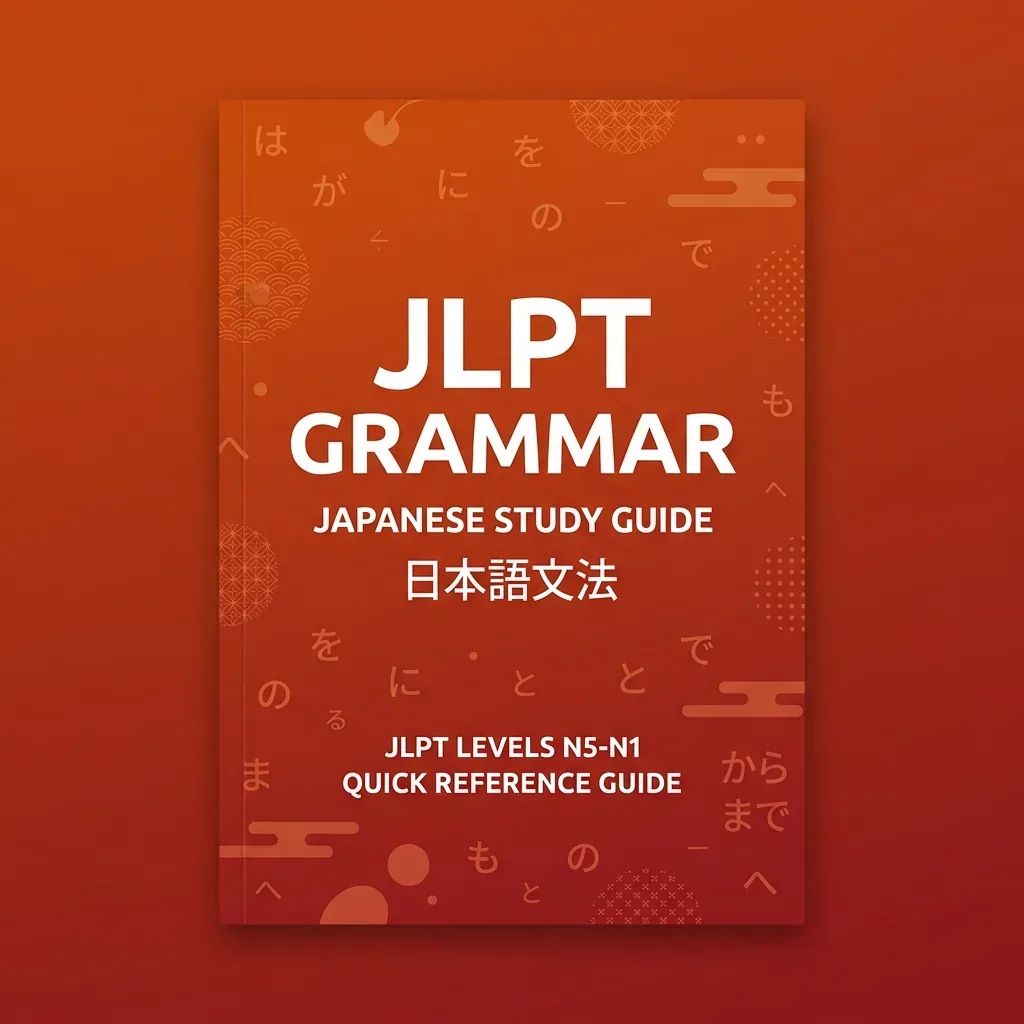
Inside This Guide

Here is what you will find inside the PDF guide to support your learning journey:

  • Conjunction maps showing plain form connections
  • \n
  • Conditional clause comparisons (-tara, -ba, -to, nara)
  • \n
  • Comparison and selection pattern guide with examples
  • \n
  • Descriptor modifications (Noun clauses, adjective linkages)
  • \n
  • Grammar patterns summary for N5, N4, and N3 preparation
  • \n
  • Furigana readings above kanji for beginner ease
  • \n
  • Multi-page, print-ready, high-resolution vector PDF
  • \n

What You'll Learn

This study resource is built with structured sections to target different aspects of your Japanese grammar and vocabulary progress.

Core Sentence Structures

Master basic and intermediate sentence patterns including clause structures and relative clauses.

Grammar Conjunctive Rules

Learn how plain form verbs, nouns, and adjectives connect with grammatical structures.

Tricky Conditional Clauses

Compare and master the usage of conditional suffixes -tara, -ba, -to, and nara.

Comparison & Desire Suffixes

Review key patterns expressing comparisons, preferences, decisions, and personal desire.

Polite vs Casual Registers

Review standard polite Japanese structures alongside casual endings used in daily life.

JLPT Exam Strategies

Understand grammar connection shortcuts to solve sentence rearrangement questions quickly.

Why Choose This PDF?

Designed specifically to address the pain points of beginner and intermediate self-study learners.

Free Direct Download

No registration, logins, or hidden subscription fees. Get the PDF study guide instantly.

Unified Reference Guide

Consolidates dozens of textbook chapters into a compact visual summary sheet.

Optimized for Printing

High-contrast vector text formatted for standard A4 sheets for offline studying.

Clear Grammar Formulas

Uses mathematical structural formulas (e.g., V-plain + tsumori) for logical clarity.

Who Is This For?

Whether preparing for tests or building practical speaking skills, this guide fits your study roadmap.

JLPT Candidates

Students preparing for N5, N4, or N3 exams who need to master grammar connection rules quickly.

Textbook Self-Study Learners

Students studying independently who need a clear reference sheet to verify grammar joints.

Language Class Students

High school or university students looking to double-check syntax during essay writing.

How to Use This Study Resource

Follow these step-by-step methods to get the maximum educational benefit from the materials.

1
Download the PDF and save it as a quick-access shortcut, or print the sheets.
2
Verify the connection rule (e.g., past form, plain present) before writing or translating.
3
Compare the different conditional clauses (tara vs ba) to select the correct context.
4
Practice combining nouns and adjectives using the modifier formulas shown.
5
Review the list of sentence rearrangement questions, applying connection logic.
6
Use the checklist formatting to track grammar points you have fully mastered.
7
Combine this guide with our online grammar notes and listening audio for daily practice.

Frequently Asked Questions

Got questions about using or printing this guide? Check out our quick answers below.

Is the JLPT Grammar Cheat Sheets PDF free to download?

Yes, this PDF resource is completely free. You can download the full guide instantly by clicking the download buttons on this page. No accounts, email signups, or payment details are required. We want to provide free, high-quality reference tools to all Japanese learners.

Can I print this grammar cheat sheet for offline study?

Yes, the document is specifically designed and formatted for standard A4 portrait paper. The crisp vector fonts print with perfect readability in color or grayscale, making it excellent for binders, workbooks, or study walls.

Which JLPT levels are covered in this grammar guide?

The PDF outlines grammar connection formulas and patterns essential for JLPT N5, N4, and N3 levels. This includes foundational particle combinations, relative clause structures, conditional patterns, and comparisons required for these exams.

Does this PDF explain how to form relative clauses in Japanese?

Yes, it contains a clear visual breakdown showing how verb clauses modify nouns. It displays the connection rules for plain present, plain past, and negative verb phrases, along with adjective-noun link rules, which is heavily tested in exams.

Why are conditional clauses (-tara, -ba, -to, nara) so confusing?

They all translate to 'if' or 'when' in English, but have different nuances. For example, -to indicates natural consequences, -tara is a general condition, -ba emphasizes the condition itself, and nara is for contextual advice. Our sheet explains these differences with examples.

Does this cheat sheet include example sentences?

Yes, each grammar formula is paired with realistic example sentences written in Japanese, accompanied by spaced hiragana readings (furigana) for kanji, and complete English translations to clarify meaning.

What is a 'grammar formula' in this PDF?

A grammar formula is a mathematical representation of how words connect. For example, to express intention using tsumori: 'V-plain (non-past) + tsumori' (e.g. iku tsumori - intend to go). These formulas help you build grammatically correct sentences.

Can I use this PDF guide on my smartphone or Kindle?

Yes, the file is fully digital-friendly. It is saved in standard vector-text format, which means you can open it in any browser or PDF viewer on iOS, Android, macOS, or Windows and zoom in without experiencing blurriness.

Is email registration required to access the PDF?

No email collection, subscription, or registration is required. We respect your time and privacy. The download link is direct, safe, and immediate.

Am I allowed to share this PDF guide with my study group?

Yes, you are welcome to share this study guide. You can print copies for study groups or send them this landing page URL so they can download the official version. Modifying, rehosting, or selling the PDF is prohibited.

Download the PDF study material now

Improve your vocabulary, readings, and grammar reference. 100% free with no registration required.

Download PDF
File size: 111 KB Version: v1.1 Last updated: 2026-06-11

About NihongoDoya

NihongoDoya is a free Japanese learning platform providing detailed, structured study guides, grammar notes, vocabulary lists, character charts, and listening practice audio from Minna no Nihongo and Irodori tracks. We build clean, printable, and high-quality digital materials to support self-study learners and language school students worldwide on their path to fluency.

Copyright & Permitted Use Notice

© 2026 NihongoDoya. All Rights Reserved. For personal educational use only.

You are permitted to:

  • Download the PDF to your personal devices.
  • Print paper copies for your own personal studies.
  • Share links to this official landing page with friends.
  • Teachers may print copies as handouts in physical classrooms.

You are NOT allowed to:

  • Reupload the PDF file to other websites or drives.
  • Sell or bundle the guide for commercial gain.
  • Modify, cut, edit, or copy parts of the text design.
  • Distribute copies via file-sharing channels or online groups.

Related Reference Sheets

Complement your studies with these free matching guides and worksheets from NihongoDoya.