
Elementary 1 (A2) notes prepared and maintained by the NihongoDoya Editorial Team.
Lesson summaries and study cards last reviewed 17 July 2026. These are independent learning materials, not official examination content. Report a correction.
Introduction
Elementary 1 (A2) builds on Starter with longer everyday tasks. These 9 can-do lessons (CEFR A2) cover hobbies and experiences, explaining how to do things, plans, polite requests at work, health advice and travel — each card pairs the can-do conversation with the grammar (りかい).
What you will learn
- Hobbies & ability: 〜ことができる, 〜たことがある
- Describing scenes with 〜ています and noun modification
- Explaining steps: 〜方, 〜てから, まず・次に
- Shopping and trying on: 〜てもいいですか, 〜すぎる
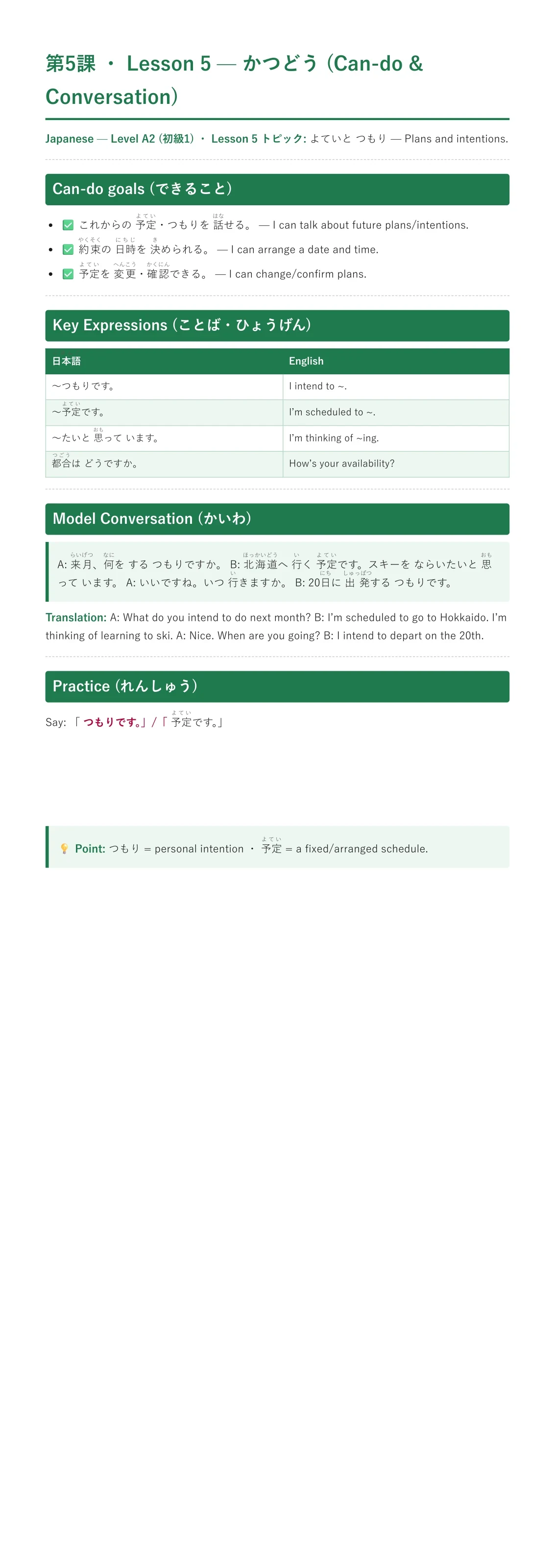
- Plans and intentions: 〜つもり, 〜予定, 〜たいと思う
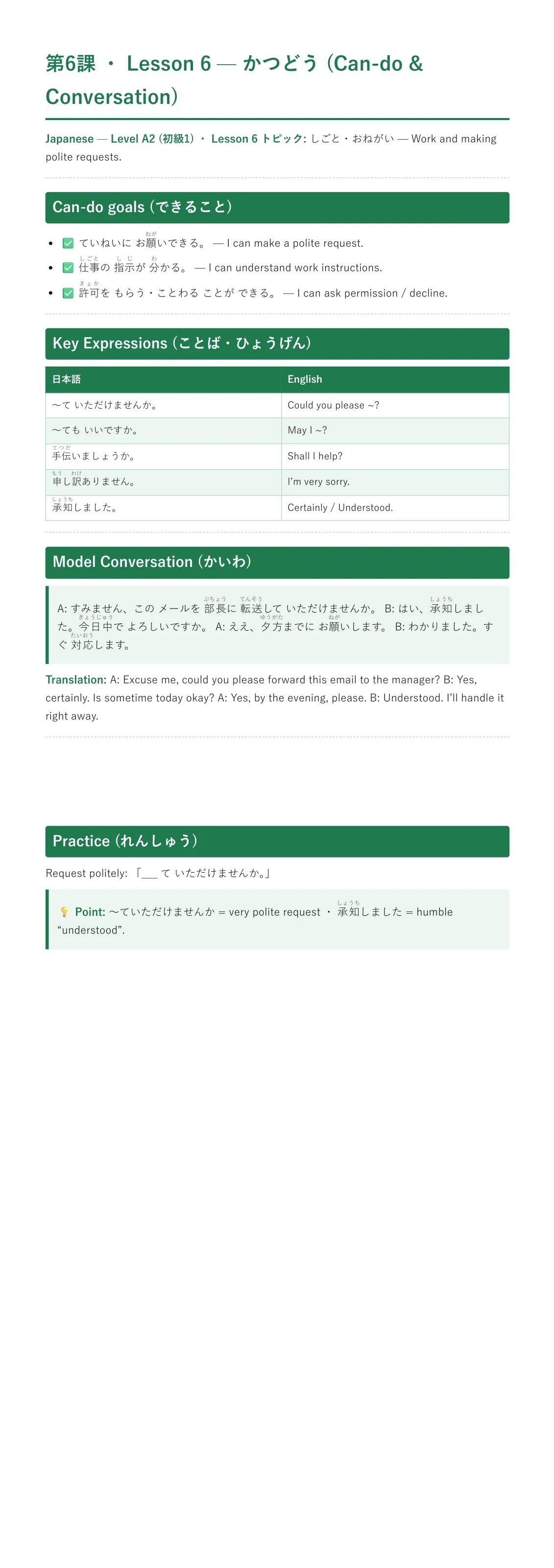
- Polite requests at work: 〜ていただけませんか, 〜ましょうか
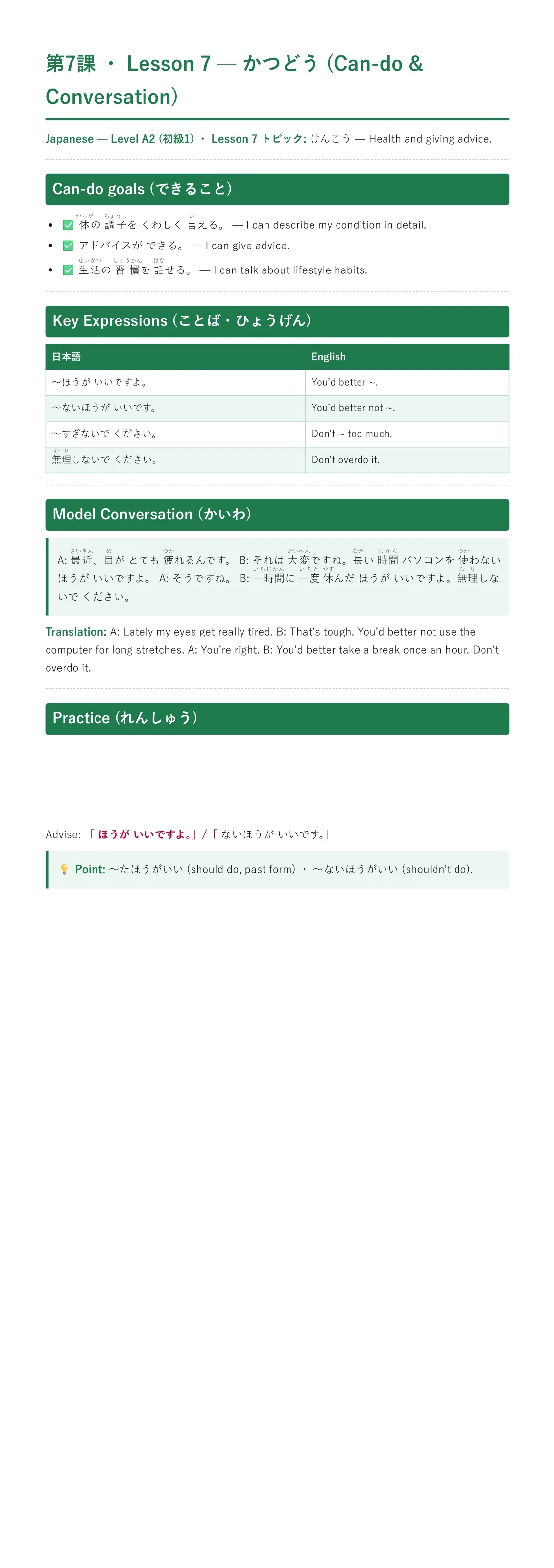
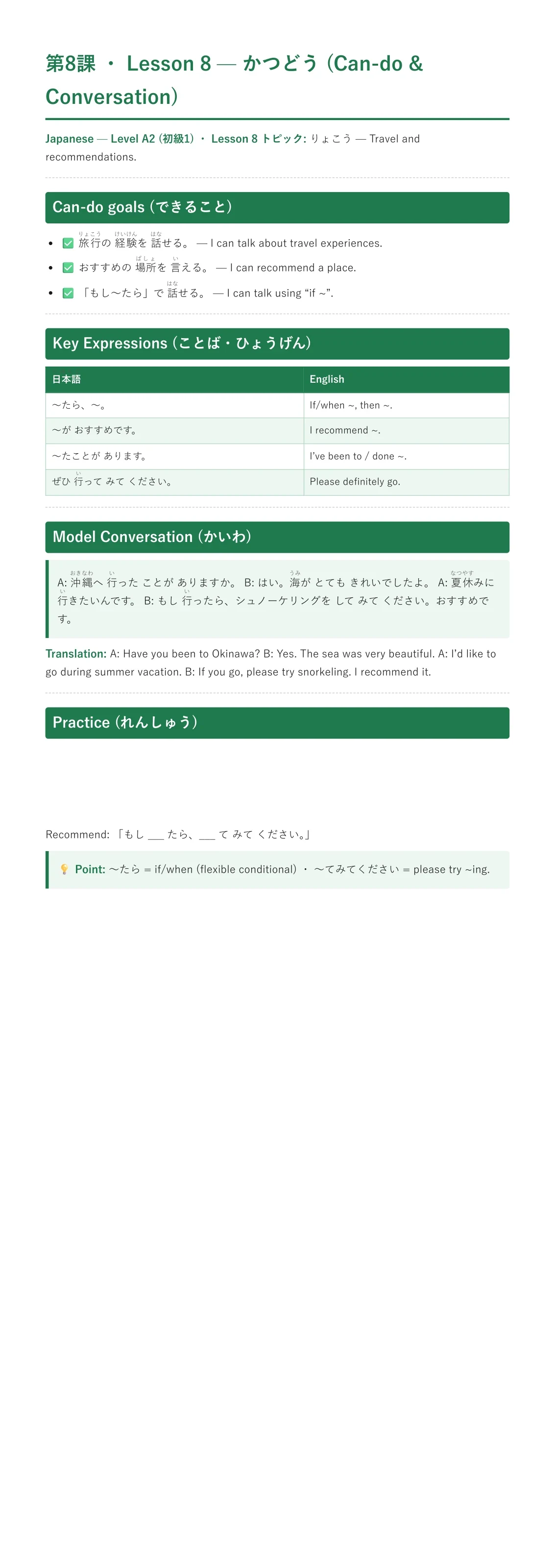
- Advice and travel: 〜たほうがいい, 〜たら, 〜てみる
Who this level is for
Best for learners who have finished Beginner (A1) (or JLPT N5) and want practical A2 Japanese for daily life and work.
A weekly can-do routine (Elementary 1)
- Read the can-do goal, then study the かつどう conversation and りかい grammar.
- Practise the conversation twice — once reading, once from memory.
- Adapt it: change the plan, the request or the hobby to fit your life.
- Note the grammar pattern (〜ことができる, 〜つもり) and reuse it in a new sentence.
- Review last week's can-do tasks so they stay active.
Common mistakes to avoid
- Forgetting the dictionary form before 〜ことができる.
- Confusing 〜つもり (intention) with 〜予定 (fixed schedule).
- Using 〜てください where a softer 〜ていただけませんか is expected.
- Mixing 〜たほうがいい (should) with plain 〜ほうがいい comparisons.
Related study materials
Build a joined-up study cycle by combining this page with the practice and reference materials below.
Frequently asked questions
What level is Elementary 1 (A2)?
CEFR A2 — roughly the first half of JLPT N4 grammar, but focused on daily-life and workplace tasks.
How is each lesson structured?
Each card has a かつどう (can-do conversation) side and a りかい (grammar and vocabulary) side, just like the textbook.
Can I study this alongside JLPT N4?
Yes — Elementary 1 gives you the spoken side of the same grammar N4 tests.
Do I need to know all of Starter first?
Knowing greetings, 〜ます forms and basic particles is enough to begin Elementary 1.
What comes next?
Elementary 2 (A2), which adds hearsay, rules, giving/receiving and handling trouble.
Elementary 1 (A2) lesson-by-lesson syllabus
Every lesson on this page includes handwritten study cards with full written explanations. Here is what each lesson covers:
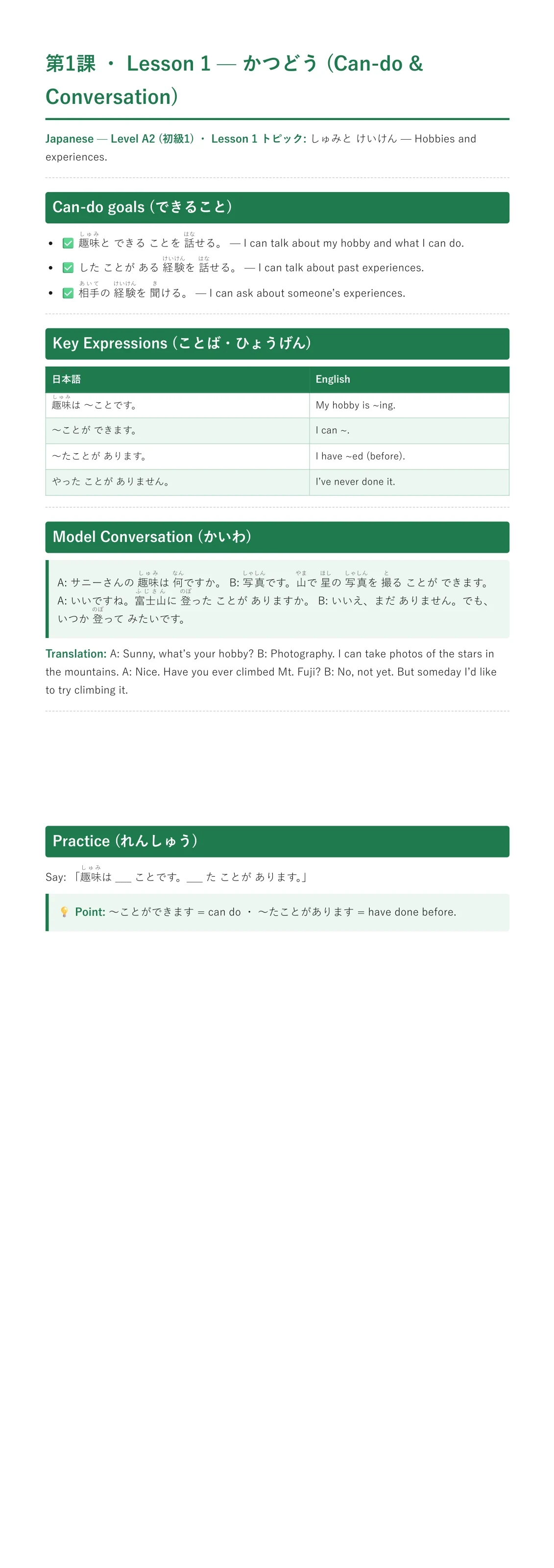
Lesson 1
B: Photography. I can take photos of the stars in the mountains.
Covers: Can-do goals (できること) · Key Expressions (ことば・ひょうげん) · Model Conversation (かいわ) · Practice (れんしゅう) · Dictionary form + ことが できます (can) · <ruby>趣味<rt>しゅみ</rt></ruby>は + dictionary form + ことです · た-form + ことが あります (experience) · Vocabulary (ことば) · Mini Practice (れんしゅう)
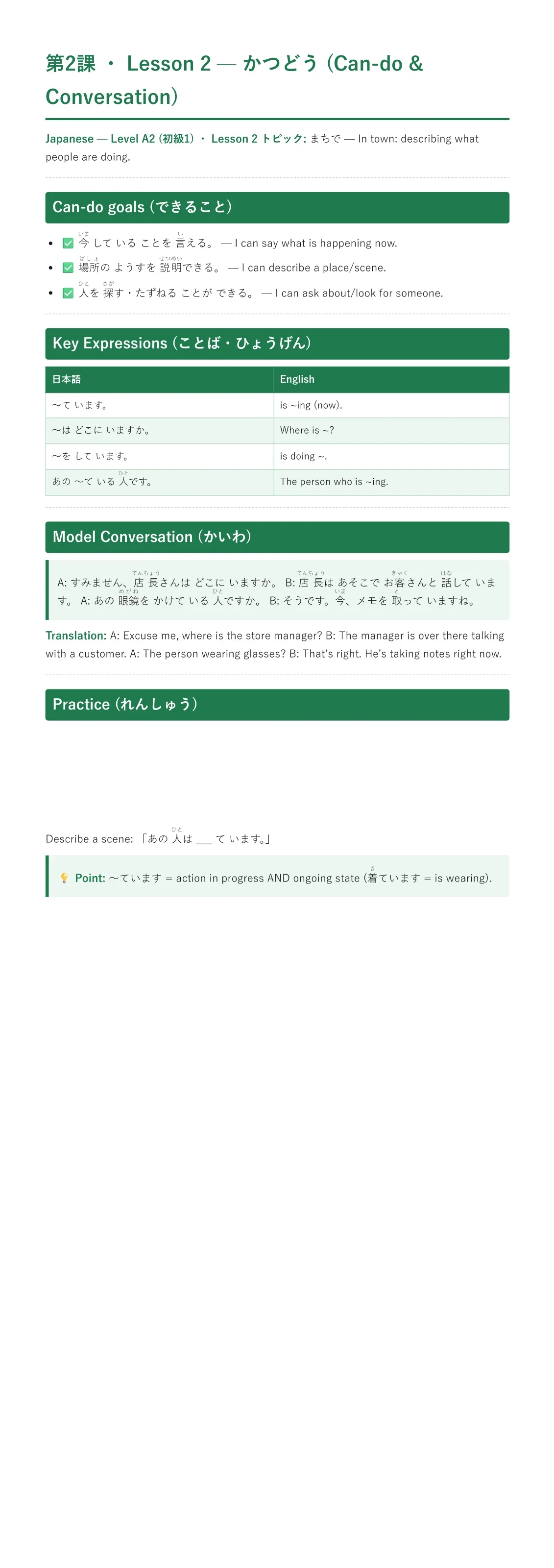
Lesson 2
A: Excuse me, where is the store manager?
Covers: Can-do goals (できること) · Key Expressions (ことば・ひょうげん) · Model Conversation (かいわ) · Practice (れんしゅう) · て-form review (て<ruby>形<rt>けい</rt></ruby>) · 〜て います (in progress / state) · 〜て いる + Noun (modifying) · Vocabulary (ことば) · Mini Practice (れんしゅう)
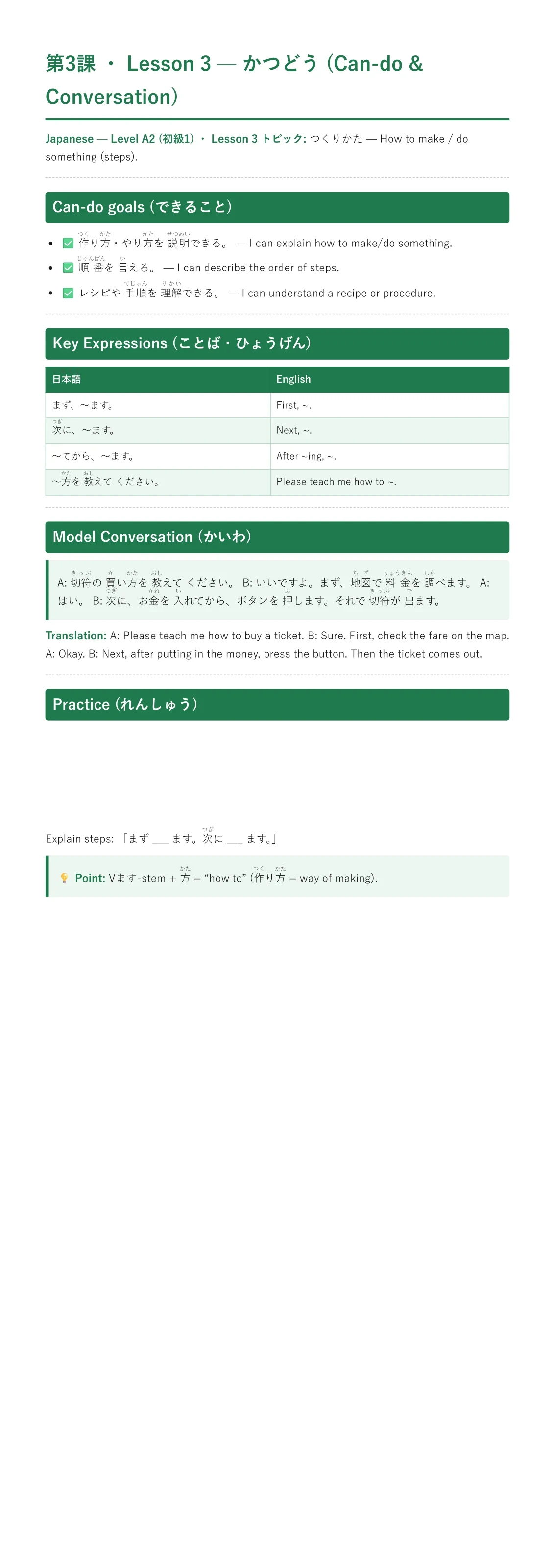
Lesson 3
B: Sure. First, check the fare on the map.
Covers: Can-do goals (できること) · Key Expressions (ことば・ひょうげん) · Model Conversation (かいわ) · Practice (れんしゅう) · Vます-stem + <ruby>方<rt>かた</rt></ruby> (how to do) · 〜てから (after doing) · Vocabulary (ことば) · Mini Practice (れんしゅう)
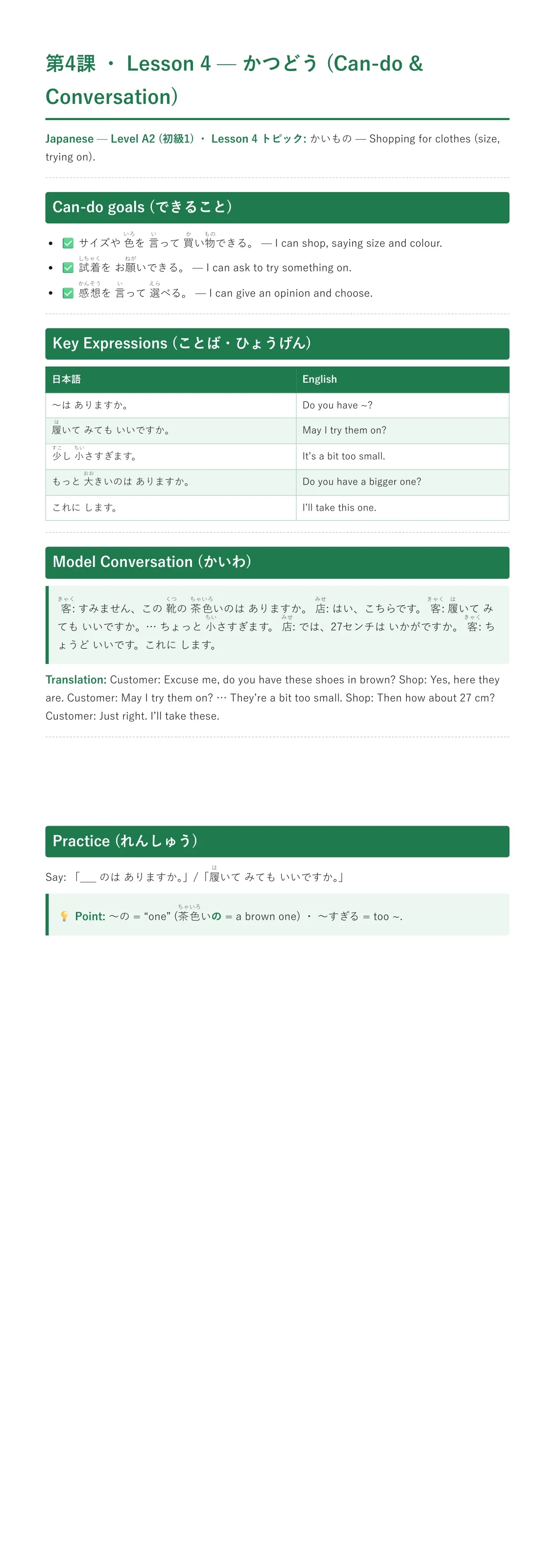
Lesson 4
Customer: Excuse me, do you have these shoes in brown?
Covers: Can-do goals (できること) · Key Expressions (ことば・ひょうげん) · Model Conversation (かいわ) · Practice (れんしゅう) · 〜ても いいですか (May I…?) · 〜すぎます (too…) · い-adj/な-adj + の (the … one) · Vocabulary (ことば) · Colours (<ruby>色<rt>いろ</rt></ruby>) · Mini Practice (れんしゅう)
Lesson 5
B: I'm scheduled to go to Hokkaido. I'm thinking of learning to ski.
Covers: Can-do goals (できること) · Key Expressions (ことば・ひょうげん) · Model Conversation (かいわ) · Practice (れんしゅう) · Dictionary form + つもりです (intend to) · Dictionary / Nの + <ruby>予定<rt>よてい</rt></ruby>です (scheduled) · 〜たいと <ruby>思<rt>おも</rt></ruby>って います (thinking of ~ing) · Vocabulary (ことば) · Dates (<ruby>日<rt>ひ</rt></ruby>) · Mini Practice (れんしゅう)
Lesson 6
A: Excuse me, could you please forward this email to the manager?
Covers: Can-do goals (できること) · Key Expressions (ことば・ひょうげん) · Model Conversation (かいわ) · Practice (れんしゅう) · 〜て いただけませんか (Could you please…? — very polite) · Politeness ladder · 〜ましょうか (Shall I…? — offer) · 〜なければ なりません (must) · Vocabulary (ことば) · Mini Practice (れんしゅう)
Lesson 7
B: That's tough. You'd better not use the computer for long stretches.
Covers: Can-do goals (できること) · Key Expressions (ことば・ひょうげん) · Model Conversation (かいわ) · Practice (れんしゅう) · 〜たほうが いいです / 〜ないほうが いいです (advice) · 〜んです (explanation) · 〜なくても いいです (don't have to) · Vocabulary (ことば) · Mini Practice (れんしゅう)
Lesson 8
A: I'd like to go during summer vacation.
Covers: Can-do goals (できること) · Key Expressions (ことば・ひょうげん) · Model Conversation (かいわ) · Practice (れんしゅう) · た-form + ら (if / when — conditional) · 〜て みます (try doing) · 〜たことが あります (experience — review) · Vocabulary (ことば) · Mini Practice (れんしゅう)
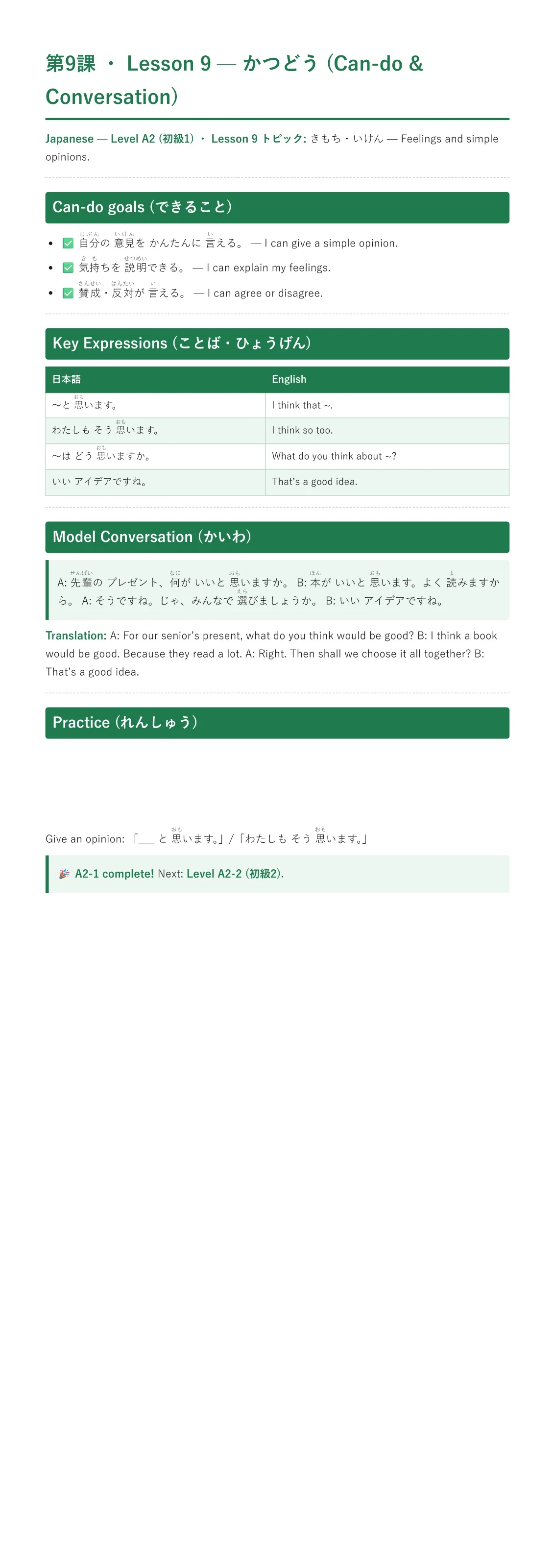
Lesson 9
A: For our senior's present, what do you think would be good?
Covers: Can-do goals (できること) · Key Expressions (ことば・ひょうげん) · Model Conversation (かいわ) · Practice (れんしゅう) · Plain form + と <ruby>思<rt>おも</rt></ruby>います (I think that) · 〜から (because — giving a reason) · Vます-stem + やすい / にくい (easy / hard to) · Vocabulary (ことば) · Mini Practice (れんしゅう) · 🎉 初級1 修了 (A2-1 complete!)