
Elementary 2 (A2) notes prepared and maintained by the NihongoDoya Editorial Team.
Lesson summaries and study cards last reviewed 17 July 2026. These are independent learning materials, not official examination content. Report a correction.
Introduction
Elementary 2 (A2) completes the A2 stage and bridges toward intermediate Japanese. These 9 can-do lessons (CEFR A2) cover passing on information, mishaps, rules and manners, goals, helping each other, handling trouble and community life — each card pairs the can-do conversation with its grammar.
What you will learn
- Passing on news: 〜そうです (hearsay), 〜と言っていました
- Mishaps and 〜てしまう, plus 〜とき and 〜ので
- Appearance and guessing: 〜そう, 〜ようだ / みたい
- Rules and manners: 〜てはいけない, 〜ことになっている
- Goals and change: 〜ようになる, 〜ようにする
- Helping each other: 〜てあげる / もらう / くれる
- Trouble and community: 〜んですが, 〜てもらえますか, 〜ことになった
Who this level is for
Best for learners finishing the A2 stage who want to bridge into intermediate Japanese and the JLPT N4–N3 range.
A weekly can-do routine (Elementary 2)
- Identify the situation (passing on news, a rule, a problem) and its can-do goal.
- Study the grammar that powers it (〜そうです, 〜てはいけない, やりもらい).
- Act out the model conversation, then improvise a similar one.
- Apply the phrases to a real exchange — a notice, a request, a small complaint.
- Revisit earlier lessons so the giving / receiving forms become automatic.
Common mistakes to avoid
- Mixing appearance 〜そう (looks) with hearsay 〜そうです (I hear).
- Confusing 〜ことにする (you decide) with 〜ことになる (it is decided).
- Dropping 〜んですが when softening a request or complaint.
- Reversing くれる (to me) and あげる (to others) in favours.
Related study materials
Build a joined-up study cycle by combining this page with the practice and reference materials below.
Frequently asked questions
What does Elementary 2 (A2) add over Elementary 1?
It adds hearsay (〜そうです), rules (〜てはいけない / ことになっている), the giving-and-receiving of favours, and handling trouble politely.
Is this enough to start N3?
It bridges toward N3. Pair it with the JLPT N3 grammar guide for exam-style coverage.
How are the lessons organised?
By can-do goal — each card shows the situation, the key phrases, a model conversation and the grammar (りかい).
Can I skip to this from N4?
Yes, if you know the て-form, plain forms and basic conditionals.
What comes next?
Pre-Intermediate (B1), which covers opinions, business keigo and giving short speeches.
Elementary 2 (A2) lesson-by-lesson syllabus
Every lesson on this page includes handwritten study cards with full written explanations. Here is what each lesson covers:
Lesson 1
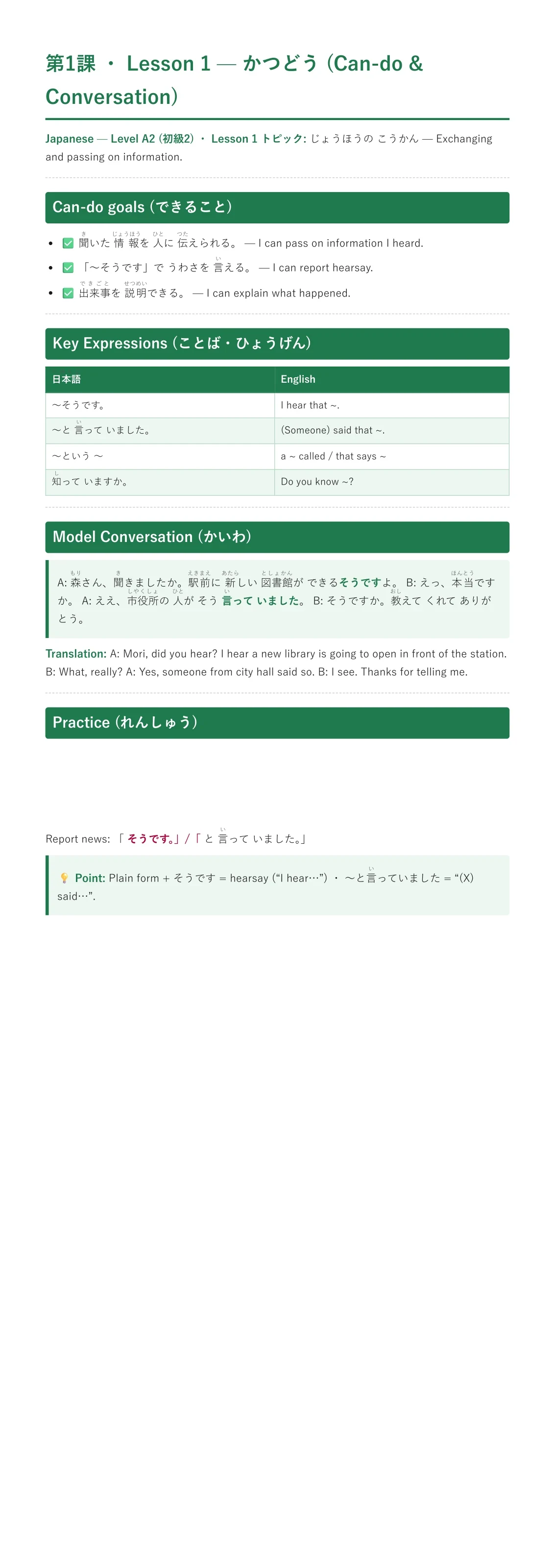
A: Mori, did you hear? I hear a new library is going to open in front of the station.
Covers: Can-do goals (できること) · Key Expressions (ことば・ひょうげん) · Model Conversation (かいわ) · Practice (れんしゅう) · Plain form + そうです (hearsay) · 〜と <ruby>言<rt>い</rt></ruby>って いました (reported speech) · 〜という + Noun · Vocabulary (ことば) · Mini Practice (れんしゅう)
Lesson 2
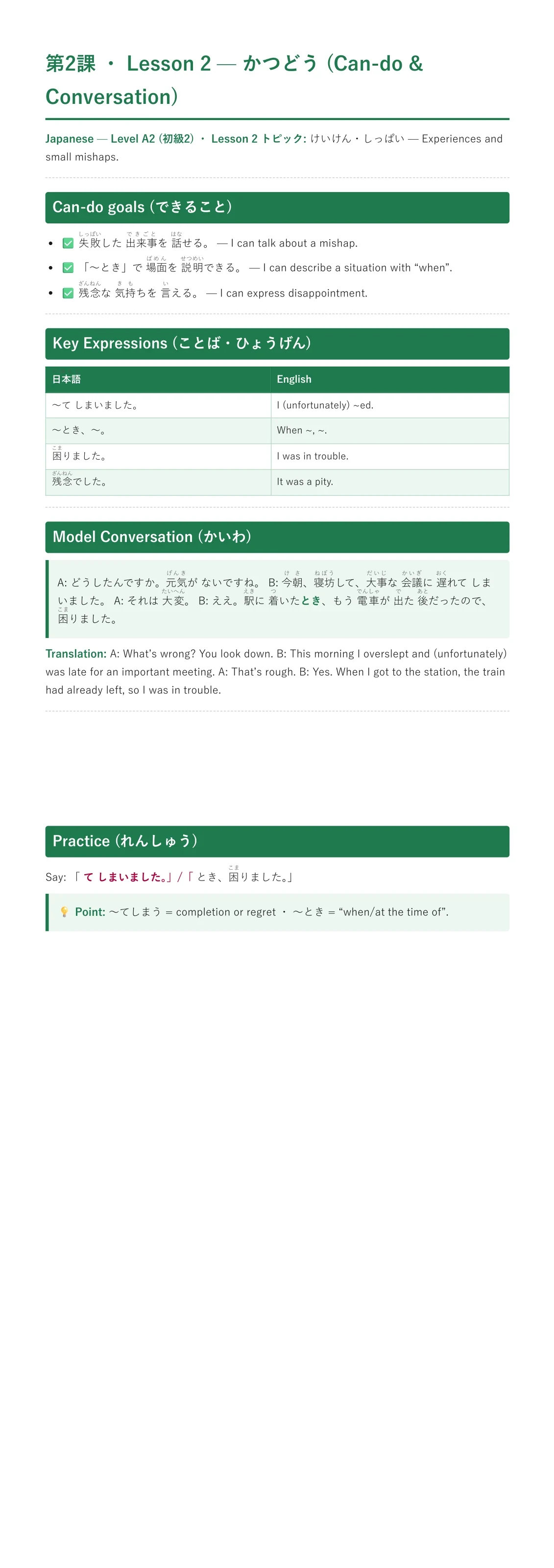
B: This morning I overslept and (unfortunately) was late for an important meeting.
Covers: Can-do goals (できること) · Key Expressions (ことば・ひょうげん) · Model Conversation (かいわ) · Practice (れんしゅう) · 〜て しまいました (completion / regret) · 〜とき (when) · 〜ので (reason — soft) · Vocabulary (ことば) · Mini Practice (れんしゅう)
Lesson 3
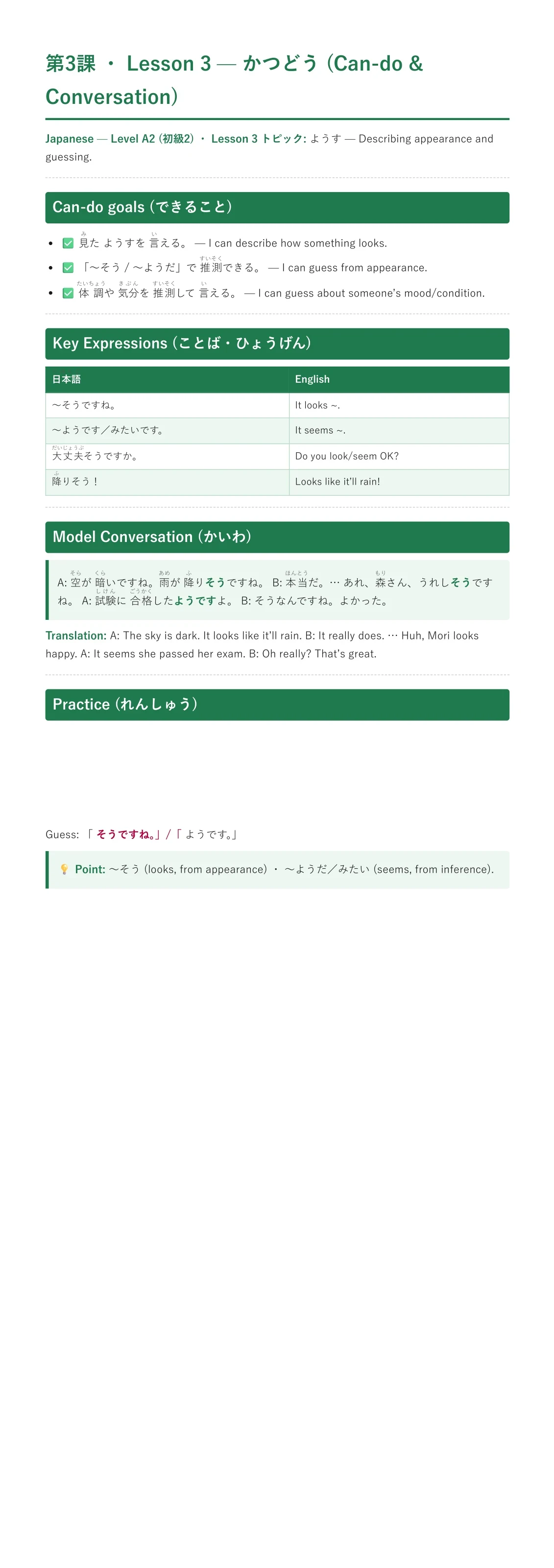
A: The sky is dark. It looks like it'll rain.
Covers: Can-do goals (できること) · Key Expressions (ことば・ひょうげん) · Model Conversation (かいわ) · Practice (れんしゅう) · 〜そうです (appearance / looks like) · 〜ようです / 〜みたいです (seems — inference) · Vocabulary (ことば) · Mini Practice (れんしゅう)
Lesson 4
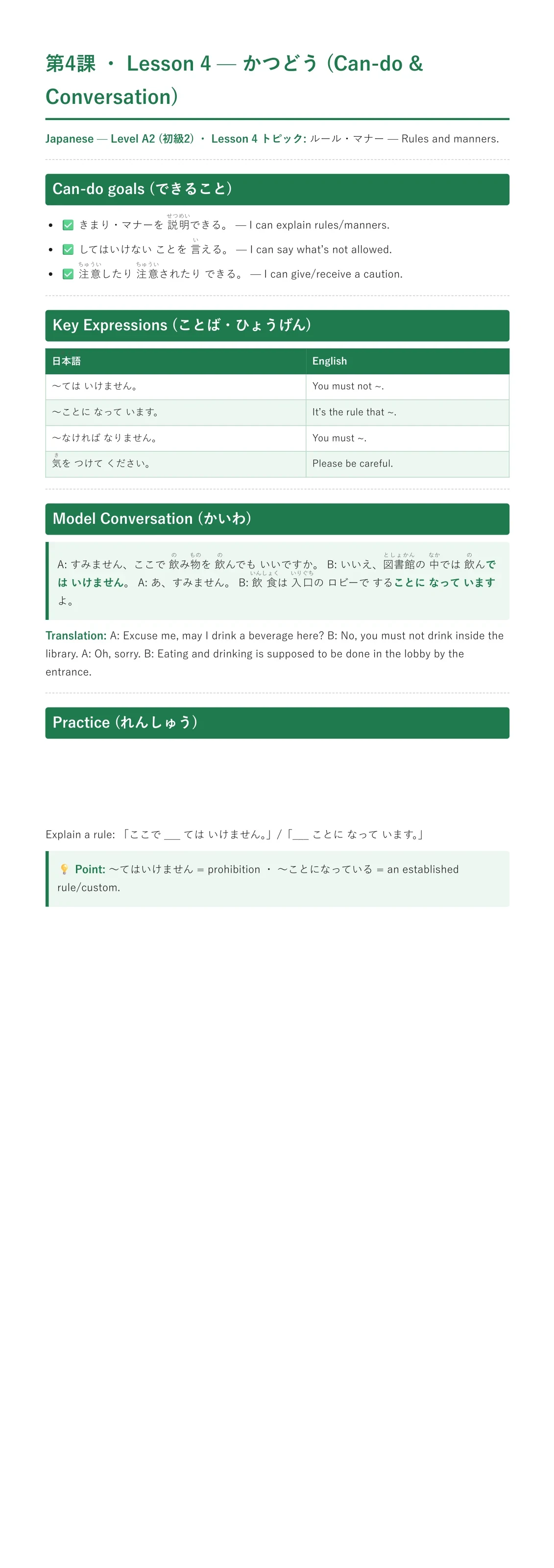
A: Excuse me, may I drink a beverage here?
Covers: Can-do goals (できること) · Key Expressions (ことば・ひょうげん) · Model Conversation (かいわ) · Practice (れんしゅう) · 〜ては いけません (must not) · 〜ても いいです (may / allowed) · 〜ことに なって います (established rule) · 〜なければ なりません (must) · Vocabulary (ことば) · Mini Practice (れんしゅう)
Lesson 5
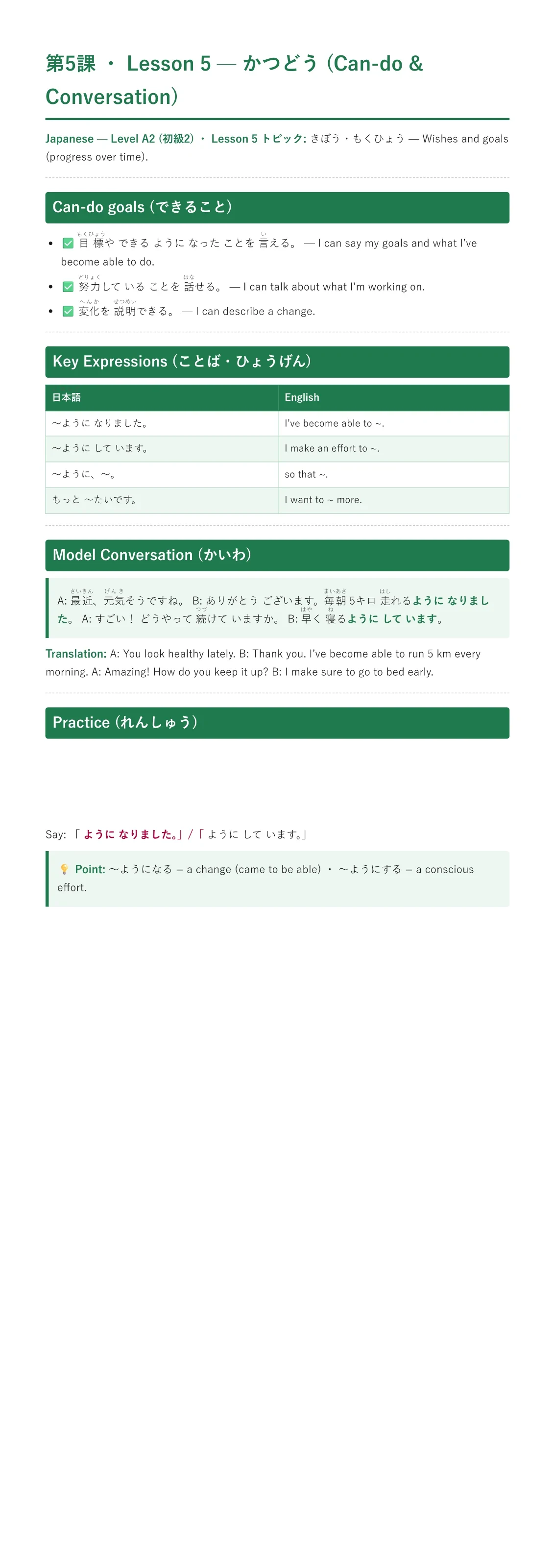
B: Thank you. I've become able to run 5 km every morning.
Covers: Can-do goals (できること) · Key Expressions (ことば・ひょうげん) · Model Conversation (かいわ) · Practice (れんしゅう) · 〜ように なりました (change — came to be able) · 〜ように して います (make an effort to) · 〜ように、〜 (so that — purpose) · Vocabulary (ことば) · Mini Practice (れんしゅう)
Lesson 6
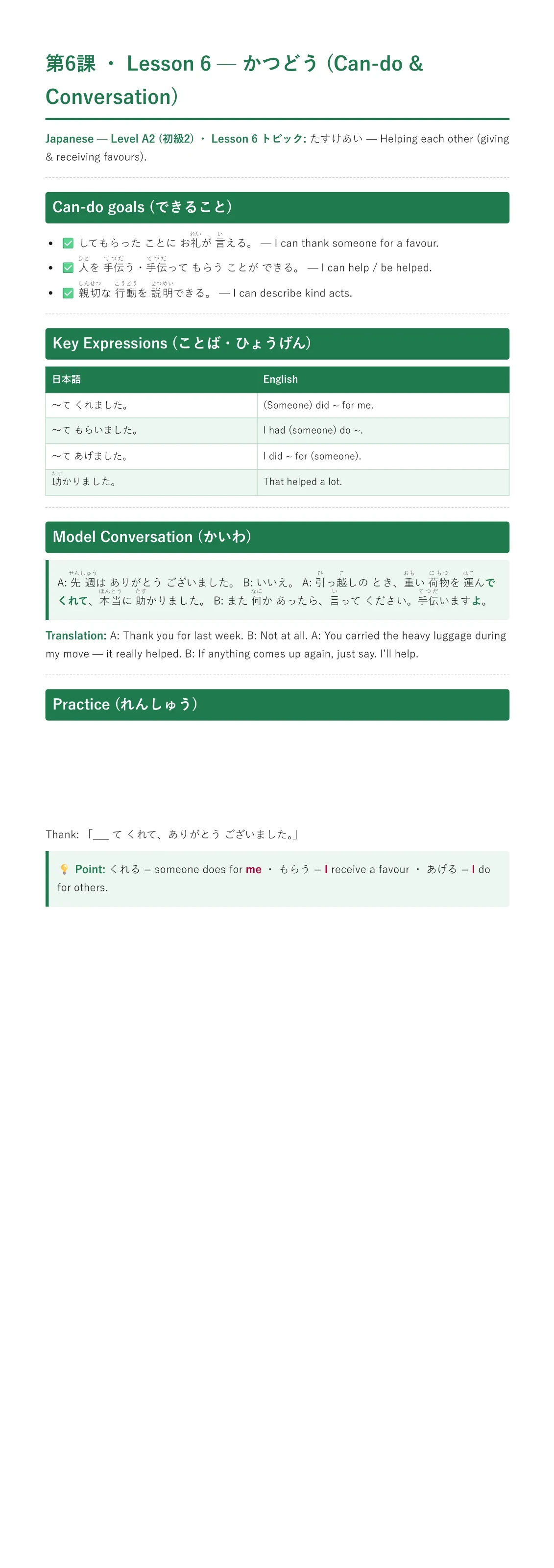
A: You carried the heavy luggage during my move — it really helped.
Covers: Can-do goals (できること) · Key Expressions (ことば・ひょうげん) · Model Conversation (かいわ) · Practice (れんしゅう) · Giving & receiving actions (て-form + やりもらい) · 〜て くれて、ありがとう (thanks for ~ing) · Vocabulary (ことば) · Mini Practice (れんしゅう)
Lesson 7
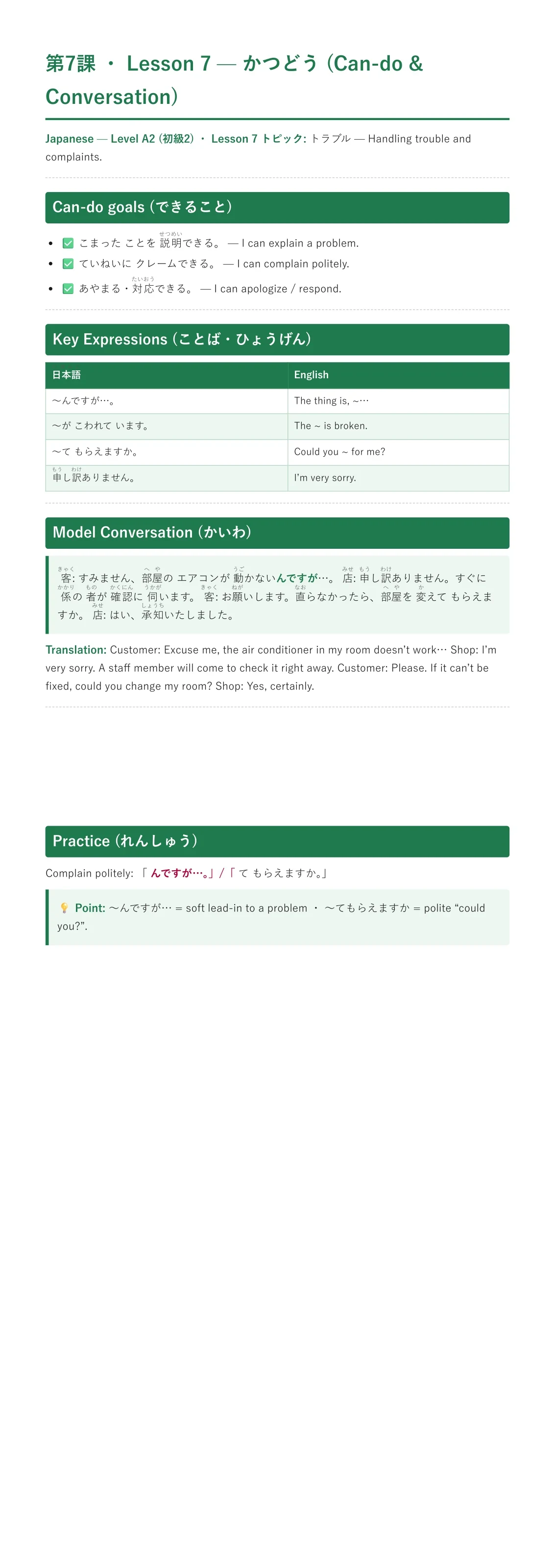
Customer: Excuse me, the air conditioner in my room doesn't work…
Covers: Can-do goals (できること) · Key Expressions (ことば・ひょうげん) · Model Conversation (かいわ) · Practice (れんしゅう) · 自動詞 + て います (resultant state) · 〜んですが…(soft introduction to a problem) · 〜て もらえますか / いただけますか (polite request) · Vocabulary (ことば) · Mini Practice (れんしゅう)
Lesson 8
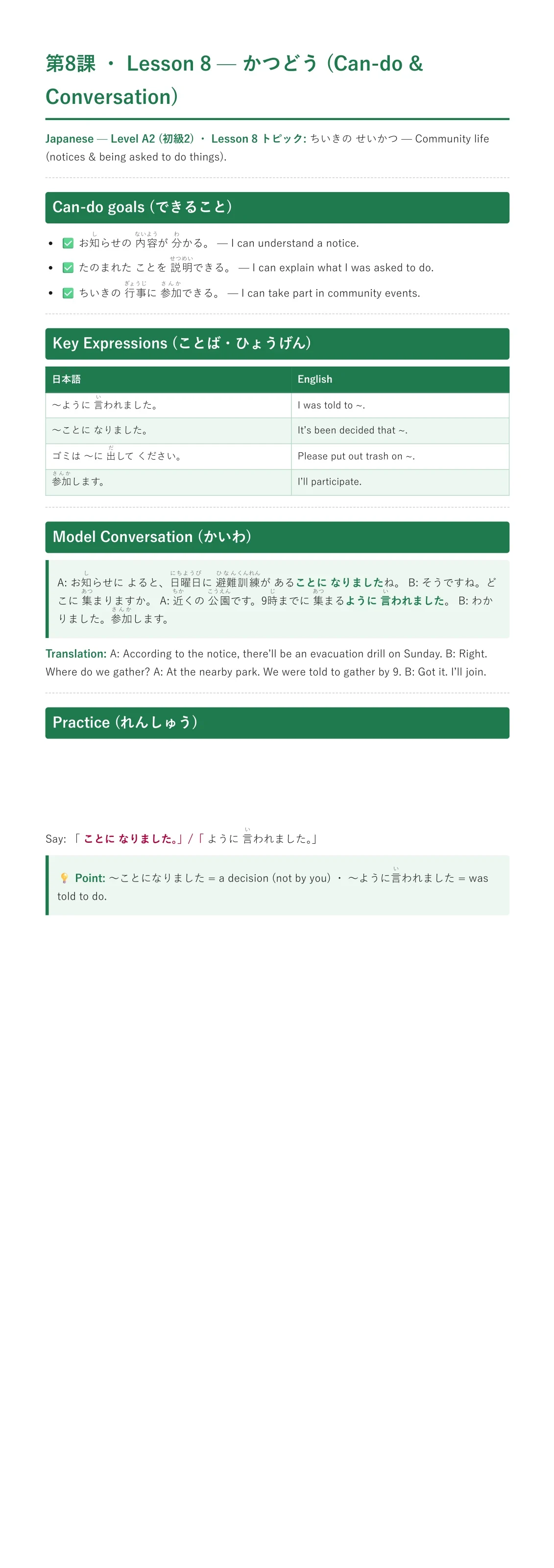
A: According to the notice, there'll be an evacuation drill on Sunday.
Covers: Can-do goals (できること) · Key Expressions (ことば・ひょうげん) · Model Conversation (かいわ) · Practice (れんしゅう) · 〜ことに なりました (a decision was made) · 〜ように <ruby>言<rt>い</rt></ruby>われました (was told to) · 〜に よると 〜そうです (according to … I hear) · Vocabulary (ことば) · Mini Practice (れんしゅう)
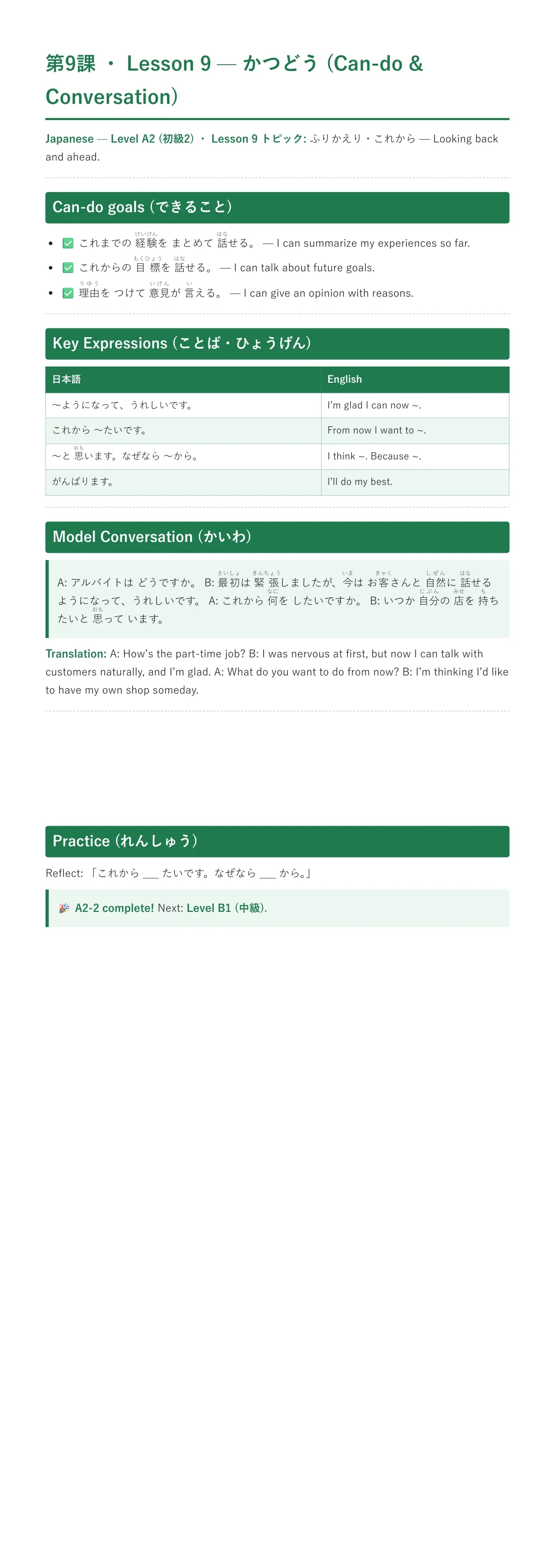
Lesson 9
B: I was nervous at first, but now I can talk with customers naturally, and I'm glad.
Covers: Can-do goals (できること) · Key Expressions (ことば・ひょうげん) · Model Conversation (かいわ) · Practice (れんしゅう) · 〜て、〜 (connecting reasons/events) · なぜなら 〜から (because — stating a reason) · いつか / もっと / これから (adverbs of future) · Vocabulary (ことば) · Mini Practice (れんしゅう) · 🎉 初級2 修了 (A2-2 complete!)