
Pre-Intermediate (B1) notes prepared and maintained by the NihongoDoya Editorial Team.
Lesson summaries and study cards last reviewed 17 July 2026. These are independent learning materials, not official examination content. Report a correction.
Introduction
Pre-Intermediate (B1) is the top of the conversational course, where situations become longer and more formal. These 8 can-do lessons (CEFR B1) cover telling episodes, giving opinions, business keigo, describing problems, comparing cultures, decisions, formal procedures and short speeches — each card pairs the can-do conversation with its grammar.
What you will learn
- Telling a story: 〜たら, 〜たところ, 〜てくる
- Giving opinions: 〜のではないでしょうか, 〜し, たしかに〜が
- Business keigo: 尊敬語, 謙譲語, 〜させていただきます
- Describing problems with the passive (受身) and 〜のに
- Comparing cultures: 〜によって, 〜のに対して, 〜という
- Decisions and the future: 〜ことにする, 〜ことになる
- Procedures and speeches: 〜場合は, 〜おかげで, 〜ようになる
Who this level is for
Best for learners who have finished the A2 stage and want B1 Japanese for work, opinions and formal situations — the bridge into JLPT N3.
A weekly routine for Pre-Intermediate
- Read the can-do goal — telling an episode, giving an opinion, business keigo.
- Study the supporting grammar (passive, 〜のではないでしょうか, 尊敬語・謙譲語).
- Speak a longer turn from the model — aim for two or three connected sentences.
- Rebuild it with your own content, keeping the polite register consistent.
- Reflect weekly on what you can now do that you couldn't a month ago.
Common mistakes to avoid
- Slipping out of keigo mid-conversation in business situations.
- Confusing 尊敬語 (raise the other) with 謙譲語 (lower yourself).
- Using の対して for contrast where による (depending on) is meant.
- Forgetting the suffering passive (足を踏まれた) for inconveniences.
Related study materials
Build a joined-up study cycle by combining this page with the practice and reference materials below.
Frequently asked questions
What level is Pre-Intermediate (B1)?
CEFR B1 — it overlaps the JLPT N4–N3 range and focuses on opinions, workplace keigo and formal procedures.
Why add a Pre-Intermediate section to the site?
To complete the A1–B1 ladder (Starter → Elementary 1 → Elementary 2 → Pre-Intermediate) so daily-life Japanese runs all the way to B1.
Do I need business keigo for this level?
Yes — Lesson 3 covers 尊敬語, 謙譲語 and 〜させていただきます for real business situations.
Can I study this with JLPT N3?
Yes — Pre-Intermediate gives the spoken and situational side of the grammar the N3 guide tests.
What comes after the conversational track?
Move fully into the JLPT track — the N3 then N2 grammar guides on this site.
Pre-Intermediate (B1) lesson-by-lesson syllabus
Every lesson on this page includes handwritten study cards with full written explanations. Here is what each lesson covers:
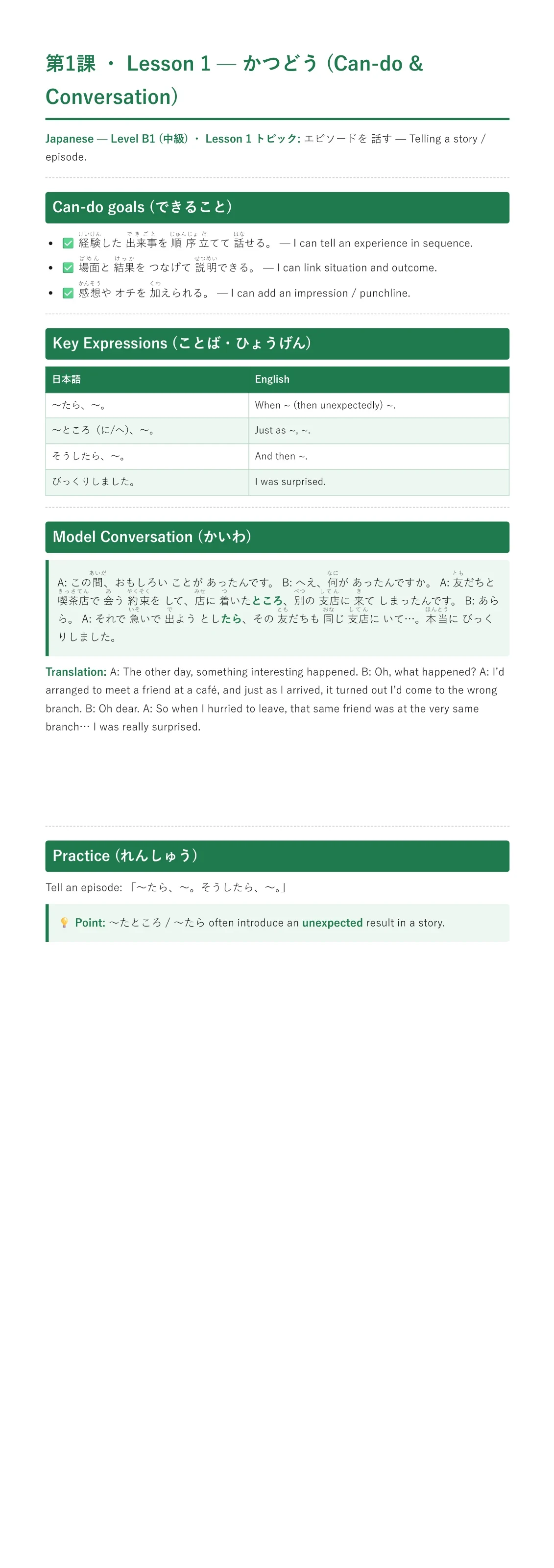
Lesson 1
A: The other day, something interesting happened.
Covers: Can-do goals (できること) · Key Expressions (ことば・ひょうげん) · Model Conversation (かいわ) · Practice (れんしゅう) · 〜たら、〜 (unexpected discovery / result) · 〜ところ(に/へ/を)(just at that moment) · 〜てくる / 〜ていく (change & movement) · Vocabulary (ことば) · Mini Practice (れんしゅう)
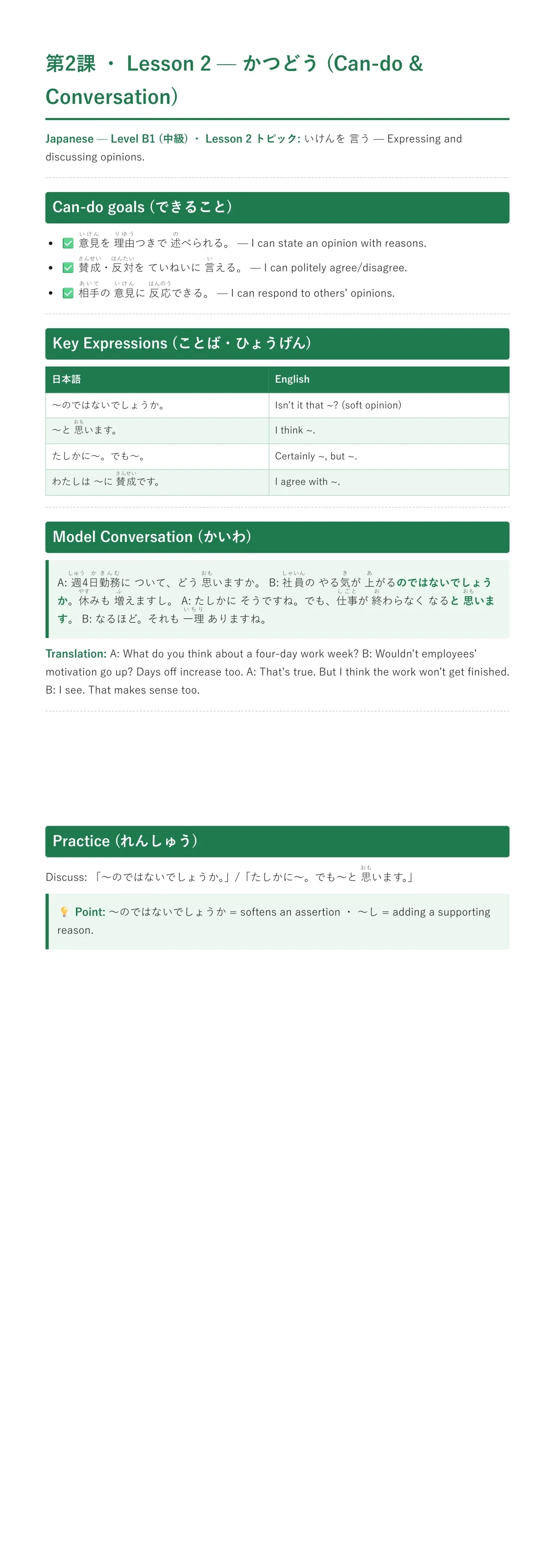
Lesson 2
A: What do you think about a four-day work week?
Covers: Can-do goals (できること) · Key Expressions (ことば・ひょうげん) · Model Conversation (かいわ) · Practice (れんしゅう) · 〜のではないでしょうか (soft opinion) · 〜し、〜 (listing supporting reasons) · 〜という 〜 / 〜ということ (nominalizing an idea) · Vocabulary (ことば) · Mini Practice (れんしゅう)
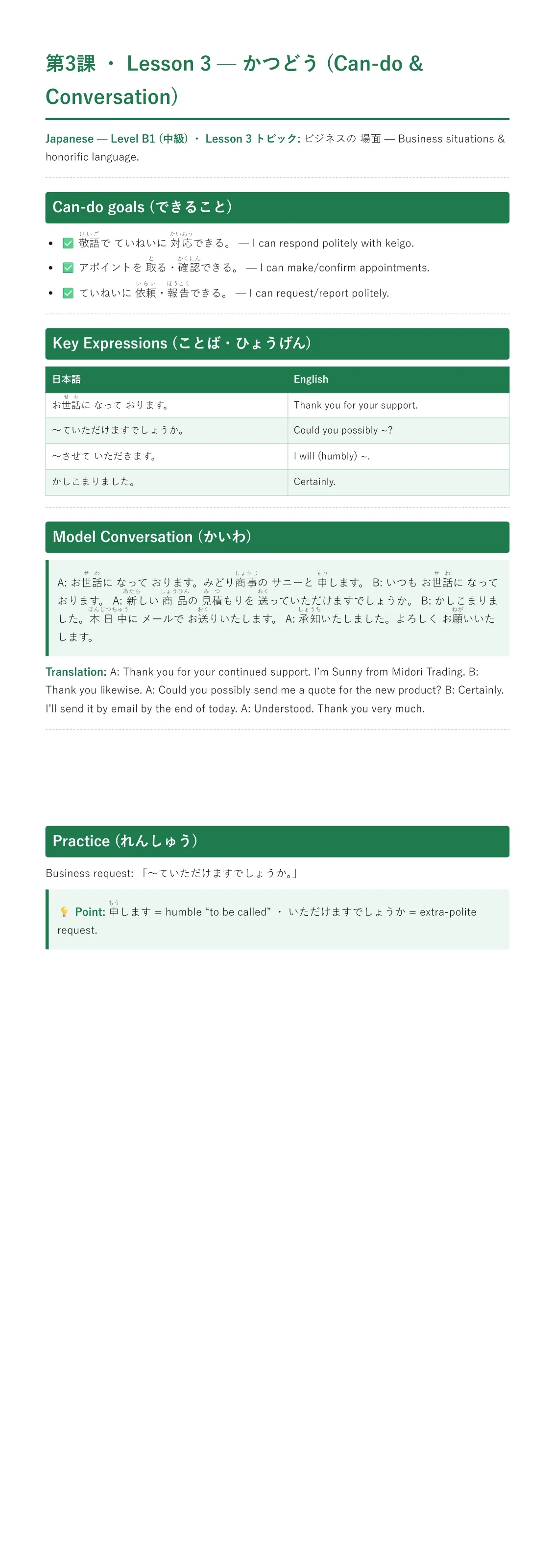
Lesson 3
A: Thank you for your continued support. I'm Sunny from Midori Trading.
Covers: Can-do goals (できること) · Key Expressions (ことば・ひょうげん) · Model Conversation (かいわ) · Practice (れんしゅう) · 尊敬語 (respectful — raise the other) · 謙譲語 (humble — lower yourself) · 〜させて いただきます (humble "I will…") · Vocabulary (ことば) · Mini Practice (れんしゅう)
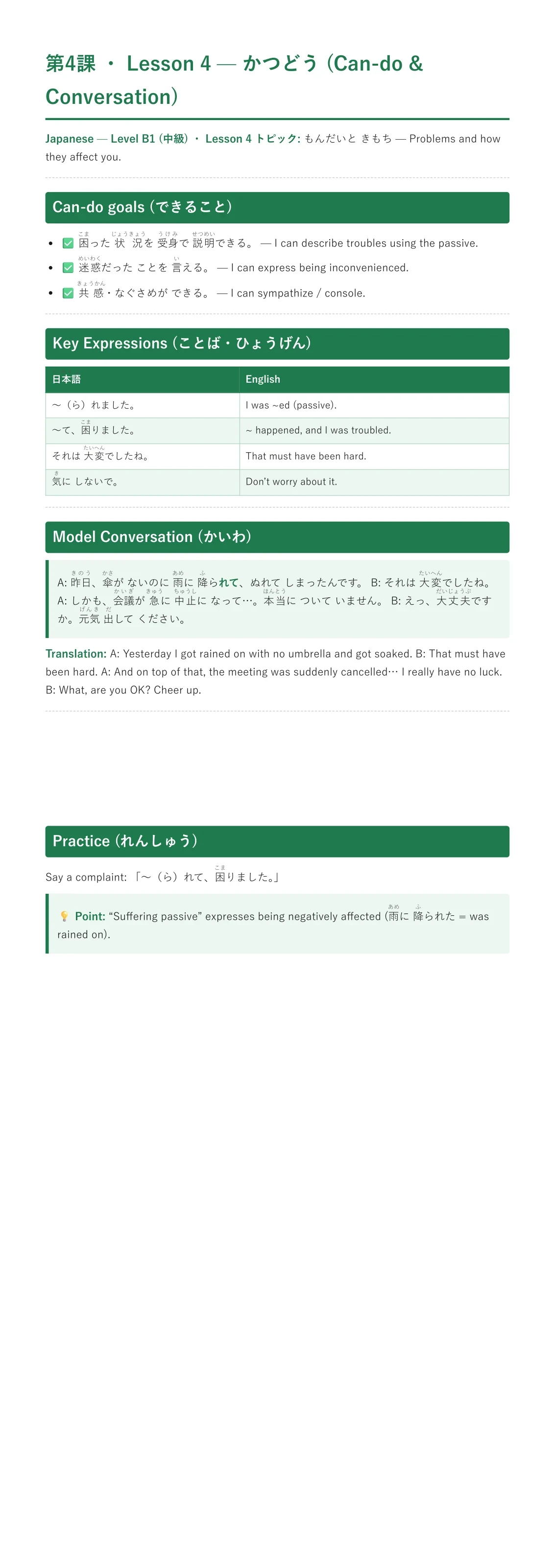
Lesson 4
A: Yesterday I got rained on with no umbrella and got soaked.
Covers: Can-do goals (できること) · Key Expressions (ことば・ひょうげん) · Model Conversation (かいわ) · Practice (れんしゅう) · Passive (受身) · Suffering passive (迷惑の受身) · 〜のに (although — frustration) · Vocabulary (ことば) · Mini Practice (れんしゅう)
Lesson 5
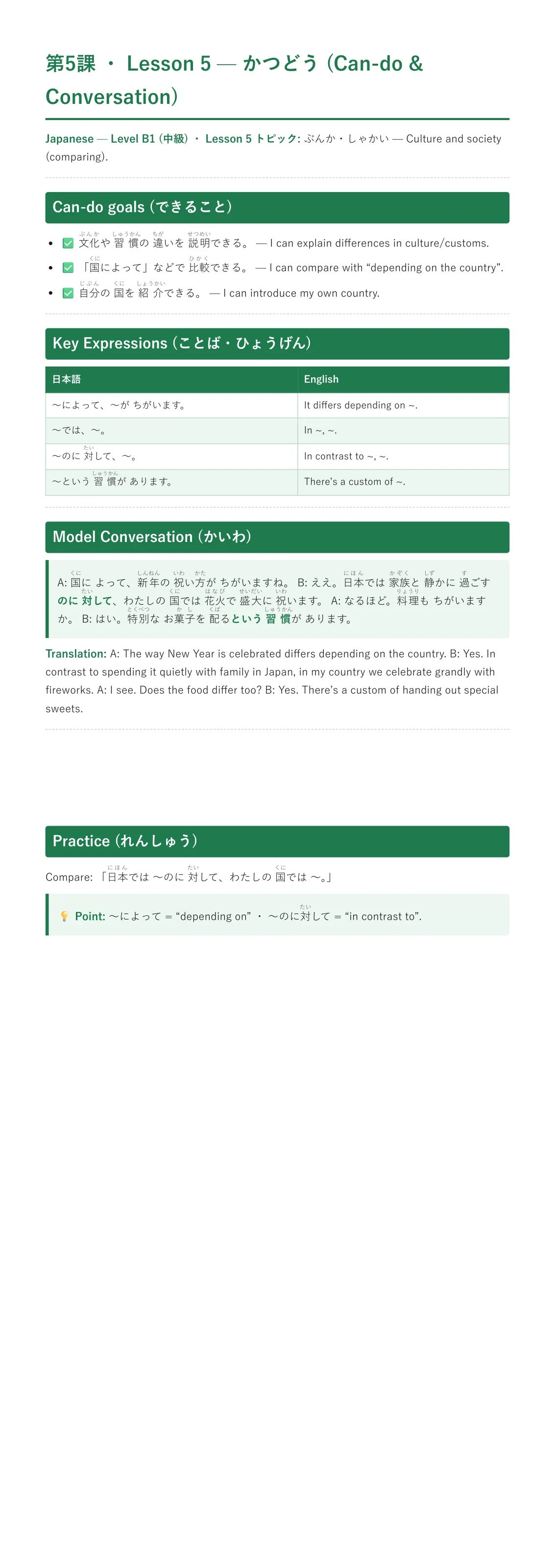
A: The way New Year is celebrated differs depending on the country.
Covers: Can-do goals (できること) · Key Expressions (ことば・ひょうげん) · Model Conversation (かいわ) · Practice (れんしゅう) · 〜によって (depending on / by) · 〜のに <ruby>対<rt>たい</rt></ruby>して (in contrast to) · 〜という 〜 (a … such that / the custom of …) · Vocabulary (ことば) · Mini Practice (れんしゅう)
Lesson 6
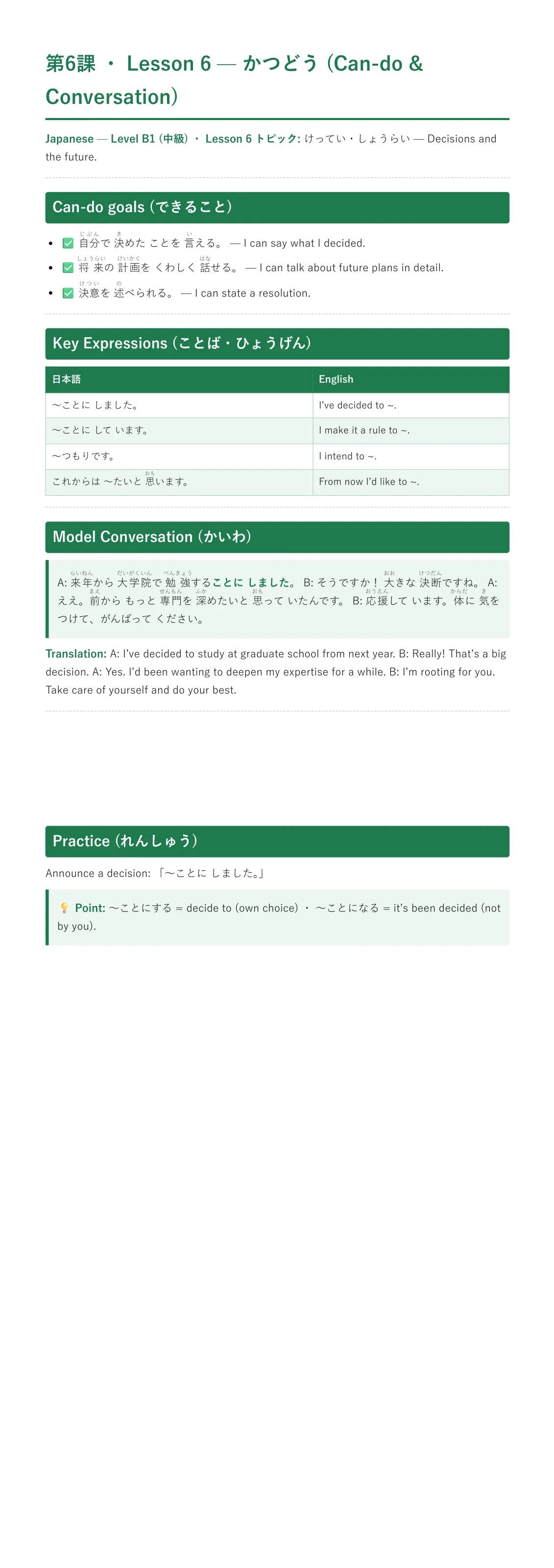
A: I've decided to study at graduate school from next year.
Covers: Can-do goals (できること) · Key Expressions (ことば・ひょうげん) · Model Conversation (かいわ) · Practice (れんしゅう) · 〜ことに しました (decided to — own decision) · 〜ことに して います (make it a rule / habit) · 〜ことに なりました (it was decided) · Vocabulary (ことば) · Mini Practice (れんしゅう)
Lesson 7
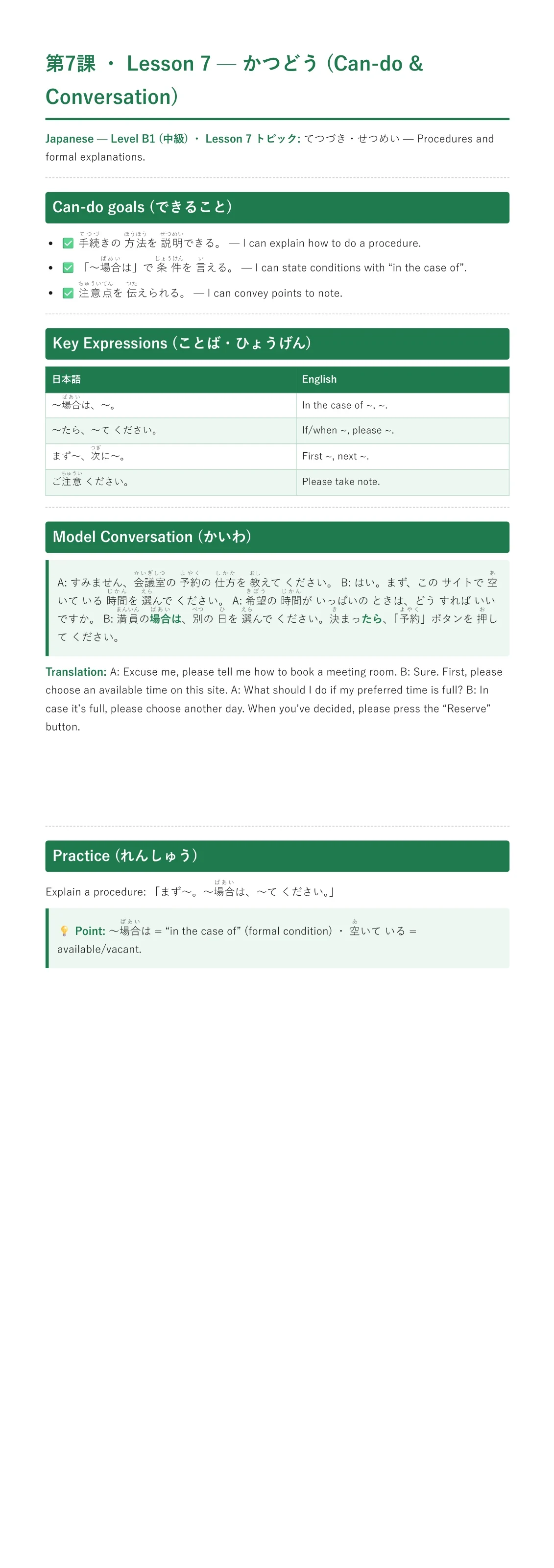
A: Excuse me, please tell me how to book a meeting room.
Covers: Can-do goals (できること) · Key Expressions (ことば・ひょうげん) · Model Conversation (かいわ) · Practice (れんしゅう) · 〜場合は (in the case of) · 〜たら / 〜ば (conditional in instructions) · お/ご 〜 (polite noun prefix) · Vocabulary (ことば) · Mini Practice (れんしゅう)
Lesson 8
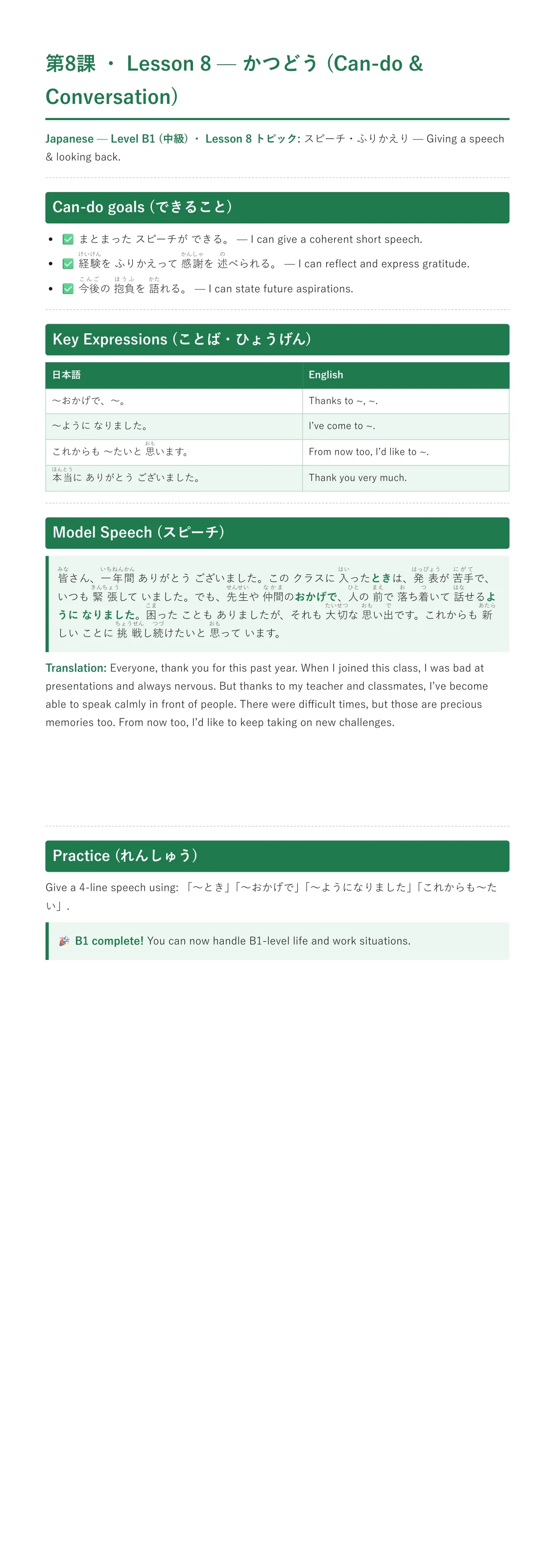
Give a 4-line speech using: 「〜とき」「〜おかげで」「〜ようになりました」「これからも〜たい」.
Covers: Can-do goals (できること) · Key Expressions (ことば・ひょうげん) · Model Speech (スピーチ) · Practice (れんしゅう) · 〜おかげで (thanks to) · 〜ように なりました (came to be able — review) · 〜続ける / 〜生かす (compound verbs for speeches) · Vocabulary (ことば) · Mini Practice (れんしゅう) · 🎉 中級 修了 (B1 complete!)