
Beginner (A1) notes prepared and maintained by the NihongoDoya Editorial Team.
Lesson summaries and study cards last reviewed 17 July 2026. These are independent learning materials, not official examination content. Report a correction.
Introduction
Beginner (A1) teaches the Japanese you need for daily life in Japan, not just exams. These 18 can-do lessons (CEFR A1) move from greetings and self-introduction to shopping, food, transport and phone calls — each card lists the lesson's can-do goals, key expressions, a model conversation and the grammar behind it.
What you will learn
- Greetings, self-introduction and saying your country and job
- 〜が好き likes, family members and これ・それ・あれ
- Shopping and prices: 〜をください, いくら, counters
- Telling the time and describing your daily routine (〜ます)
- Saying where things are: あります・います with 上・下・となり
- Transport (〜で行きます) and inviting people (〜ませんか)
- Talking about a past day off (〜ました) and weather
Who this level is for
Best for absolute beginners who have learned kana and want to start speaking everyday Japanese — and a great spoken-language companion to JLPT N5.
A weekly can-do routine (Starter)
- Set the lesson's can-do goal as your target — e.g. "order food", "ask the price".
- Learn the key phrases and the grammar (りかい) behind them.
- Role-play the model conversation aloud, swapping in your own details.
- Use the new phrases in one real situation that week if you can.
- Check the can-do box only when you can do the task without looking.
Common mistakes to avoid
- Adding 〜さん to your own name (use it only for other people).
- Forgetting the particle が with 好き (すしが好きです).
- Mixing あります (things) and います (people / animals).
- Dropping the topic は in self-introductions (わたしは…).
Related study materials
Build a joined-up study cycle by combining this page with the practice and reference materials below.
Frequently asked questions
What is the conversational track and how is it different from JLPT books?
It is a free, conversational 'Japanese for daily life' course. It is built around can-do goals for real situations, while JLPT books focus on exam structure.
Is Beginner (A1) the same level as N5?
Roughly. Starter is CEFR A1 and overlaps a lot with JLPT N5 grammar, but it emphasises speaking and daily-life tasks.
Do I need kanji for Beginner (A1)?
No — kana is enough. A few common kanji appear gradually with readings.
Can I use the conversational track and N5 together?
Yes, that is ideal: use N5 for exam grammar and Beginner (A1) for talking.
What comes after Beginner (A1)?
Elementary 1 (A2), which adds experiences, plans and polite requests.
Beginner (A1) lesson-by-lesson syllabus
Every lesson on this page includes handwritten study cards with full written explanations. Here is what each lesson covers:
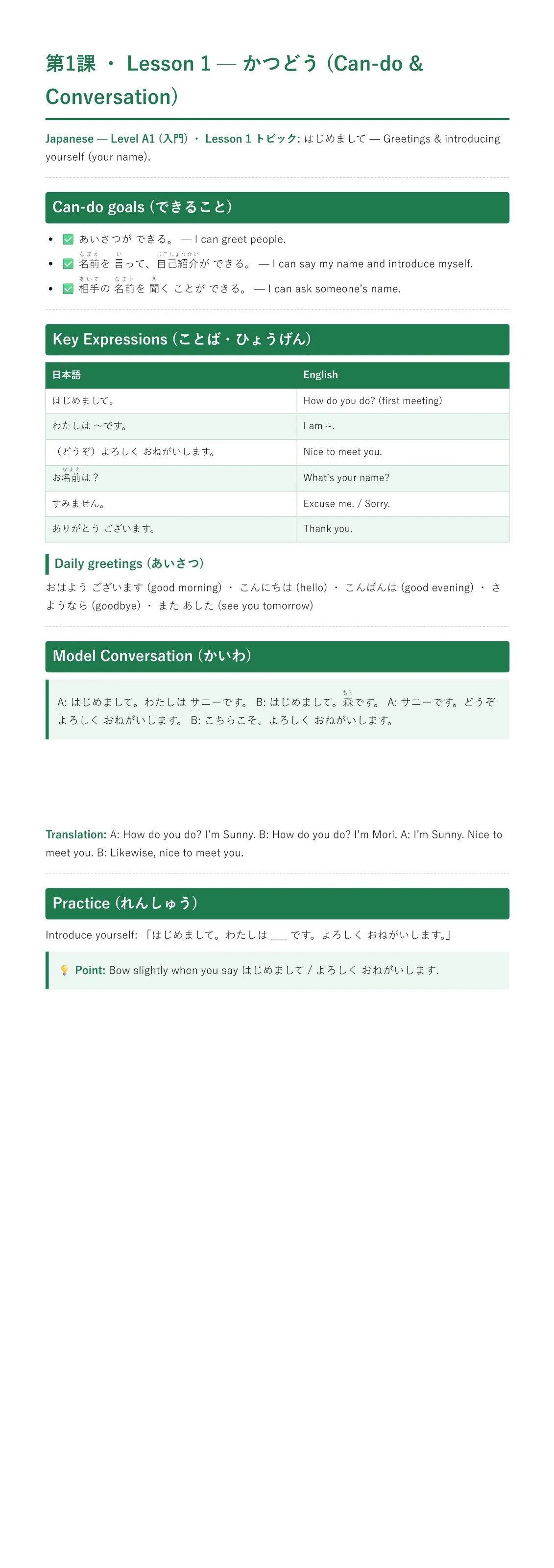
Lesson 1
おはよう ございます (good morning) ・ こんにちは (hello) ・ こんばんは (good evening) ・ さようなら (goodbye) ・ また あした (see you tomorrow)
Covers: Can-do goals (できること) · Key Expressions (ことば・ひょうげん) · Daily greetings (あいさつ) · Model Conversation (かいわ) · Practice (れんしゅう) · 〜は 〜です (A is B) · 〜です か (question) · 〜さん (Mr./Ms.) · Vocabulary (ことば) · Countries (くに) — examples · Mini Practice (れんしゅう)
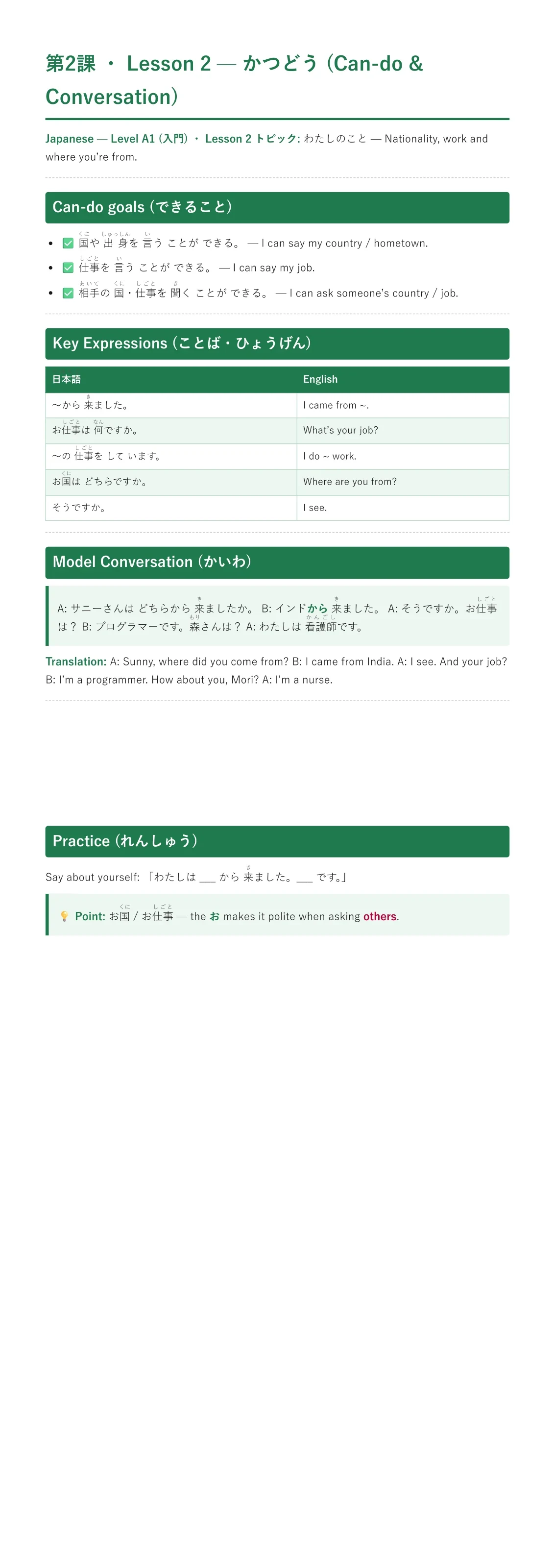
Lesson 2
B: I'm a programmer. How about you, Mori?
Covers: Can-do goals (できること) · Key Expressions (ことば・ひょうげん) · Model Conversation (かいわ) · Practice (れんしゅう) · 〜から <ruby>来<rt>き</rt></ruby>ました (I came from ~) · N1の N2 (の = of / belonging) · <ruby>何<rt>なに</rt></ruby> / どちら (what / where — polite) · Vocabulary (ことば) · Mini Practice (れんしゅう)
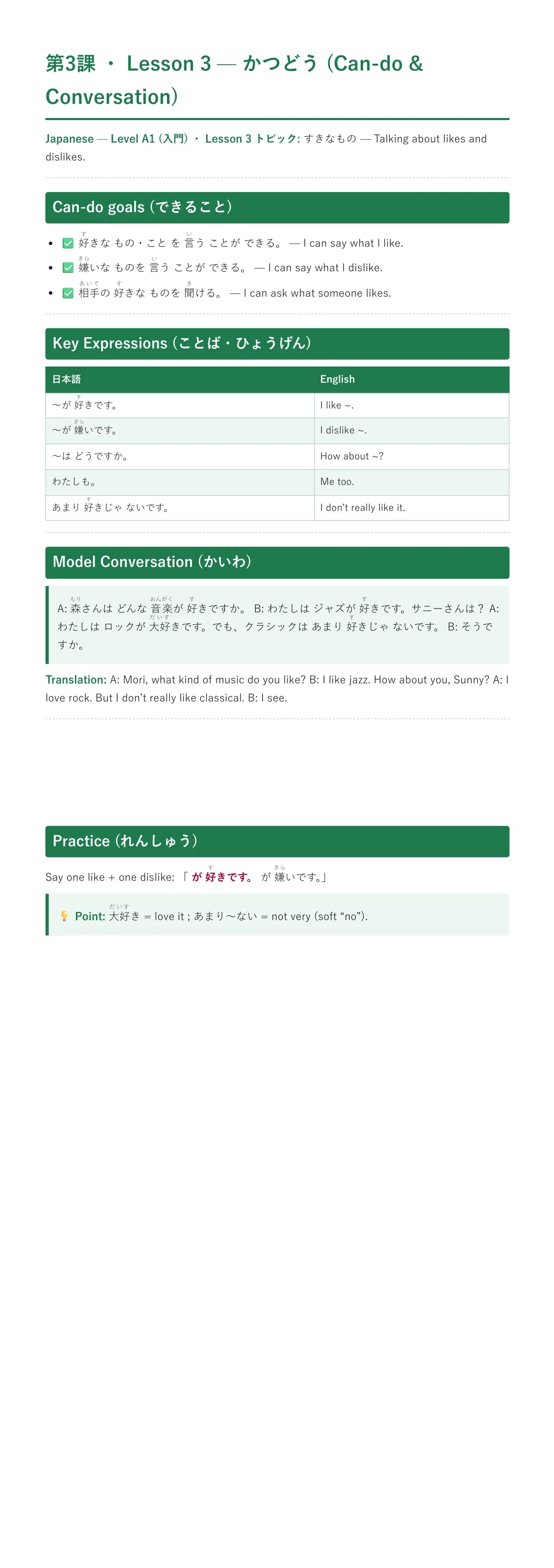
Lesson 3
A: I love rock. But I don't really like classical.
Covers: Can-do goals (できること) · Key Expressions (ことば・ひょうげん) · Model Conversation (かいわ) · Practice (れんしゅう) · 〜が <ruby>好<rt>す</rt></ruby>きです / <ruby>嫌<rt>きら</rt></ruby>いです (like / dislike) · 〜も (also / too) · Vocabulary (ことば) · Mini Practice (れんしゅう)
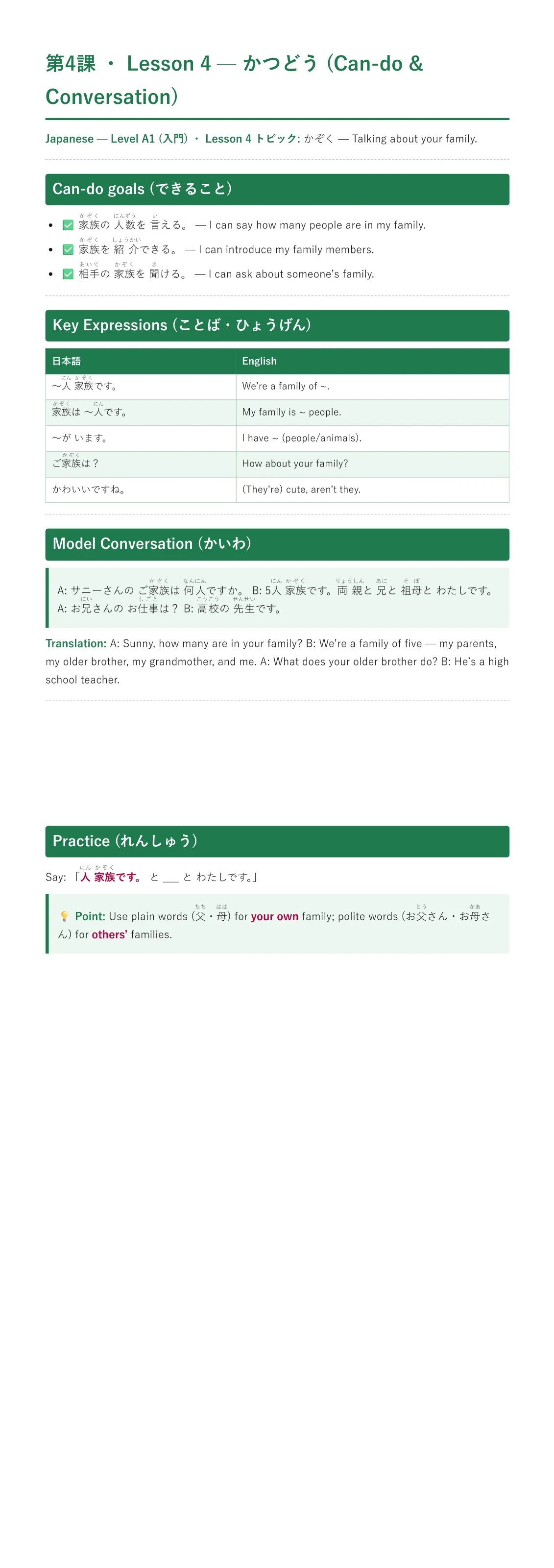
Lesson 4
B: We're a family of five — my parents, my older brother, my grandmother, and me.
Covers: Can-do goals (できること) · Key Expressions (ことば・ひょうげん) · Model Conversation (かいわ) · Practice (れんしゅう) · 〜が います (have / there is — people & animals) · Counting people 〜<ruby>人<rt>にん</rt></ruby> · Age 〜さい · Vocabulary (ことば) — Family · Mini Practice (れんしゅう)
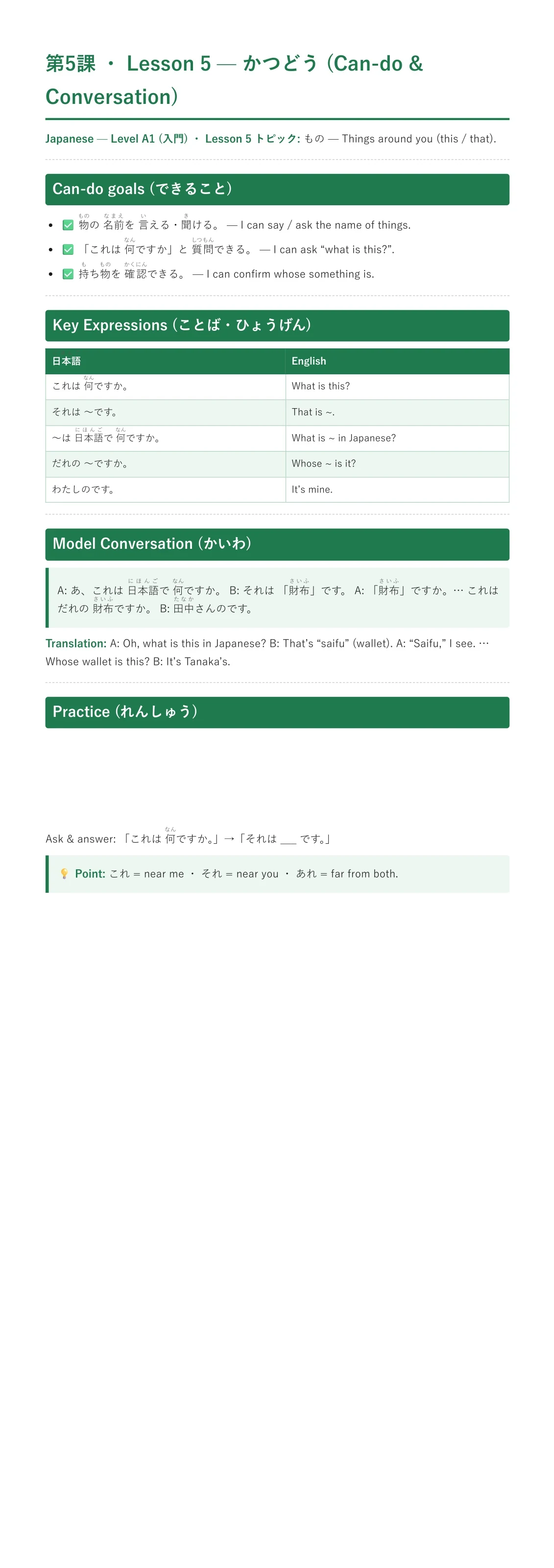
Lesson 5
A: "Saifu," I see. …Whose wallet is this?
Covers: Can-do goals (できること) · Key Expressions (ことば・ひょうげん) · Model Conversation (かいわ) · Practice (れんしゅう) · これ / それ / あれ / どれ (this / that / which) · の (possession) & だれの (whose) · 〜は <ruby>日本語<rt>にほんご</rt></ruby>で <ruby>何<rt>なん</rt></ruby>ですか · Vocabulary (ことば) · Mini Practice (れんしゅう)
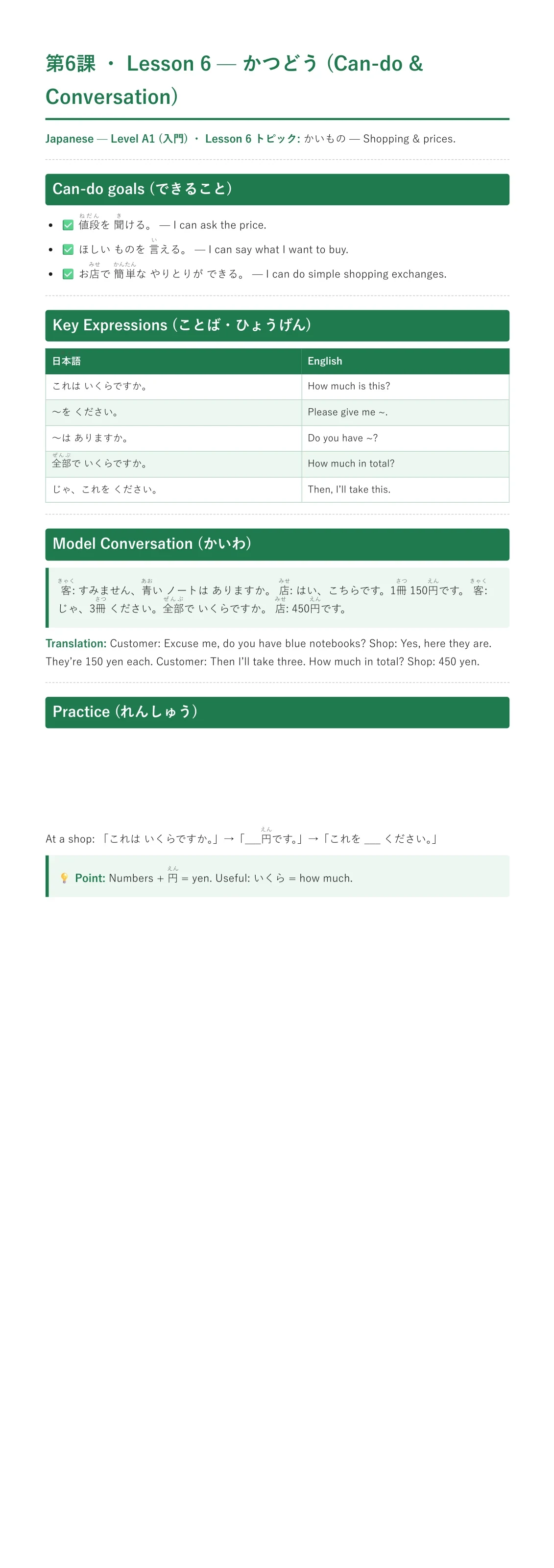
Lesson 6
Customer: Excuse me, do you have blue notebooks?
Covers: Can-do goals (できること) · Key Expressions (ことば・ひょうげん) · Model Conversation (かいわ) · Practice (れんしゅう) · 〜を ください (Please give me ~) · いくら / 〜<ruby>円<rt>えん</rt></ruby> (how much / yen) · Counting things 〜つ · Numbers for prices · Vocabulary (ことば) · Mini Practice (れんしゅう)
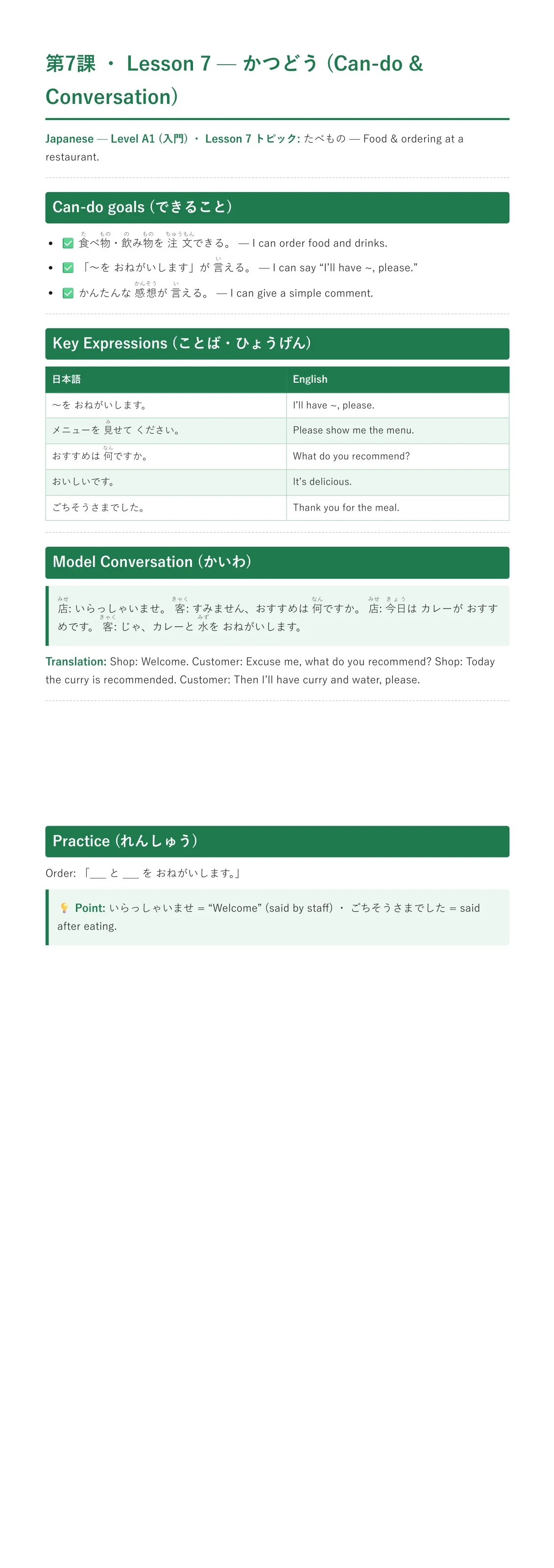
Lesson 7
Customer: Excuse me, what do you recommend?
Covers: Can-do goals (できること) · Key Expressions (ことば・ひょうげん) · Model Conversation (かいわ) · Practice (れんしゅう) · 〜を おねがいします (I'll have ~ / please) · 〜と 〜 (and — listing nouns) · Simple adjectives for food · Vocabulary (ことば) · Mini Practice (れんしゅう)
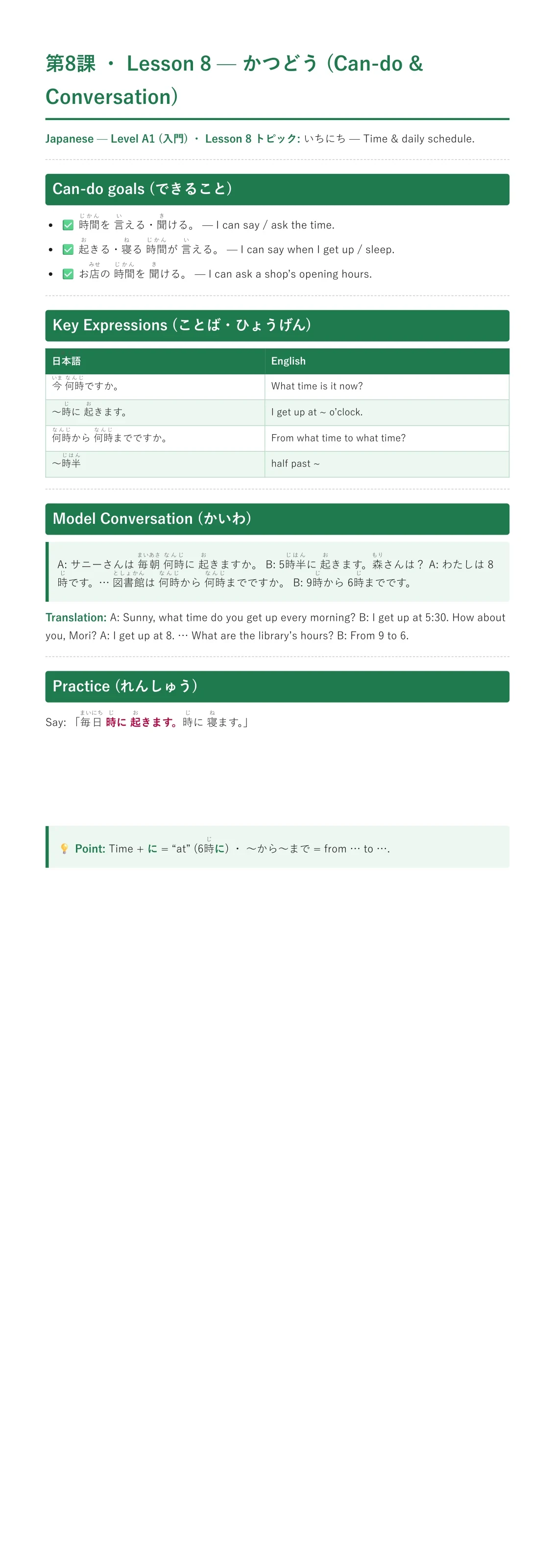
Lesson 8
A: Sunny, what time do you get up every morning?
Covers: Can-do goals (できること) · Key Expressions (ことば・ひょうげん) · Model Conversation (かいわ) · Practice (れんしゅう) · 〜<ruby>時<rt>じ</rt></ruby>に + verb (at … o'clock) · 〜ます / 〜ません (present polite) · 〜から 〜まで (from … to …) · Time readings (<ruby>注意<rt>ちゅうい</rt></ruby>) · Vocabulary (ことば) · Mini Practice (れんしゅう)
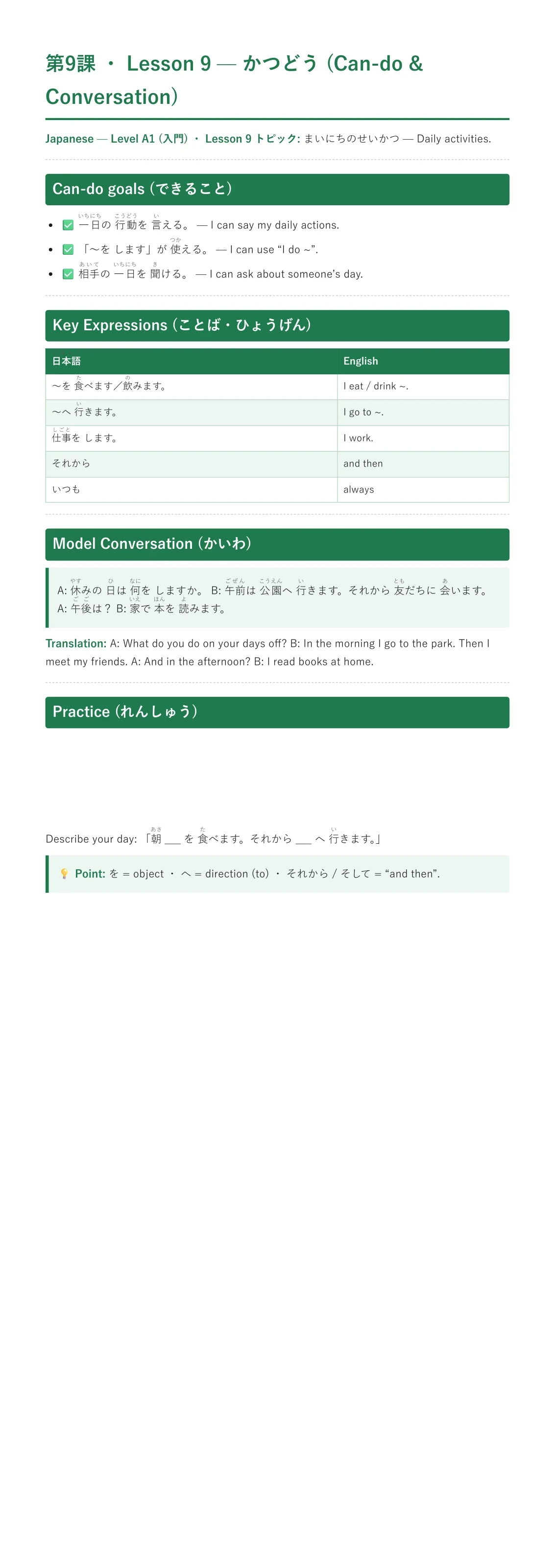
Lesson 9
B: In the morning I go to the park. Then I meet my friends.
Covers: Can-do goals (できること) · Key Expressions (ことば・ひょうげん) · Model Conversation (かいわ) · Practice (れんしゅう) · 〜を + verb (object marker) · 〜へ <ruby>行<rt>い</rt></ruby>きます / <ruby>来<rt>き</rt></ruby>ます / <ruby>帰<rt>かえ</rt></ruby>ります (direction; へ = "e") · それから / そして (and then / and) · Vocabulary (ことば) · Mini Practice (れんしゅう)
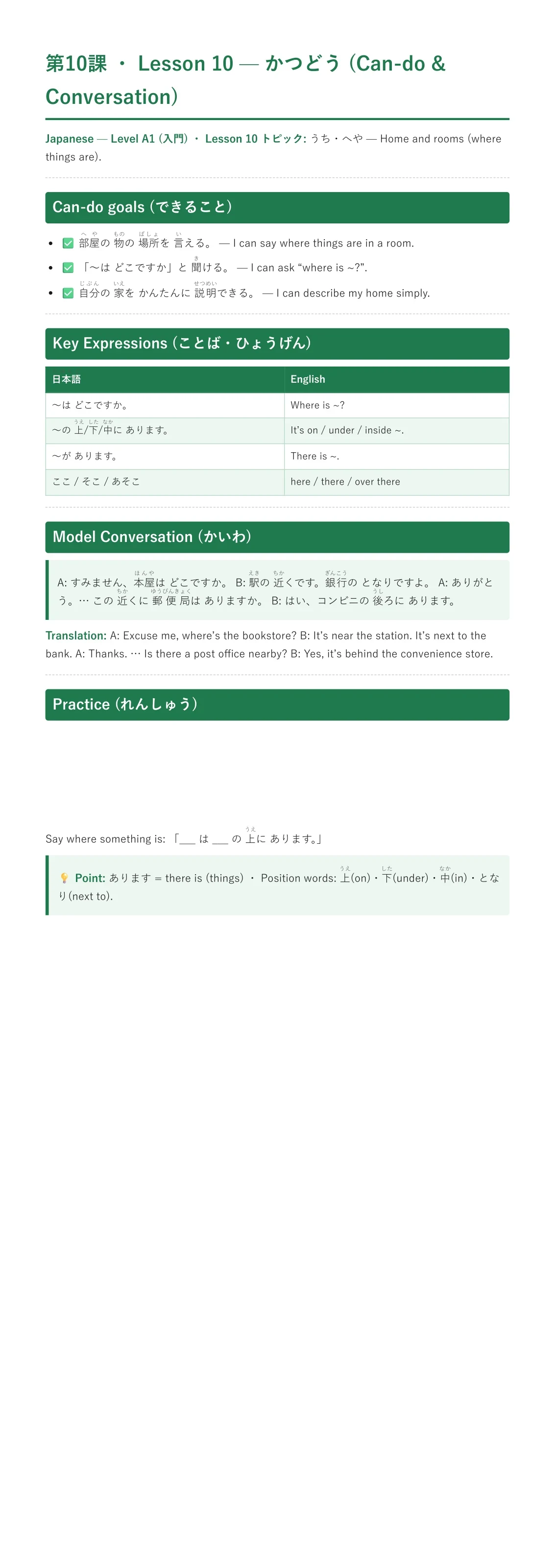
Lesson 10
B: It's near the station. It's next to the bank.
Covers: Can-do goals (できること) · Key Expressions (ことば・ひょうげん) · Model Conversation (かいわ) · Practice (れんしゅう) · 〜に 〜が あります / います (existence) · 〜は 〜に あります (where a thing is) · Vocabulary (ことば) · Mini Practice (れんしゅう)
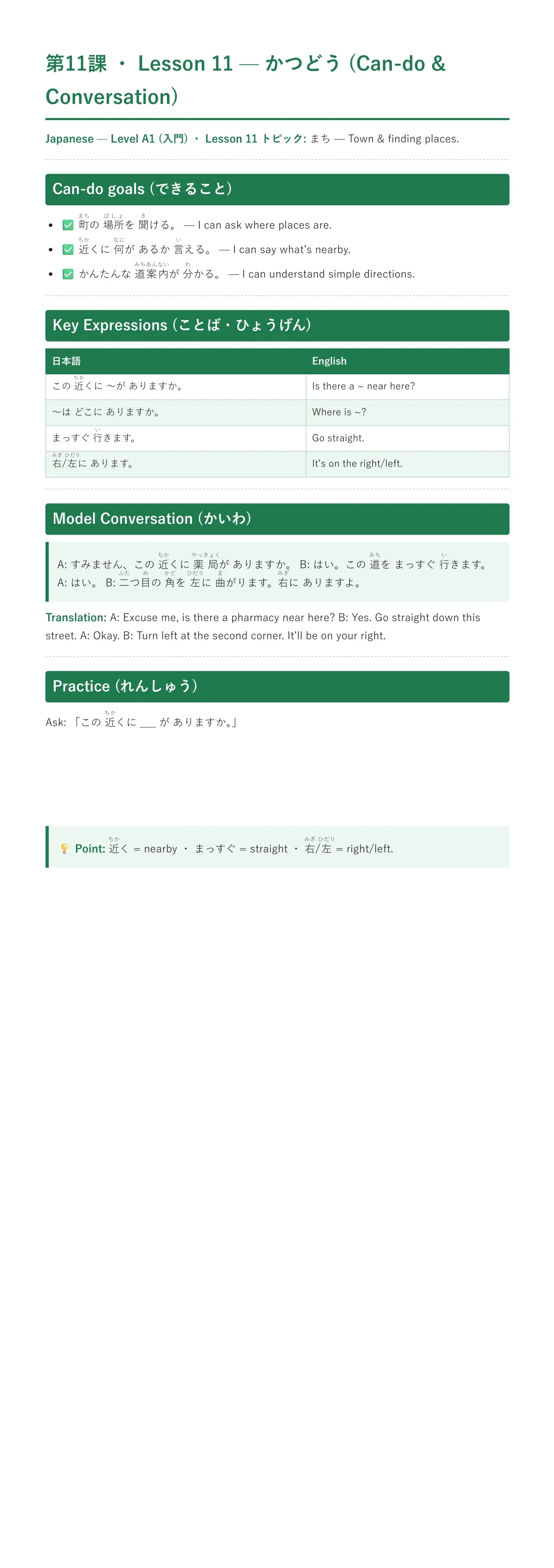
Lesson 11
A: Excuse me, is there a pharmacy near here?
Covers: Can-do goals (できること) · Key Expressions (ことば・ひょうげん) · Model Conversation (かいわ) · Practice (れんしゅう) · この <ruby>近<rt>ちか</rt></ruby>くに 〜が ありますか · 〜を <ruby>右<rt>みぎ</rt></ruby>/<ruby>左<rt>ひだり</rt></ruby>に <ruby>行<rt>い</rt></ruby>きます・<ruby>曲<rt>ま</rt></ruby>がります · 〜や〜 (listing examples) · Vocabulary (ことば) · Mini Practice (れんしゅう)
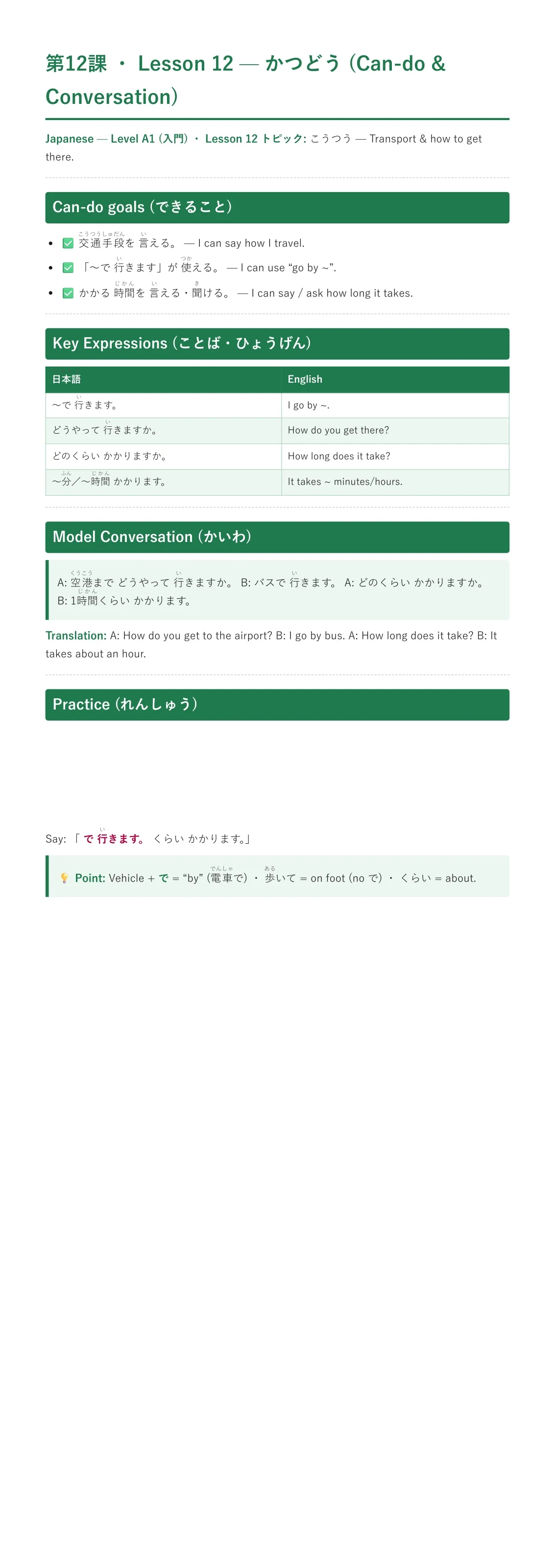
Lesson 12
Say: 「 で <ruby>行<rt>い</rt></ruby>きます。 くらい かかります。」
Covers: Can-do goals (できること) · Key Expressions (ことば・ひょうげん) · Model Conversation (かいわ) · Practice (れんしゅう) · 〜で <ruby>行<rt>い</rt></ruby>きます (by — means of transport) · 〜まで (up to / as far as) · どのくらい / 〜くらい (how long / about) · Vocabulary (ことば) · Mini Practice (れんしゅう)
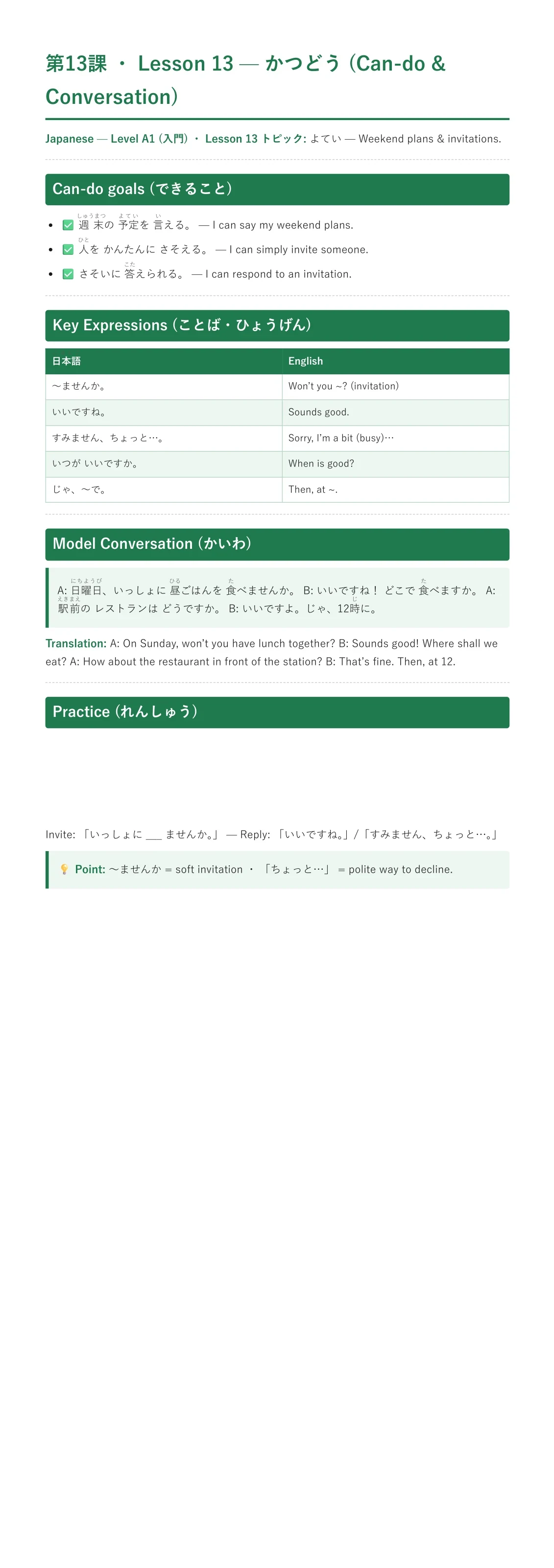
Lesson 13
A: On Sunday, won't you have lunch together?
Covers: Can-do goals (できること) · Key Expressions (ことば・ひょうげん) · Model Conversation (かいわ) · Practice (れんしゅう) · 〜ませんか (invitation — Won't you…?) · 〜ましょう (let's) · 〜は どうですか (How about…?) · Vocabulary (ことば) · Days (<ruby>曜日<rt>ようび</rt></ruby>) · Mini Practice (れんしゅう)
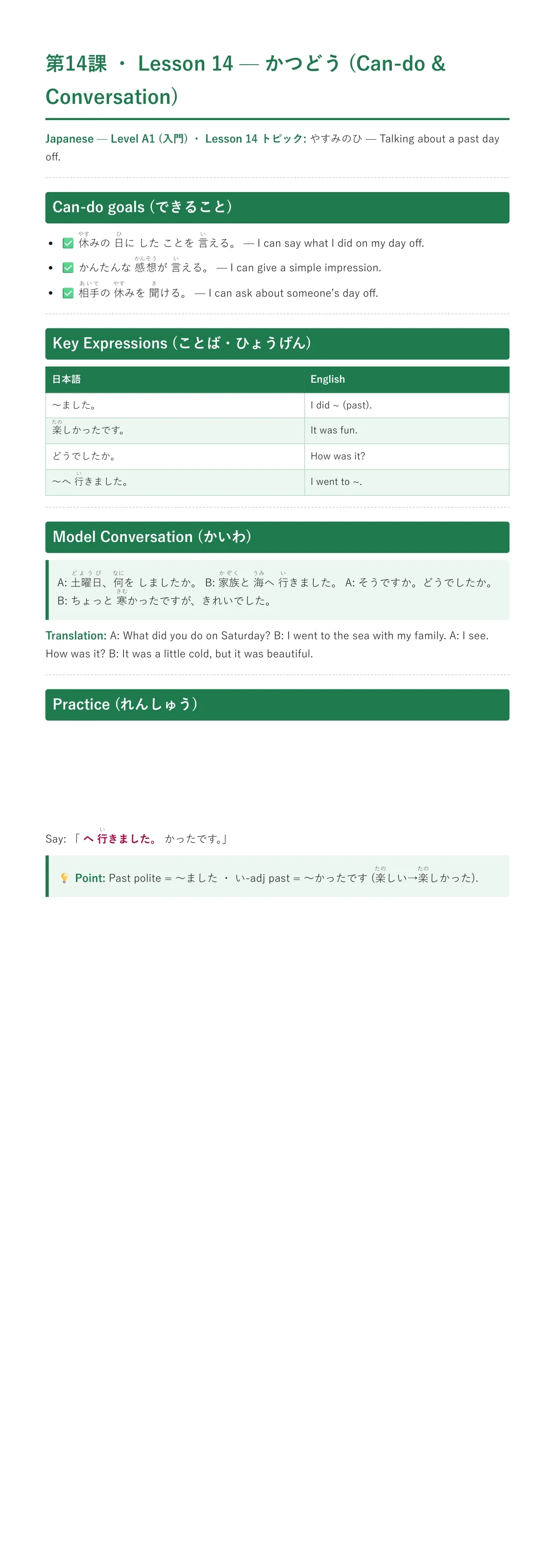
Lesson 14
B: It was a little cold, but it was beautiful.
Covers: Can-do goals (できること) · Key Expressions (ことば・ひょうげん) · Model Conversation (かいわ) · Practice (れんしゅう) · 〜ました / 〜ませんでした (past polite) · い-adjective past: 〜かったです · 〜と (with a person) · Vocabulary (ことば) · Mini Practice (れんしゅう)
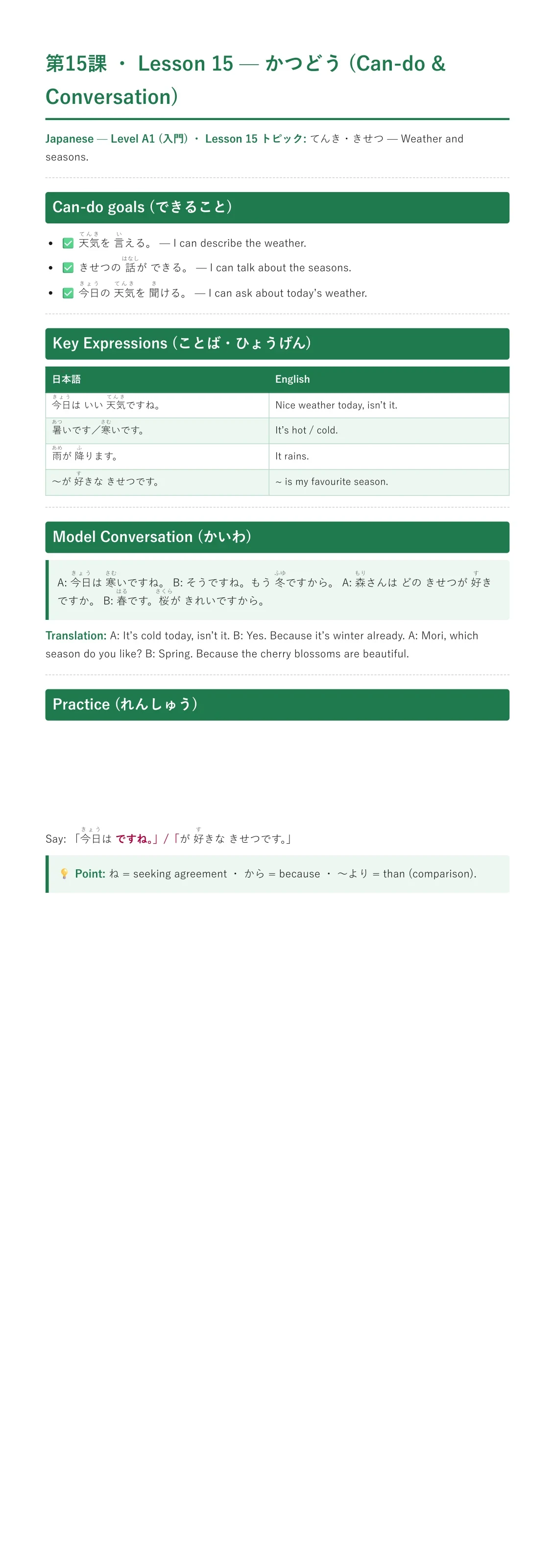
Lesson 15
B: Spring. Because the cherry blossoms are beautiful.
Covers: Can-do goals (できること) · Key Expressions (ことば・ひょうげん) · Model Conversation (かいわ) · Practice (れんしゅう) · い-adjective + です / 〜くないです · 〜から (because) · 〜は 〜より (A is more … than B) · Vocabulary (ことば) · Mini Practice (れんしゅう)
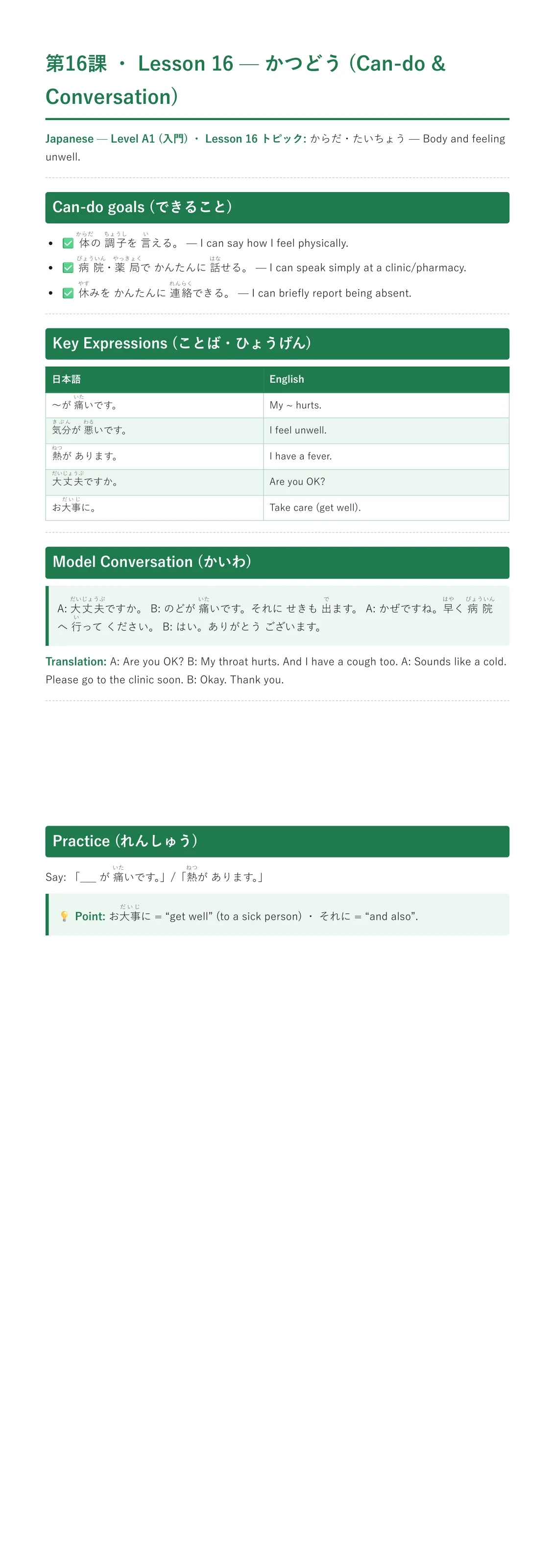
Lesson 16
B: My throat hurts. And I have a cough too.
Covers: Can-do goals (できること) · Key Expressions (ことば・ひょうげん) · Model Conversation (かいわ) · Practice (れんしゅう) · 〜が <ruby>痛<rt>いた</rt></ruby>いです (My ~ hurts) · 〜が あります (have — symptoms) · 〜て ください (please do) · Vocabulary (ことば) · Mini Practice (れんしゅう)
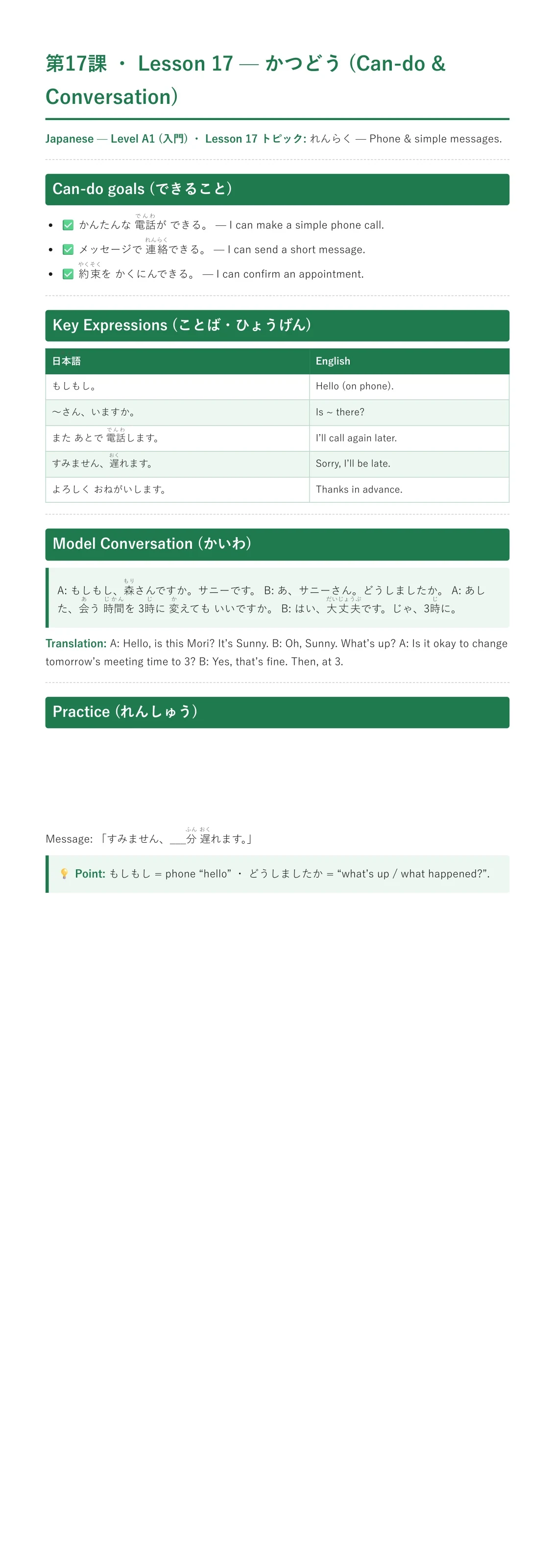
Lesson 17
A: Is it okay to change tomorrow's meeting time to 3?
Covers: Can-do goals (できること) · Key Expressions (ことば・ひょうげん) · Model Conversation (かいわ) · Practice (れんしゅう) · 〜ます (future / intention) · 〜が、〜 (but / softener) · 〜ね / 〜よ (sentence-end particles) · Vocabulary (ことば) · Mini Practice (れんしゅう)
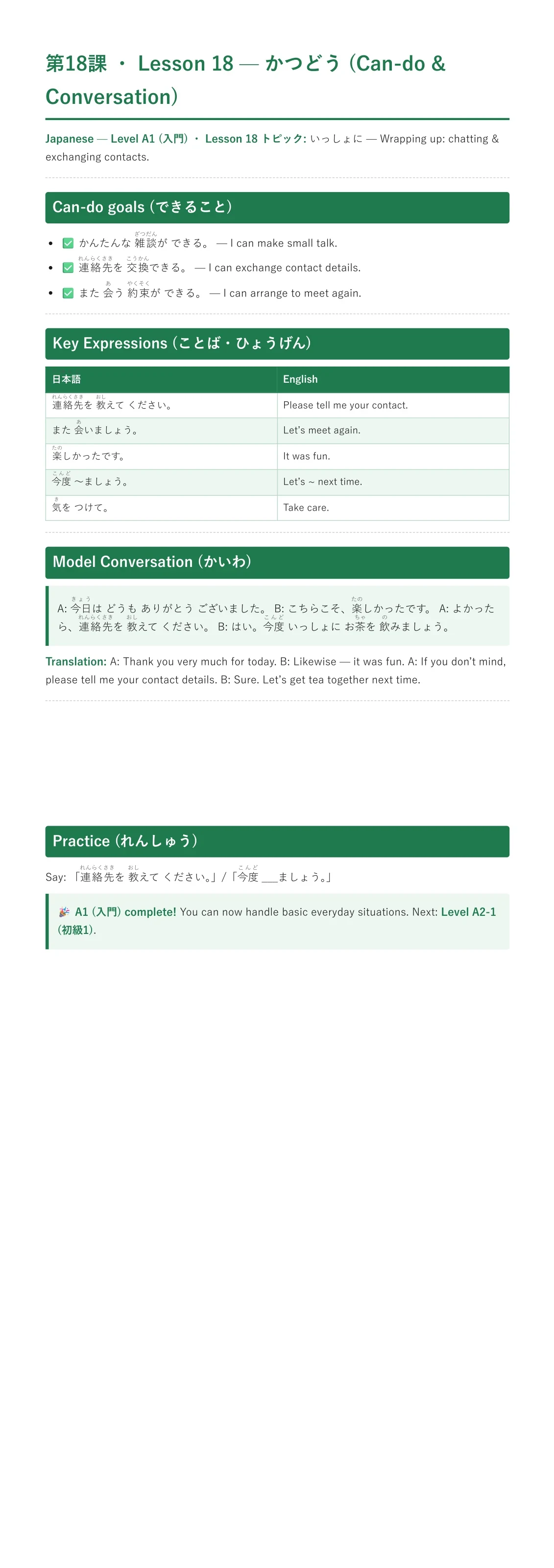
Lesson 18
A: If you don't mind, please tell me your contact details.
Covers: Can-do goals (できること) · Key Expressions (ことば・ひょうげん) · Model Conversation (かいわ) · Practice (れんしゅう) · 〜て ください (please do — review) · 〜ましょう / 〜ましょうか (let's / shall we) · <ruby>今度<rt>こんど</rt></ruby> / また (next time / again) · Vocabulary (ことば) · Mini Practice (れんしゅう) · 🎉 入門 修了 (A1 complete!)