
JLPT N1 notes prepared and maintained by the NihongoDoya Editorial Team.
Lesson summaries and study cards last reviewed 17 July 2026. These are independent learning materials, not official examination content. Report a correction.
Introduction
This page covers JLPT N1 grammar by function, combining the comprehensive grammar track's functional units (lessons 1–13) with the weekly-summary track 8-week set (lessons 14–21). N1 grammar is largely formal and literary, so the example sentences use written style, with formation, comparison tables, a reading and practice on each card.
What you will learn
- Time & simultaneity: 〜が早いか, 〜や否や, 〜なり, 〜てからというもの
- Cause & basis: 〜ばこそ, 〜とあって, 〜ともなると, 〜ゆえに
- Concession: 〜うが〜まいが, 〜であれ, 〜といえども, 〜ものを
- Limitation & emphasis: 〜をおいて, 〜ならでは, 〜だに, 〜すら, 〜たりとも
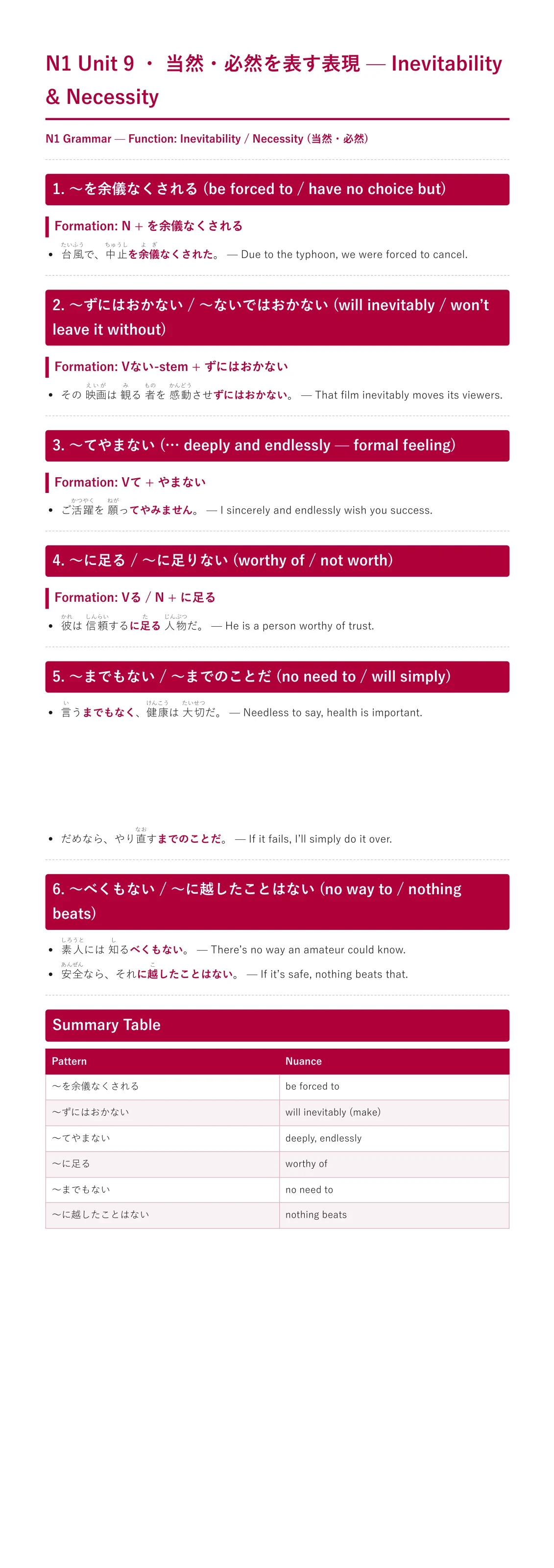
- Necessity: 〜を余儀なくされる, 〜てやまない, 〜に足る, 〜べくもない
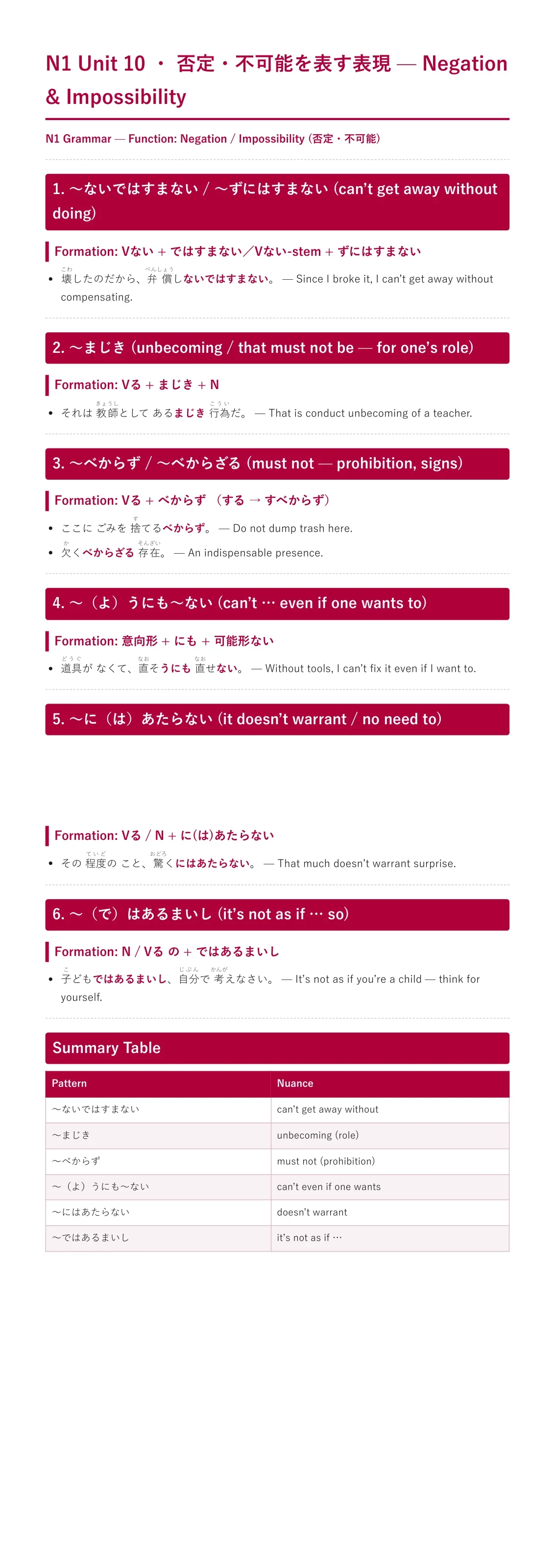
- Negation: 〜ないではすまない, 〜まじき, 〜べからず, 〜にはあたらない
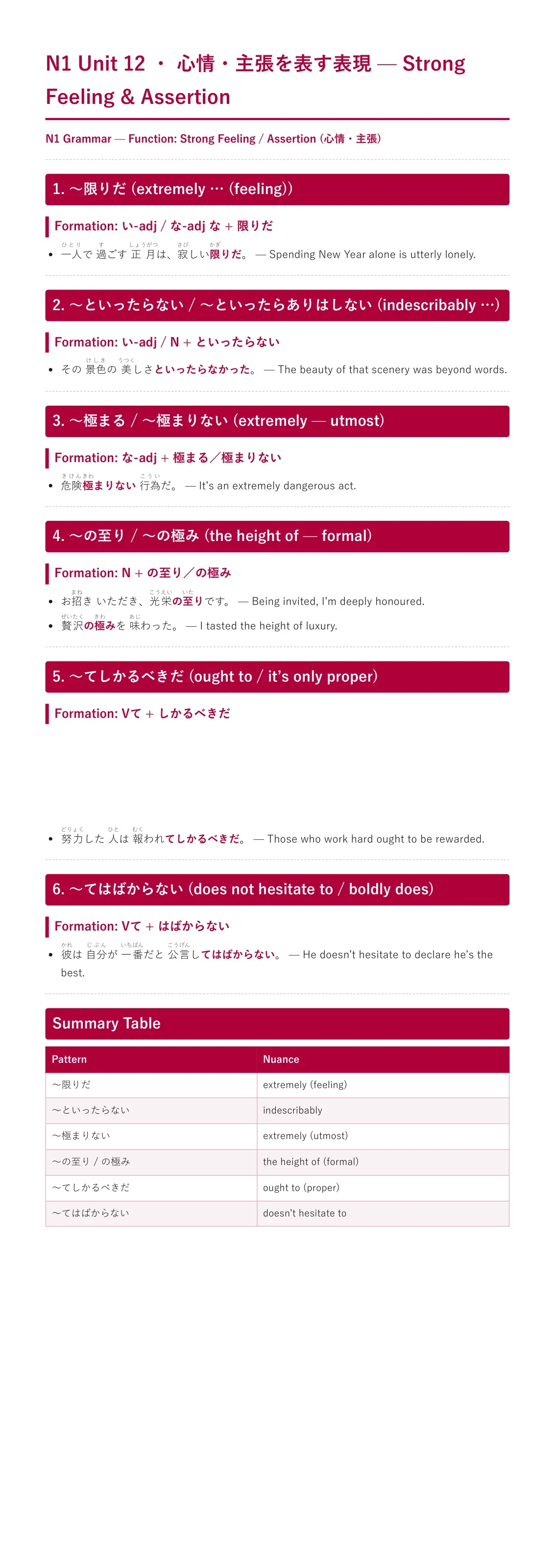
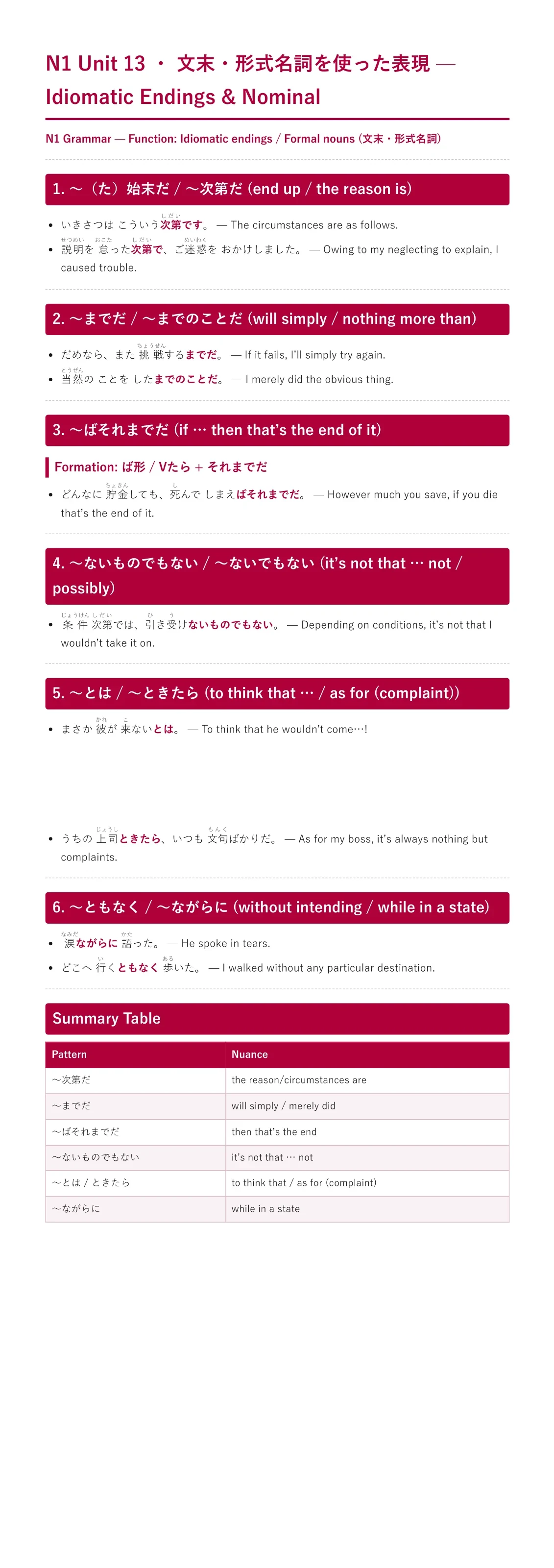
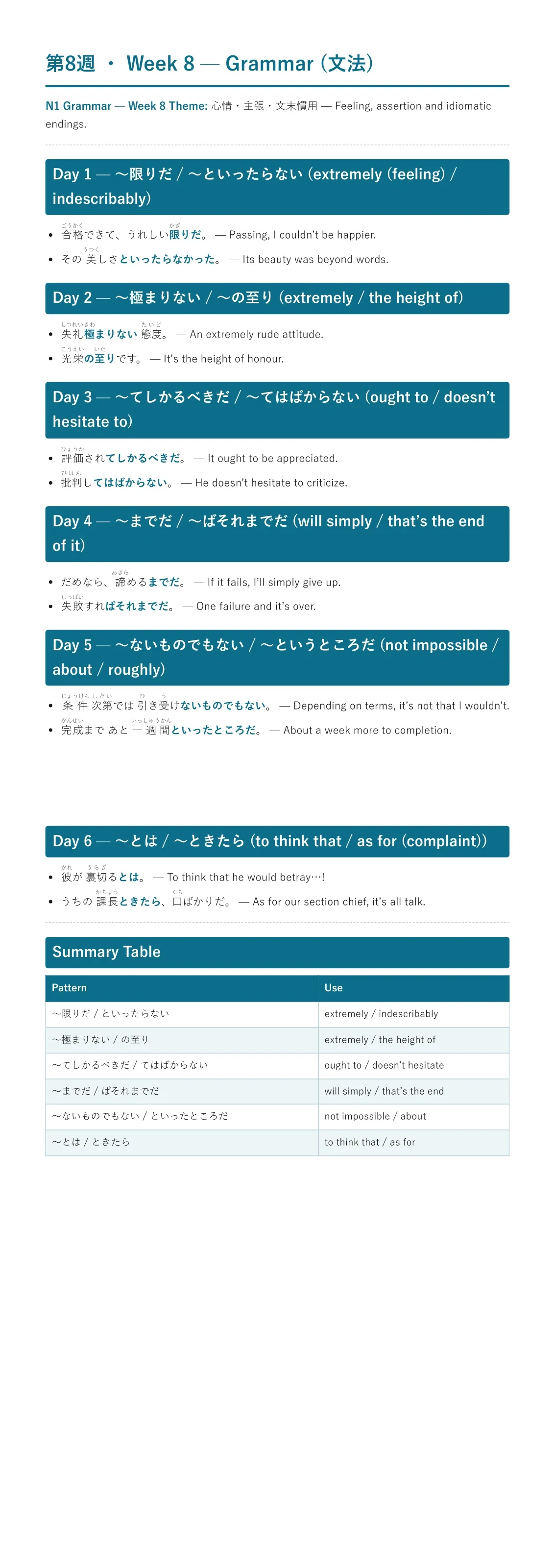
- Strong feeling & endings: 〜限りだ, 〜極まりない, 〜の至り, 〜ばそれまでだ
Who this level is for
Best for advanced learners aiming at the JLPT N1 exam, academic study, or professional work in Japanese who need formal and literary grammar.
How to absorb N1 grammar
- Read the unit and accept that most N1 patterns live in writing, not speech.
- Note the classical connections (〜ゆえ, 〜べく, 〜まじき) that break normal rules.
- Collect each pattern in a sentence you could meet in an editorial or essay.
- Train recognition by spotting the pattern in the example reading.
- Review the comparison tables weekly — at N1, recognition speed is the goal.
Common mistakes to avoid
- Using literary patterns (〜が早いか, 〜んがため) in casual conversation.
- Confusing 〜ものの (although) with 〜ものを (reproach).
- Misreading 〜ゆえ / 〜べく / 〜まじき, which follow classical connections.
- Forgetting 〜だに and 〜すら attach to single nouns for emphasis.
Related study materials
Build a joined-up study cycle by combining this page with the matching JLPT N1 grammar guide and the JLPT N1 Japanese word list.
Frequently asked questions
What makes N1 grammar difficult?
Most N1 patterns are formal or literary and rarely appear in speech, so they must be learned through reading. This guide groups them by function and uses written-style examples.
How are the two books combined here?
Lessons 1–13 are the comprehensive grammar track's functional units; lessons 14–21 are the weekly-summary track 8-week plan — the same N1 grammar set from two angles.
Do native speakers use N1 grammar?
Mostly in writing, speeches and formal documents. Recognising them in reading and listening is the main goal at this level.
How many grammar points are on N1?
Around 200 formal patterns. The functional units here cover the core set with formation, 比較 tables and practice.
What should I do after passing N1?
Shift from study to use — extensive reading, native podcasts and writing practice. Keep the comparison tables as a quick reference.
JLPT N1 lesson-by-lesson syllabus
Every lesson on this page includes handwritten study cards with full written explanations. Here is what each lesson covers:
Lesson 1
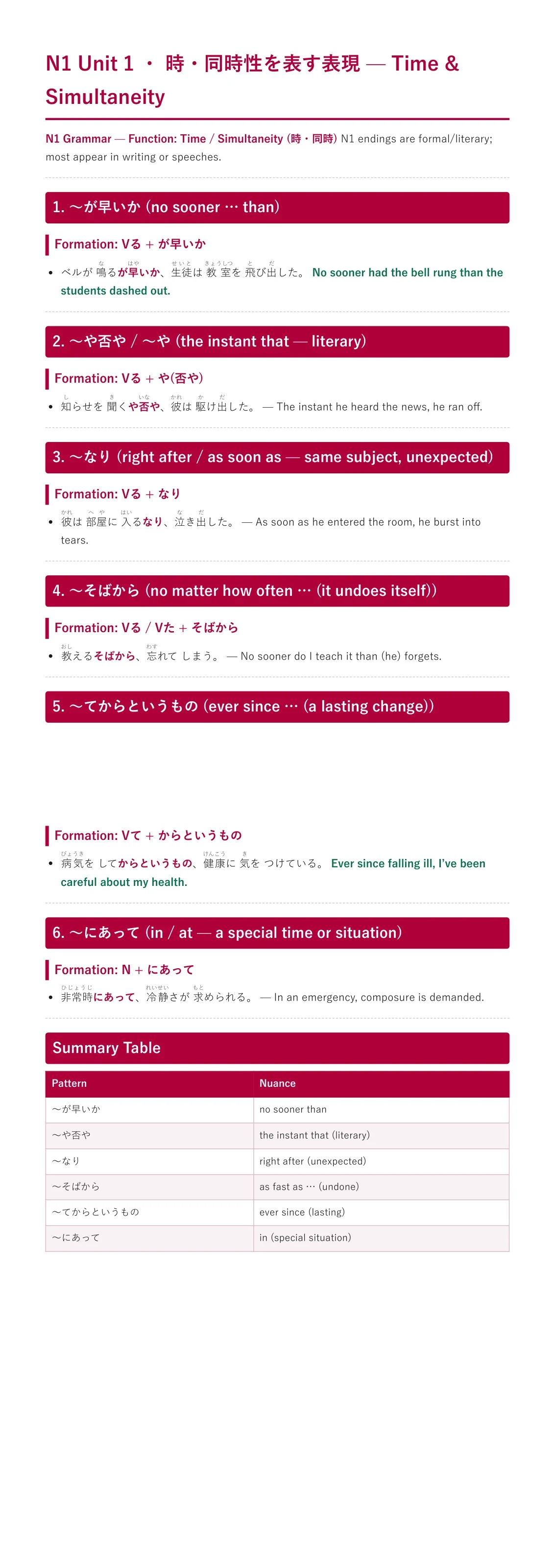
N1 endings are formal/literary; most appear in writing or speeches.
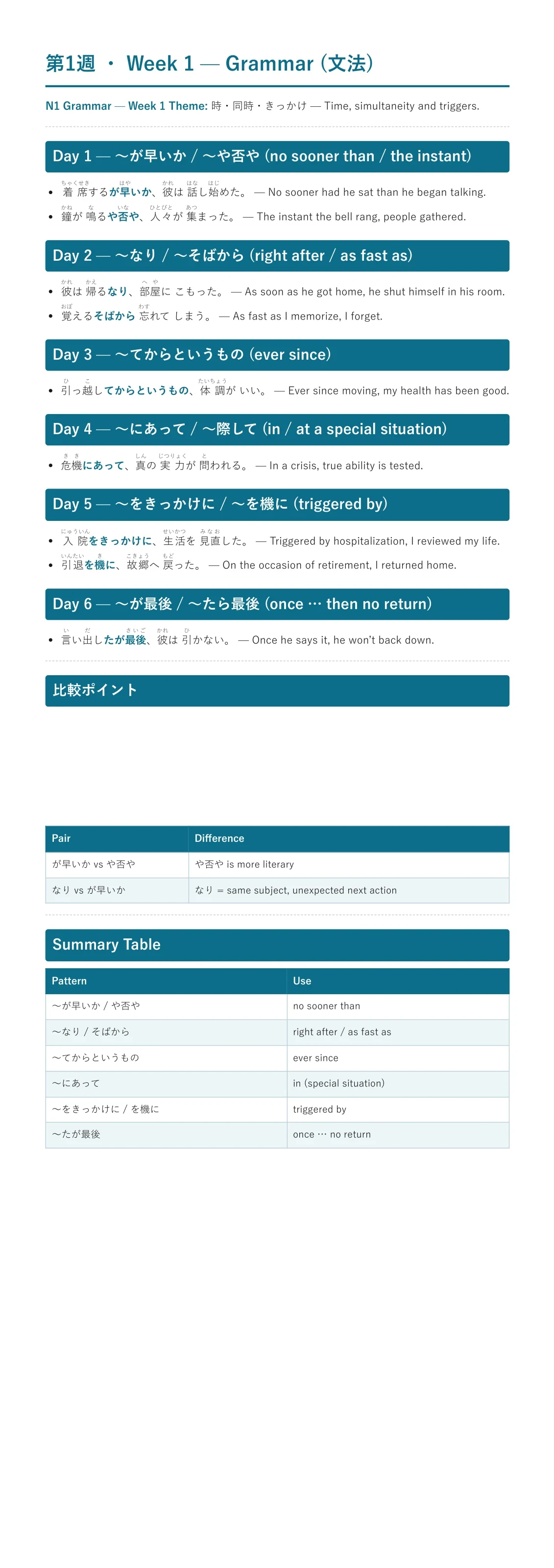
Covers: 〜が早いか (no sooner … than) · Formation: Vる + が早いか · 〜や否や / 〜や (the instant that — literary) · Formation: Vる + や(否や) · 〜なり (right after / as soon as — same subject, unexpected) · Formation: Vる + なり · 〜そばから (no matter how often … (it undoes itself)) · Formation: Vる / Vた + そばから · 〜てからというもの (ever since … (a lasting change)) · Formation: Vて + からというもの · 〜にあって (in / at — a special time or situation) · Formation: N + にあって · Summary Table · Quick reference (接続) · Example Sentences (例文) · Short Reading (読解) · Practice (練習) · Mini Production (作文)
Lesson 2
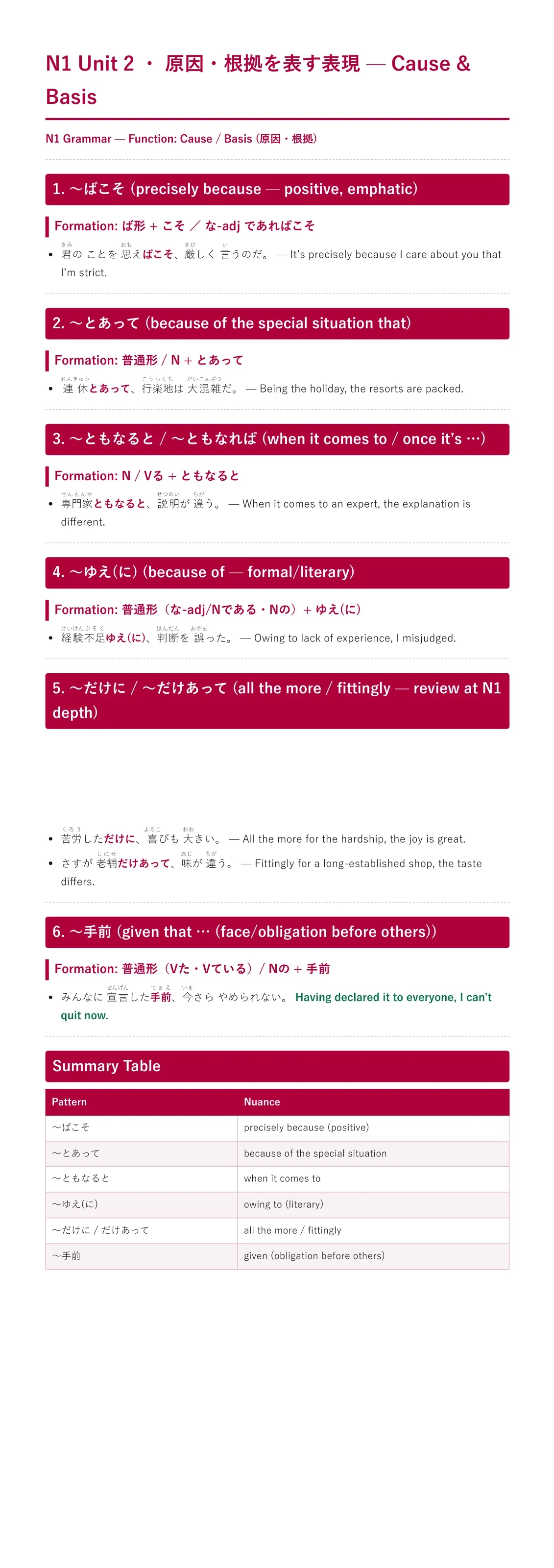
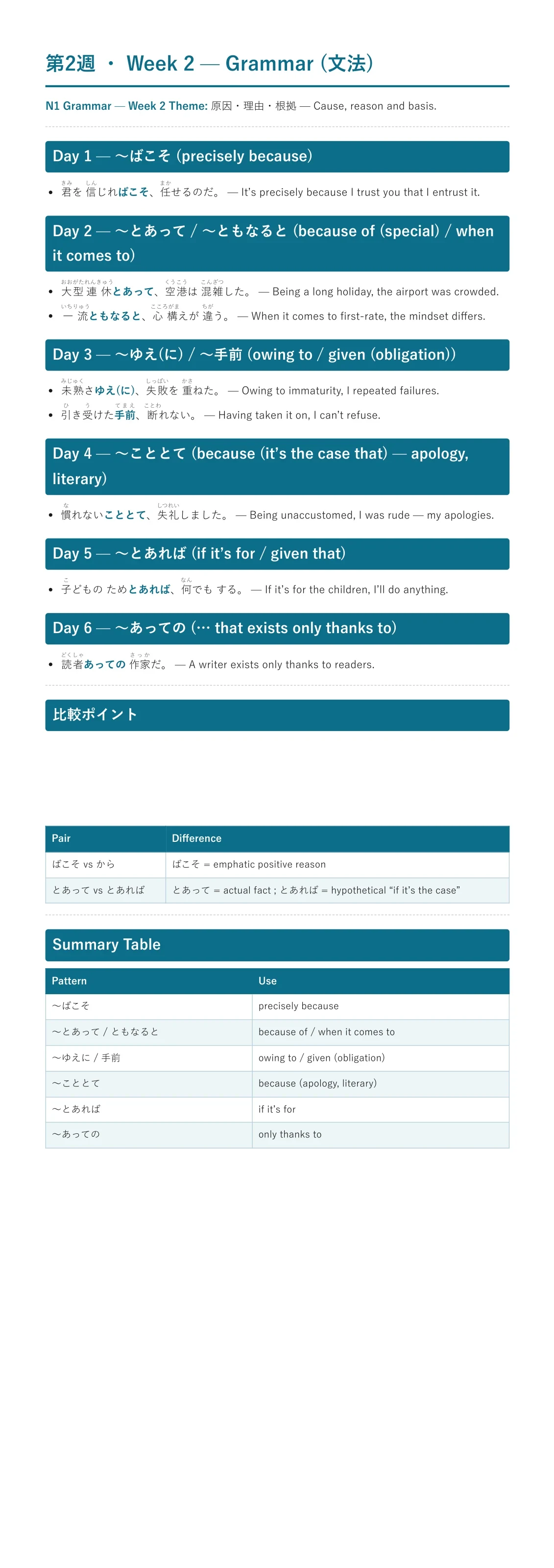
Covers: 〜ばこそ (precisely because — positive, emphatic) · Formation: ば形 + こそ / な-adj であればこそ · 〜とあって (because of the special situation that) · Formation: 普通形 / N + とあって · 〜ともなると / 〜ともなれば (when it comes to / once it's …) · Formation: N / Vる + ともなると · 〜ゆえ(に) (because of — formal/literary) · Formation: 普通形(な-adj/Nである・Nの)+ ゆえ(に) · 〜だけに / 〜だけあって (all the more / fittingly — review at N1 depth) · 〜手前 (given that … (face/obligation before others)) · Formation: 普通形(Vた・Vている)/ Nの + 手前 · Summary Table · Quick reference (接続) · Example Sentences (例文) · Short Reading (読解) · Practice (練習) · Mini Production (作文)
Lesson 3
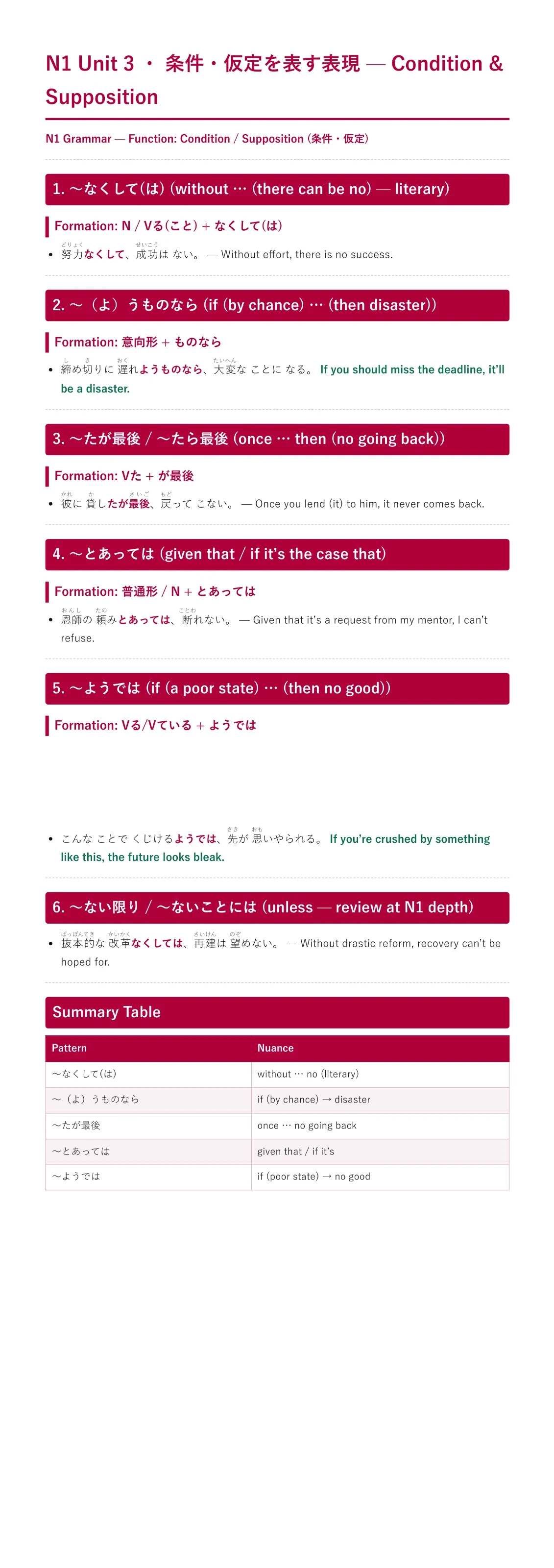
Covers: 〜なくして(は) (without … (there can be no) — literary) · Formation: N / Vる(こと) + なくして(は) · 〜(よ)うものなら (if (by chance) … (then disaster)) · Formation: 意向形 + ものなら · 〜たが最後 / 〜たら最後 (once … then (no going back)) · Formation: Vた + が最後 · 〜とあっては (given that / if it's the case that) · Formation: 普通形 / N + とあっては · 〜ようでは (if (a poor state) … (then no good)) · Formation: Vる/Vている + ようでは · 〜ない限り / 〜ないことには (unless — review at N1 depth) · Summary Table · Quick reference (接続) · Example Sentences (例文) · Short Reading (読解) · Practice (練習) · Mini Production (作文)
Lesson 4
a. ようが/まいが b. であれ/であれ c. にせよ/にせよ d. ものを/ものを
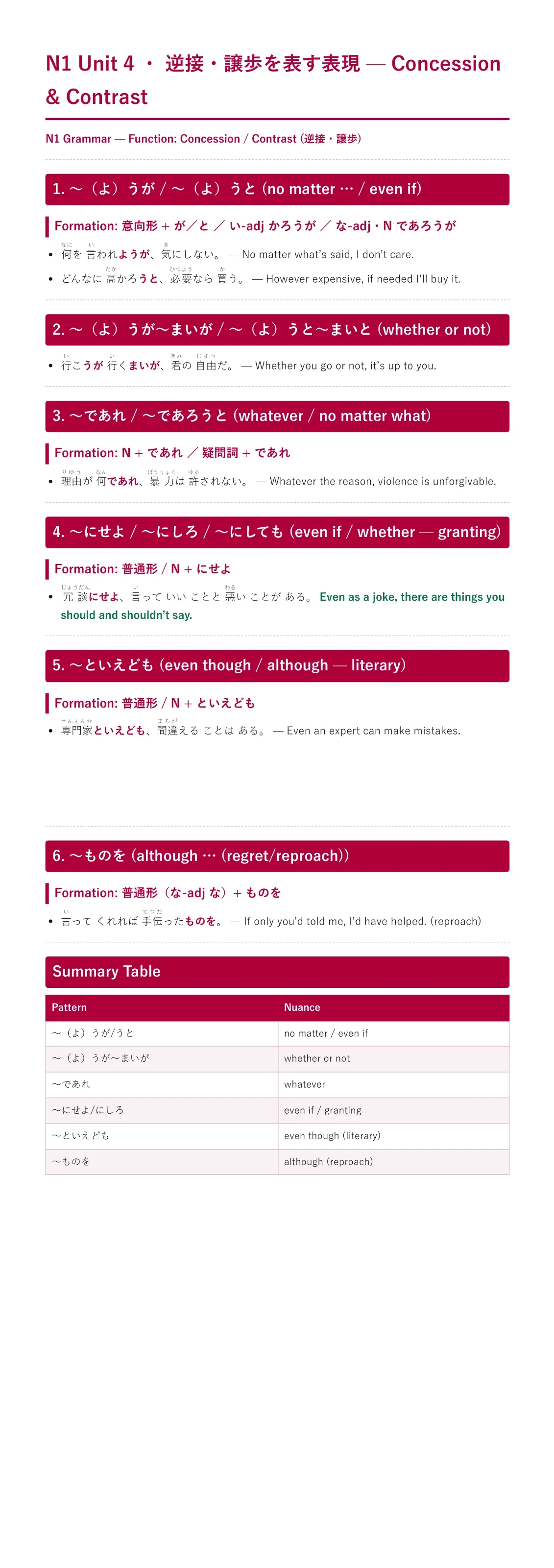
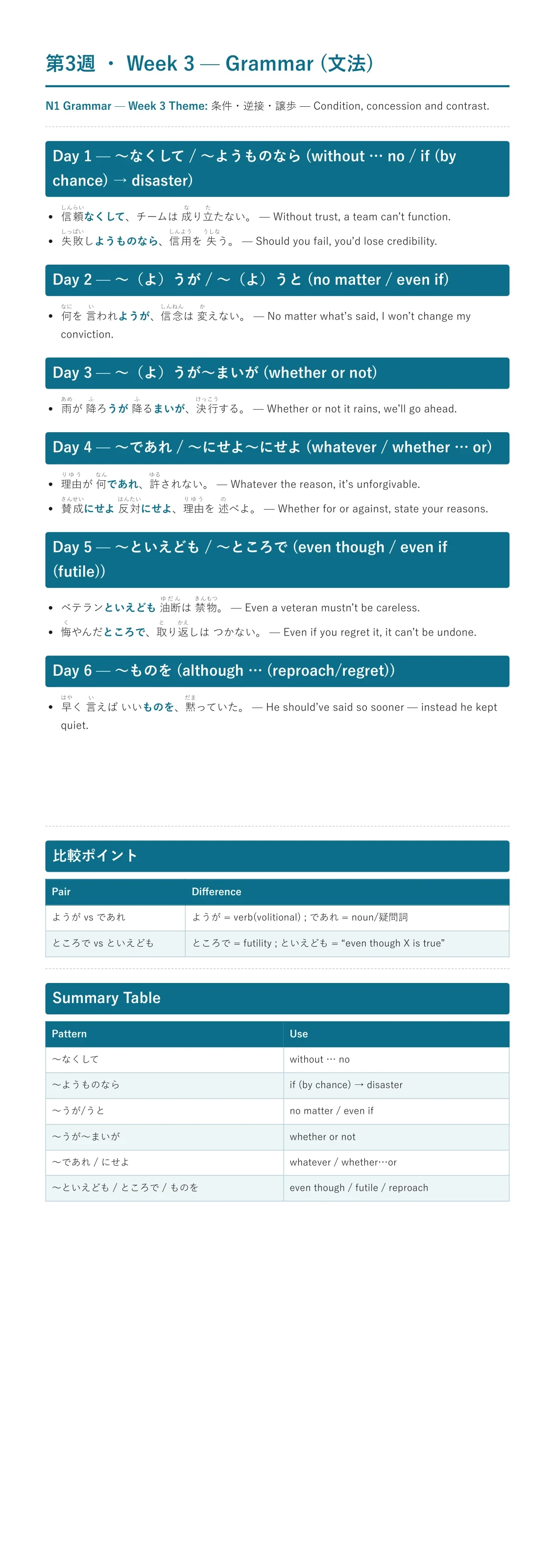
Covers: 〜(よ)うが / 〜(よ)うと (no matter … / even if) · Formation: 意向形 + が/と / い-adj かろうが / な-adj・N であろうが · 〜(よ)うが〜まいが / 〜(よ)うと〜まいと (whether or not) · 〜であれ / 〜であろうと (whatever / no matter what) · Formation: N + であれ / 疑問詞 + であれ · 〜にせよ / 〜にしろ / 〜にしても (even if / whether — granting) · Formation: 普通形 / N + にせよ · 〜といえども (even though / although — literary) · Formation: 普通形 / N + といえども · 〜ものを (although … (regret/reproach)) · Formation: 普通形(な-adj な)+ ものを · Summary Table · Quick reference (接続) · Example Sentences (例文) · Short Reading (読解) · Practice (練習) · Mini Production (作文)
Lesson 5
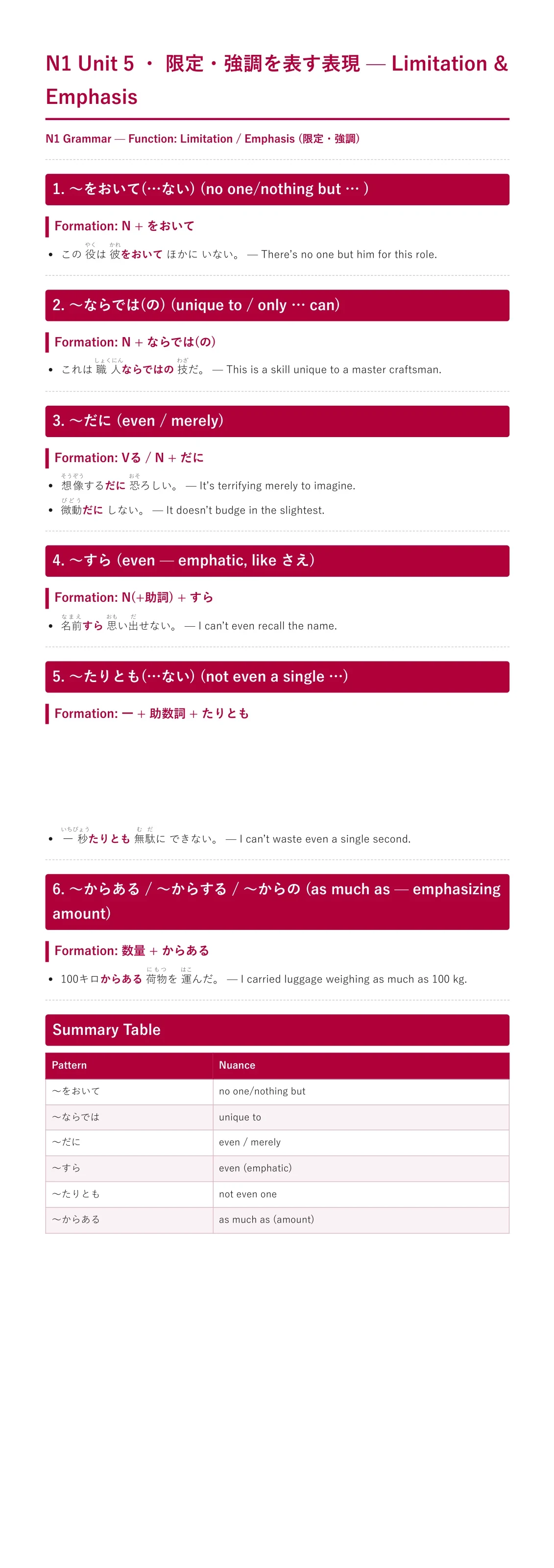
Covers: 〜をおいて(…ない) (no one/nothing but … ) · Formation: N + をおいて · 〜ならでは(の) (unique to / only … can) · Formation: N + ならでは(の) · 〜だに (even / merely) · Formation: Vる / N + だに · 〜すら (even — emphatic, like さえ) · Formation: N(+助詞) + すら · 〜たりとも(…ない) (not even a single …) · Formation: 一 + 助数詞 + たりとも · 〜からある / 〜からする / 〜からの (as much as — emphasizing amount) · Formation: 数量 + からある · Summary Table · Quick reference (接続) · Example Sentences (例文) · Short Reading (読解) · Practice (練習) · Mini Production (作文)
Lesson 6
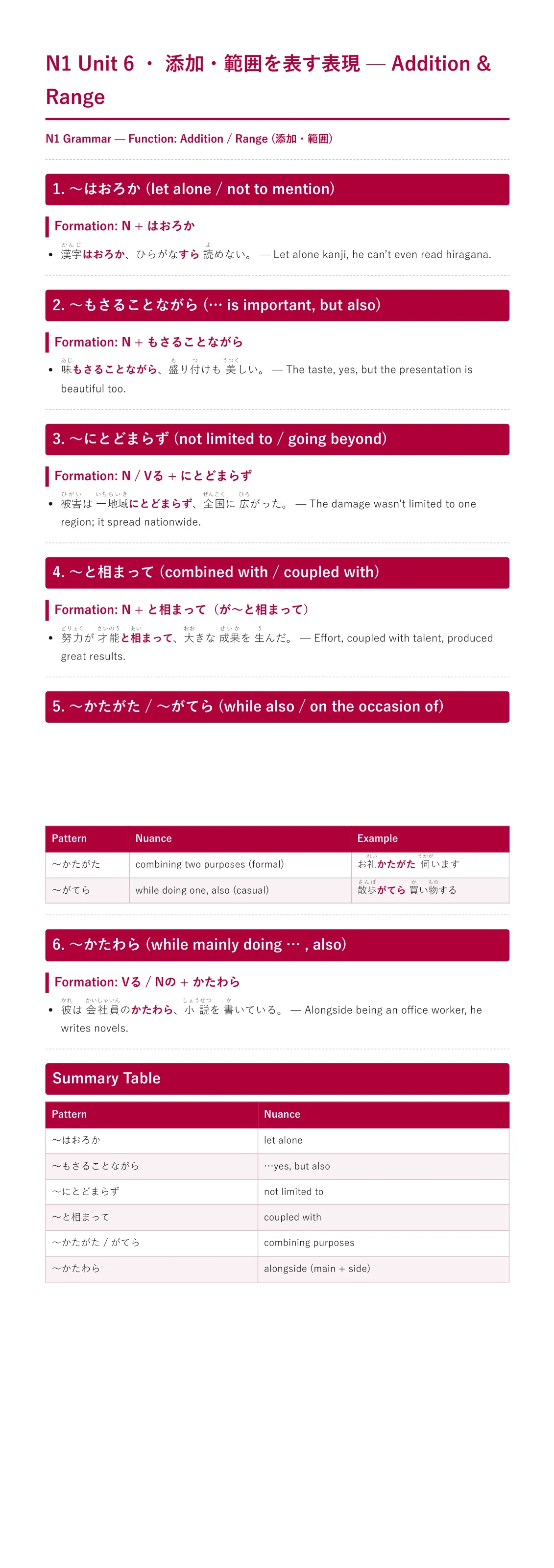
Covers: 〜はおろか (let alone / not to mention) · Formation: N + はおろか · 〜もさることながら (… is important, but also) · Formation: N + もさることながら · 〜にとどまらず (not limited to / going beyond) · Formation: N / Vる + にとどまらず · 〜と相まって (combined with / coupled with) · Formation: N + と相まって(が〜と相まって) · 〜かたがた / 〜がてら (while also / on the occasion of) · 〜かたわら (while mainly doing … , also) · Formation: Vる / Nの + かたわら · Summary Table · Quick reference (接続) · Example Sentences (例文) · Short Reading (読解) · Practice (練習) · Mini Production (作文)
Lesson 7
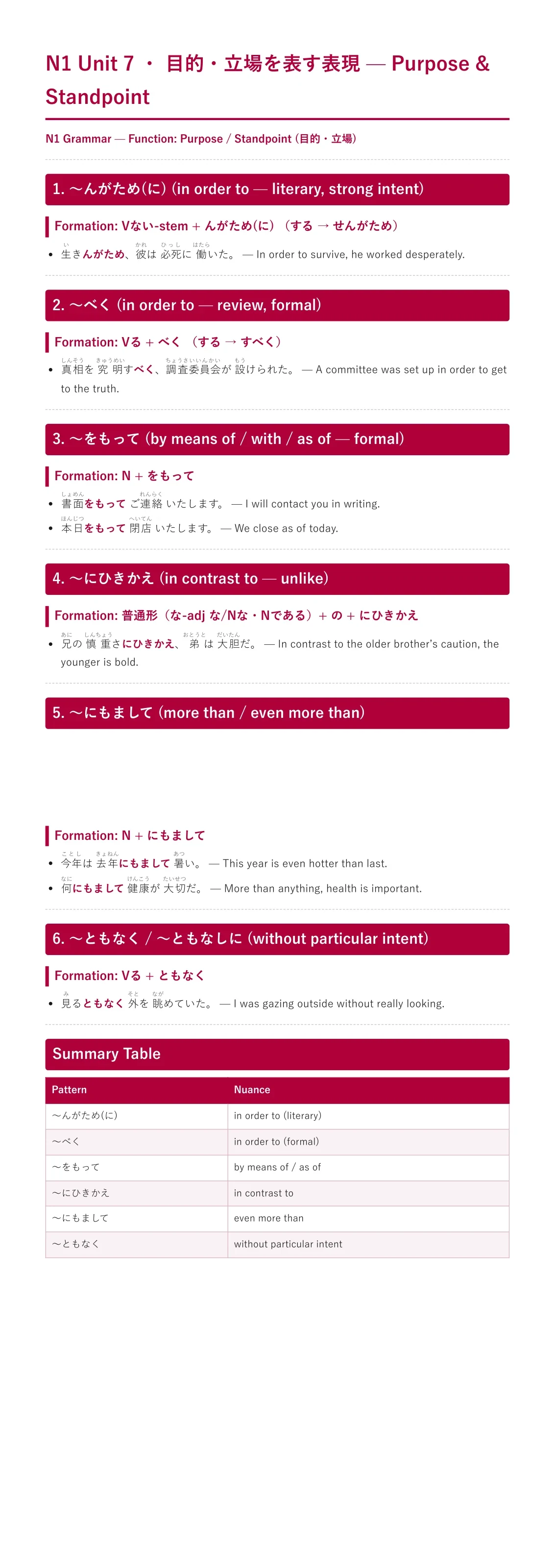
Covers: 〜んがため(に) (in order to — literary, strong intent) · Formation: Vない-stem + んがため(に) (する → せんがため) · 〜べく (in order to — review, formal) · Formation: Vる + べく (する → すべく) · 〜をもって (by means of / with / as of — formal) · Formation: N + をもって · 〜にひきかえ (in contrast to — unlike) · Formation: 普通形(な-adj な/Nな・Nである)+ の + にひきかえ · 〜にもまして (more than / even more than) · Formation: N + にもまして · 〜ともなく / 〜ともなしに (without particular intent) · Formation: Vる + ともなく · Summary Table · Quick reference (接続) · Example Sentences (例文) · Short Reading (読解) · Practice (練習) · Mini Production (作文)
Lesson 8
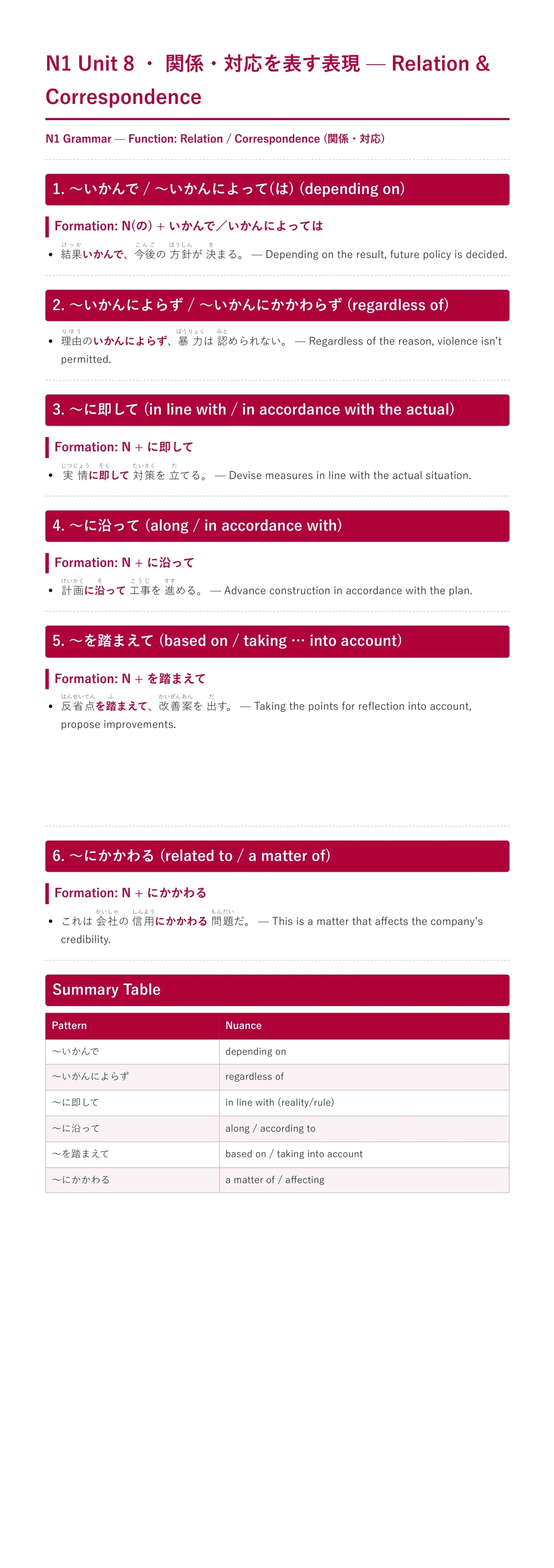
Covers: 〜いかんで / 〜いかんによって(は) (depending on) · Formation: N(の) + いかんで/いかんによっては · 〜いかんによらず / 〜いかんにかかわらず (regardless of) · 〜に即して (in line with / in accordance with the actual) · Formation: N + に即して · 〜に沿って (along / in accordance with) · Formation: N + に沿って · 〜を踏まえて (based on / taking … into account) · Formation: N + を踏まえて · 〜にかかわる (related to / a matter of) · Formation: N + にかかわる · Summary Table · Quick reference (all attach to a Noun) · Example Sentences (例文) · Short Reading (読解) · Practice (練習) · Mini Production (作文)
Lesson 9
Covers: 〜を余儀なくされる (be forced to / have no choice but) · Formation: N + を余儀なくされる · 〜ずにはおかない / 〜ないではおかない (will inevitably / won't leave it without) · Formation: Vない-stem + ずにはおかない · 〜てやまない (… deeply and endlessly — formal feeling) · Formation: Vて + やまない · 〜に足る / 〜に足りない (worthy of / not worth) · Formation: Vる / N + に足る · 〜までもない / 〜までのことだ (no need to / will simply) · 〜べくもない / 〜に越したことはない (no way to / nothing beats) · Summary Table · Quick reference (接続) · Example Sentences (例文) · Short Reading (読解) · Practice (練習) · Mini Production (作文)
Lesson 10
Covers: 〜ないではすまない / 〜ずにはすまない (can't get away without doing) · Formation: Vない + ではすまない/Vない-stem + ずにはすまない · 〜まじき (unbecoming / that must not be — for one's role) · Formation: Vる + まじき + N · 〜べからず / 〜べからざる (must not — prohibition, signs) · Formation: Vる + べからず (する → すべからず) · 〜(よ)うにも〜ない (can't … even if one wants to) · Formation: 意向形 + にも + 可能形ない · 〜に(は)あたらない (it doesn't warrant / no need to) · Formation: Vる / N + に(は)あたらない · 〜(で)はあるまいし (it's not as if … so) · Formation: N / Vる の + ではあるまいし · Summary Table · Quick reference (接続) · Example Sentences (例文) · Short Reading (読解) · Practice (練習) · Mini Production (作文)
Lesson 11
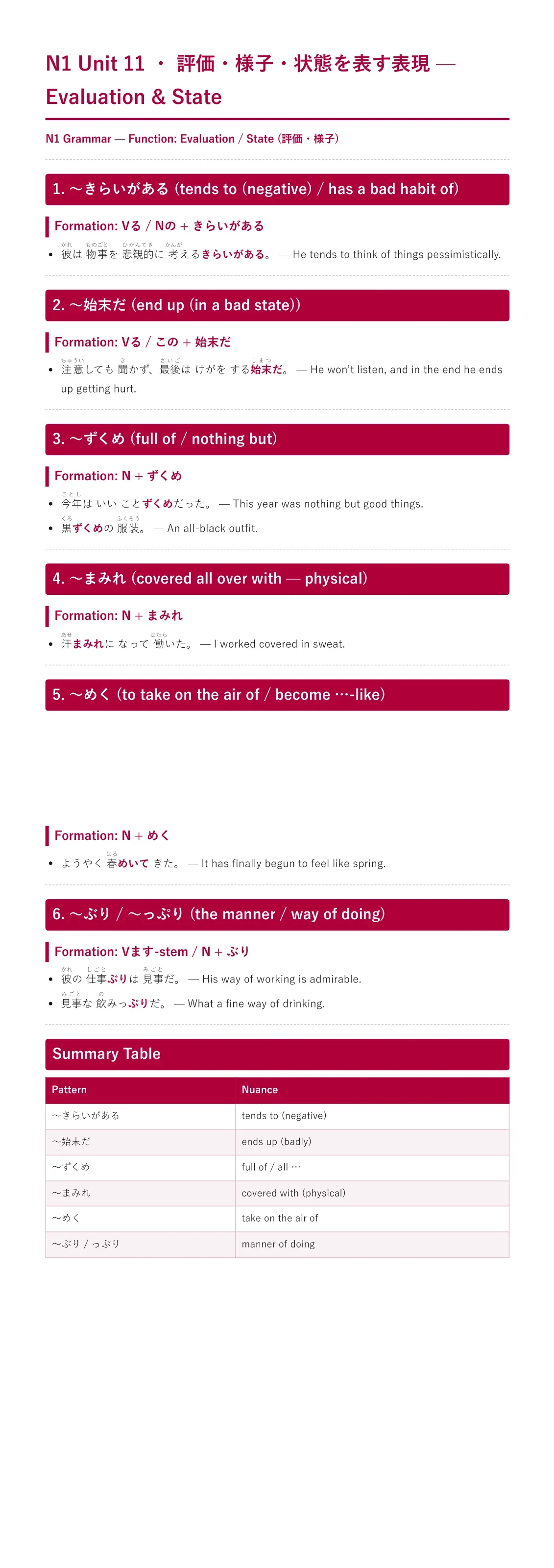
Covers: 〜きらいがある (tends to (negative) / has a bad habit of) · Formation: Vる / Nの + きらいがある · 〜始末だ (end up (in a bad state)) · Formation: Vる / この + 始末だ · 〜ずくめ (full of / nothing but) · Formation: N + ずくめ · 〜まみれ (covered all over with — physical) · Formation: N + まみれ · 〜めく (to take on the air of / become …-like) · Formation: N + めく · 〜ぶり / 〜っぷり (the manner / way of doing) · Formation: Vます-stem / N + ぶり · Summary Table · Quick reference (接続) · Example Sentences (例文) · Short Reading (読解) · Practice (練習) · Mini Production (作文)
Lesson 12
Covers: 〜限りだ (extremely … (feeling)) · Formation: い-adj / な-adj な + 限りだ · 〜といったらない / 〜といったらありはしない (indescribably …) · Formation: い-adj / N + といったらない · 〜極まる / 〜極まりない (extremely — utmost) · Formation: な-adj + 極まる/極まりない · 〜の至り / 〜の極み (the height of — formal) · Formation: N + の至り/の極み · 〜てしかるべきだ (ought to / it's only proper) · Formation: Vて + しかるべきだ · 〜てはばからない (does not hesitate to / boldly does) · Formation: Vて + はばからない · Summary Table · Quick reference (接続) · Example Sentences (例文) · Short Reading (読解) · Practice (練習) · Mini Production (作文)
Lesson 13
You've covered the core N1 grammar across 13 functional units. Pair this with reading (読解), vocabulary (語彙), kanji (漢字), and listening (聴解) practice for full exam coverage. これで JLPT 文法の 頂点です — おめでとうございます!
Covers: 〜(た)始末だ / 〜次第だ (end up / the reason is) · 〜までだ / 〜までのことだ (will simply / nothing more than) · 〜ばそれまでだ (if … then that's the end of it) · Formation: ば形 / Vたら + それまでだ · 〜ないものでもない / 〜ないでもない (it's not that … not / possibly) · 〜とは / 〜ときたら (to think that … / as for (complaint)) · 〜ともなく / 〜ながらに (without intending / while in a state) · Summary Table · Quick reference (接続) · Example Sentences (例文) · Short Reading (読解) · Practice (練習) · Mini Production (作文)
Lesson 14
Covers: Day 1 — 〜が早いか / 〜や否や (no sooner than / the instant) · Day 2 — 〜なり / 〜そばから (right after / as fast as) · Day 3 — 〜てからというもの (ever since) · Day 4 — 〜にあって / 〜際して (in / at a special situation) · Day 5 — 〜をきっかけに / 〜を機に (triggered by) · Day 6 — 〜が最後 / 〜たら最後 (once … then no return) · 比較ポイント · Summary Table · Example Sentences (例文) · Short Reading (読解) · Practice (練習) · Mini Production (作文)
Lesson 15
Covers: Day 1 — 〜ばこそ (precisely because) · Day 2 — 〜とあって / 〜ともなると (because of (special) / when it comes to) · Day 3 — 〜ゆえ(に) / 〜手前 (owing to / given (obligation)) · Day 4 — 〜こととて (because (it's the case that) — apology, literary) · Day 5 — 〜とあれば (if it's for / given that) · Day 6 — 〜あっての (… that exists only thanks to) · 比較ポイント · Summary Table · Example Sentences (例文) · Short Reading (読解) · Practice (練習) · Mini Production (作文)
Lesson 16
a. ようが/まいが b. なくして/なくして c. ものを/ものを d. であれ/であれ
Covers: Day 1 — 〜なくして / 〜ようものなら (without … no / if (by chance) → disaster) · Day 2 — 〜(よ)うが / 〜(よ)うと (no matter / even if) · Day 3 — 〜(よ)うが〜まいが (whether or not) · Day 4 — 〜であれ / 〜にせよ〜にせよ (whatever / whether … or) · Day 5 — 〜といえども / 〜ところで (even though / even if (futile)) · Day 6 — 〜ものを (although … (reproach/regret)) · 比較ポイント · Summary Table · Example Sentences (例文) · Short Reading (読解) · Practice (練習) · Mini Production (作文)
Lesson 17
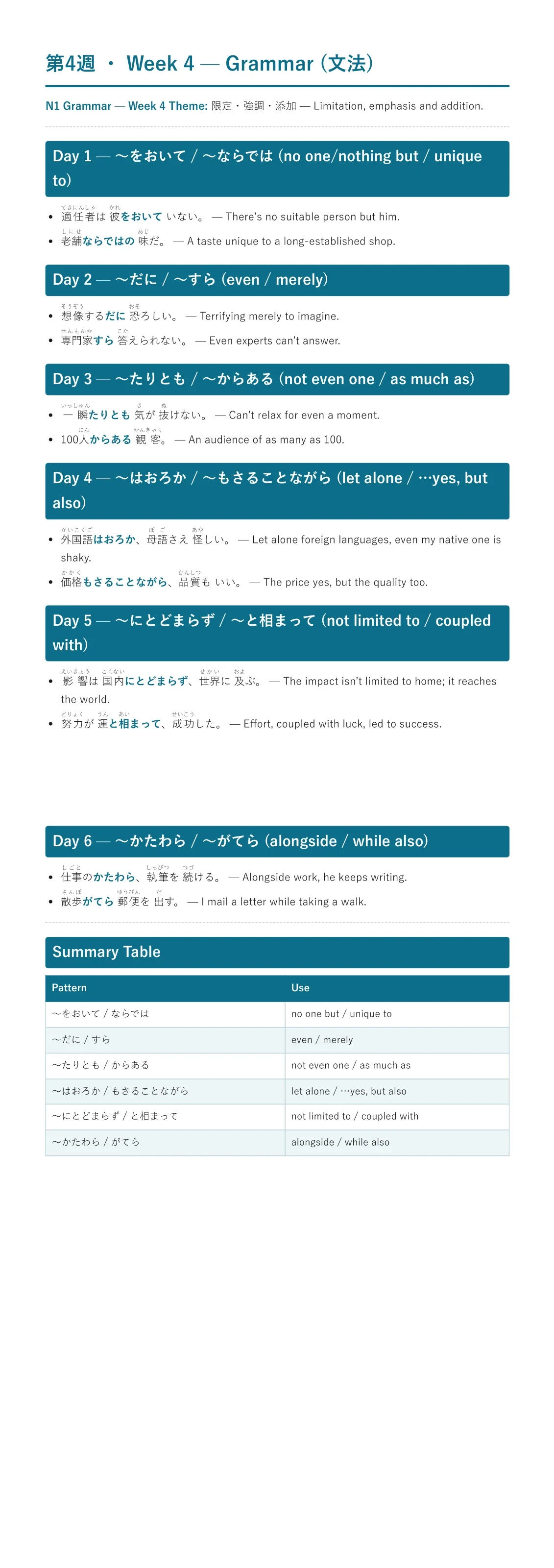
Covers: Day 1 — 〜をおいて / 〜ならでは (no one/nothing but / unique to) · Day 2 — 〜だに / 〜すら (even / merely) · Day 3 — 〜たりとも / 〜からある (not even one / as much as) · Day 4 — 〜はおろか / 〜もさることながら (let alone / …yes, but also) · Day 5 — 〜にとどまらず / 〜と相まって (not limited to / coupled with) · Day 6 — 〜かたわら / 〜がてら (alongside / while also) · Summary Table · Example Sentences (例文) · Short Reading (読解) · Practice (練習) · Mini Production (作文)
Lesson 18
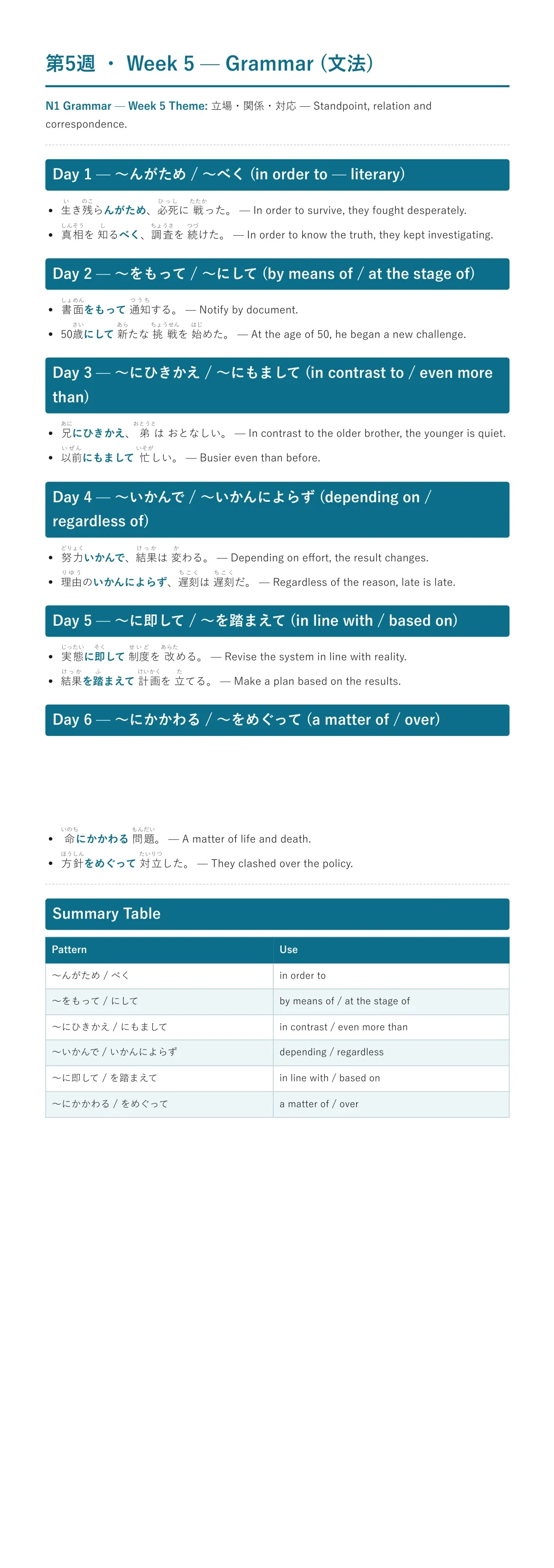
Covers: Day 1 — 〜んがため / 〜べく (in order to — literary) · Day 2 — 〜をもって / 〜にして (by means of / at the stage of) · Day 3 — 〜にひきかえ / 〜にもまして (in contrast to / even more than) · Day 4 — 〜いかんで / 〜いかんによらず (depending on / regardless of) · Day 5 — 〜に即して / 〜を踏まえて (in line with / based on) · Day 6 — 〜にかかわる / 〜をめぐって (a matter of / over) · Summary Table · Example Sentences (例文) · Short Reading (読解) · Practice (練習) · Mini Production (作文)
Lesson 19
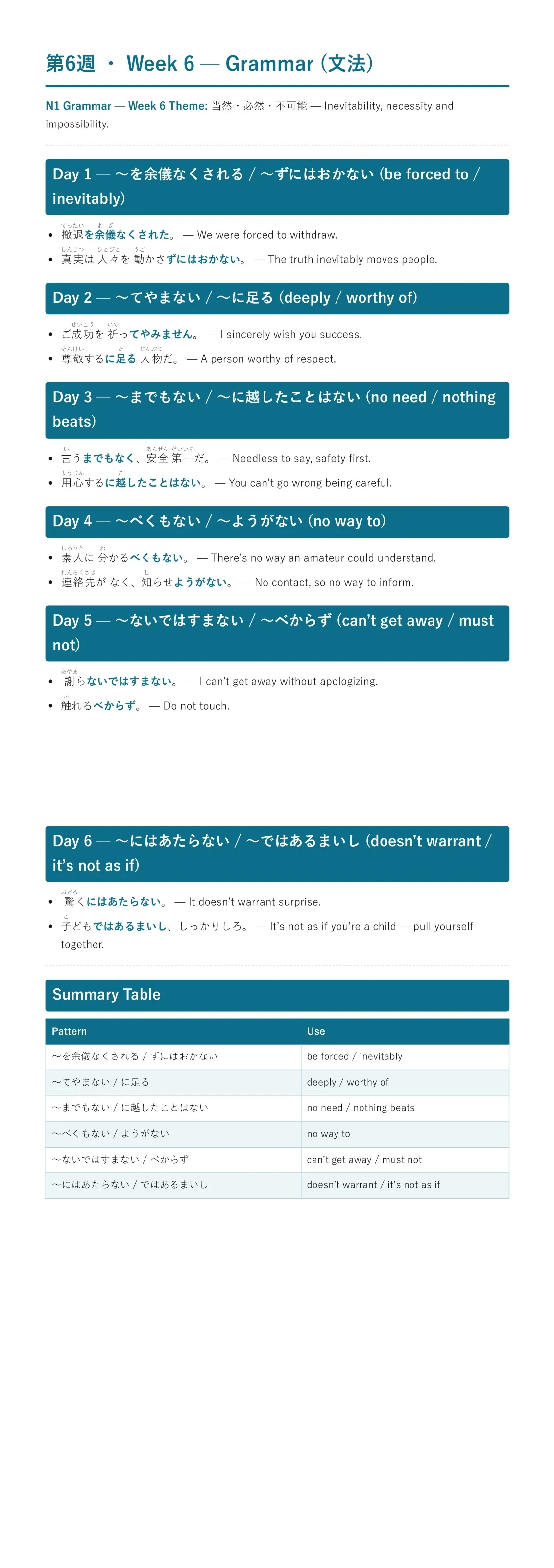
Covers: Day 1 — 〜を余儀なくされる / 〜ずにはおかない (be forced to / inevitably) · Day 2 — 〜てやまない / 〜に足る (deeply / worthy of) · Day 3 — 〜までもない / 〜に越したことはない (no need / nothing beats) · Day 4 — 〜べくもない / 〜ようがない (no way to) · Day 5 — 〜ないではすまない / 〜べからず (can't get away / must not) · Day 6 — 〜にはあたらない / 〜ではあるまいし (doesn't warrant / it's not as if) · Summary Table · Example Sentences (例文) · Short Reading (読解) · Practice (練習) · Mini Production (作文)
Lesson 20
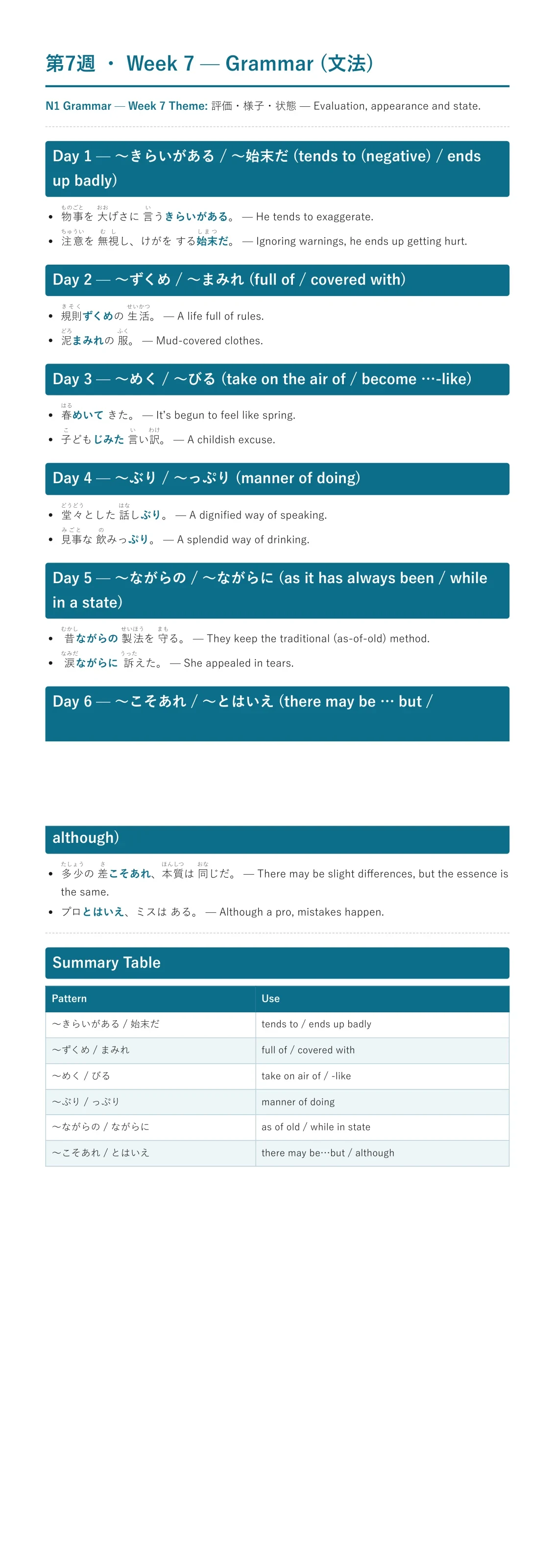
Covers: Day 1 — 〜きらいがある / 〜始末だ (tends to (negative) / ends up badly) · Day 2 — 〜ずくめ / 〜まみれ (full of / covered with) · Day 3 — 〜めく / 〜びる (take on the air of / become …-like) · Day 4 — 〜ぶり / 〜っぷり (manner of doing) · Day 5 — 〜ながらの / 〜ながらに (as it has always been / while in a state) · Day 6 — 〜こそあれ / 〜とはいえ (there may be … but / although) · Summary Table · Example Sentences (例文) · Short Reading (読解) · Practice (練習) · Mini Production (作文)
Lesson 21
You've reached the top of the JLPT grammar ladder (N5 → N1). お疲れさまでした! Pair this with Summary Grammar N1 漢字・語彙・読解・聴解 and lots of reading practice. 合格を 祈っています!
Covers: Day 1 — 〜限りだ / 〜といったらない (extremely (feeling) / indescribably) · Day 2 — 〜極まりない / 〜の至り (extremely / the height of) · Day 3 — 〜てしかるべきだ / 〜てはばからない (ought to / doesn't hesitate to) · Day 4 — 〜までだ / 〜ばそれまでだ (will simply / that's the end of it) · Day 5 — 〜ないものでもない / 〜というところだ (not impossible / about / roughly) · Day 6 — 〜とは / 〜ときたら (to think that / as for (complaint)) · Summary Table · Example Sentences (例文) · Short Reading (読解) · Practice (練習) · Mini Production (作文) · 🎉 8週間 修了 — JLPT 文法 完全制覇!