
JLPT N5 notes prepared and maintained by the NihongoDoya Editorial Team.
Lesson summaries and study cards last reviewed 17 July 2026. These are independent learning materials, not official examination content. Report a correction.
Introduction
Welcome to the JLPT N5 study guide at NihongoDoya. This page gathers every core sentence pattern, particle and conjugation from the standard Beginner 1 syllabus (lessons 1–25) — から です・ます to the て-form — with worked examples, clear summaries and practice on each lesson card. Whether you are revising for JLPT N5 or starting Japanese from scratch, the cards above let you jump straight to the topic you need.
What you will learn
- Particles は, が, を, に, で and へ in everyday sentences
- Polite forms です / 〜ます with their negative and past variants
- これ・それ・あれ demonstratives and 〜が好き / 上手 preferences
- あります・います existence with position words (上・下・となり)
- The て-form for 〜てください, 〜ています and 〜てから
- Plain, dictionary and た-forms: 〜ことができる, 〜たことがある, 〜たり
- Conditionals 〜たら and giving/receiving あげます・もらいます・くれます
Who this level is for
Best for complete beginners who already know hiragana and katakana, and for self-study learners working toward the December or July JLPT N5 sitting.
A weekly rhythm for N5 grammar
- Read one lesson card and write the sentence pattern out by hand in kana.
- Swap the example words for your own — names, foods, places you know.
- Say each example aloud twice to fix the particle order in your ear.
- Learn ten matching words from the N5 word list and reuse them in the pattern.
- Recap yesterday's lesson for five minutes before starting the next one.
Common mistakes to avoid
- Mixing up は (topic) and が (subject) — は for known things, が for new or contrasting information.
- Forgetting that the て-form spelling changes by verb group (っ, んで, いて).
- Picking the wrong counter — people, flat items and machines all use different counters.
- Treating な-adjectives like い-adjectives in the negative or past form.
Related study materials
Build a joined-up study cycle by combining this page with the matching JLPT N5 grammar guide, the JLPT N5 Japanese word list
Frequently asked questions
How long does it take to finish the JLPT N5 grammar syllabus?
Most self-study learners cover the standard Beginner 1 syllabus (lessons 1–25) in three to six months at one lesson per week, with daily 30-minute sessions. Pair each lesson with the matching word list for the fastest retention.
Do I need to know kanji before starting N5 grammar?
No. You only need hiragana and katakana. The lesson cards gradually introduce common kanji, and the matching Japanese word list shows readings for every entry.
Can I use this guide alongside a class?
Yes — every lesson follows the order of the standard Beginner 1 syllabus, so it works as supplementary reading for classroom learners and as a primary resource for self-study.
Should I study Beginner (A1) at the same time as N5?
Beginner (A1) focuses on daily-life Japanese, while JLPT N5 focuses on exam structure. Many learners use both — N5 for testing and the conversational track for talking.
What should I do after finishing this level?
Move to the JLPT N4 grammar guide (the standard Beginner 2 syllabus, lessons 26–50) and keep drilling N5 words for two more weeks.
JLPT N5 lesson-by-lesson syllabus
Every lesson on this page includes handwritten study cards with full written explanations. Here is what each lesson covers:
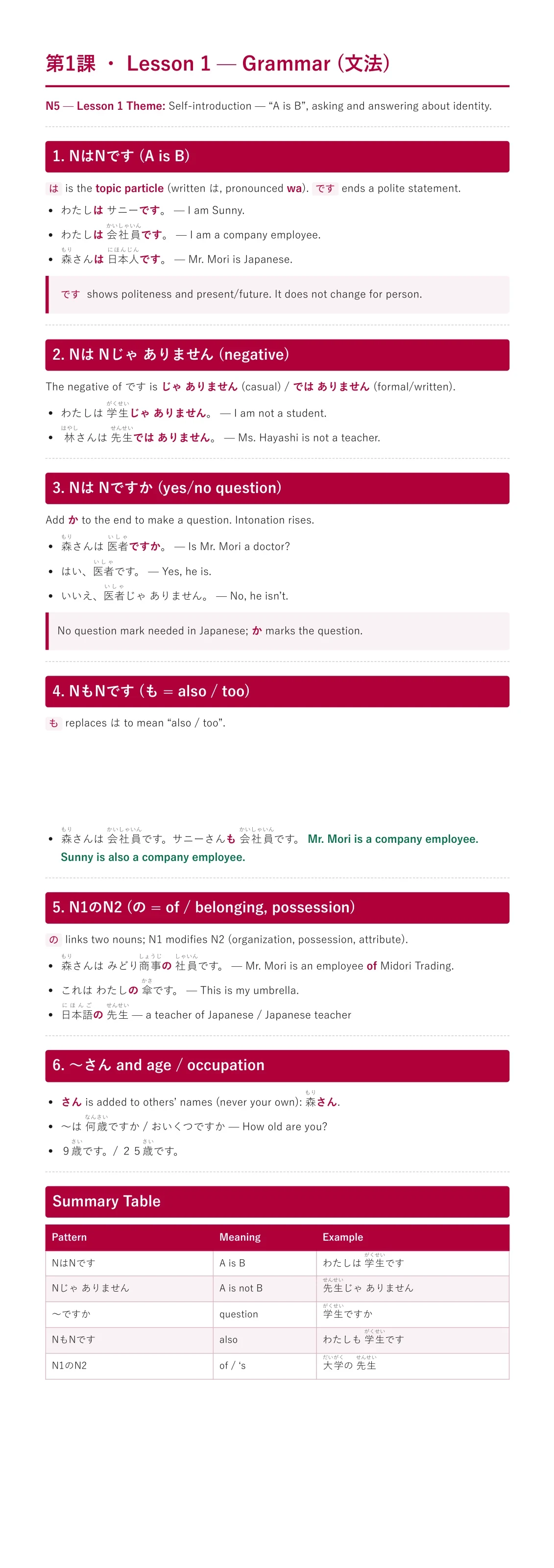
Lesson 1
The negative of です is じゃ ありません (casual) / では ありません (formal/written).
Covers: NはNです (A is B) · Nは Nじゃ ありません (negative) · Nは Nですか (yes/no question) · NもNです (も = also / too) · N1のN2 (の = of / belonging, possession) · 〜さん and age / occupation · Summary Table · Key Vocabulary (単語) · Greetings (あいさつ) · Example Sentences (例文) · Model Conversation (会話) — 初対面 · Mini Practice (練習)
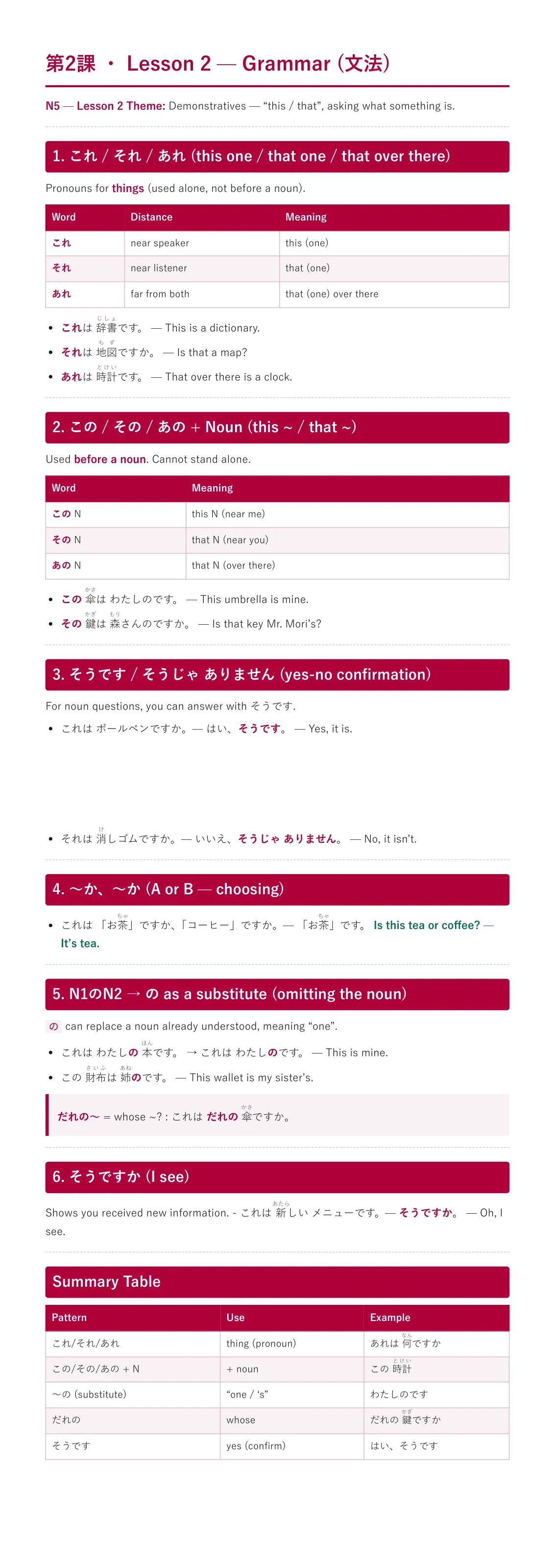
Lesson 2
Pronouns for things (used alone, not before a noun).
Covers: これ / それ / あれ (this one / that one / that over there) · この / その / あの + Noun (this ~ / that ~) · そうです / そうじゃ ありません (yes-no confirmation) · 〜か、〜か (A or B — choosing) · N1のN2 → の as a substitute (omitting the noun) · そうですか (I see) · Summary Table · Key Vocabulary (単語) · Example Sentences (例文) · Model Conversation (会話) — これは何ですか · Mini Practice (練習)
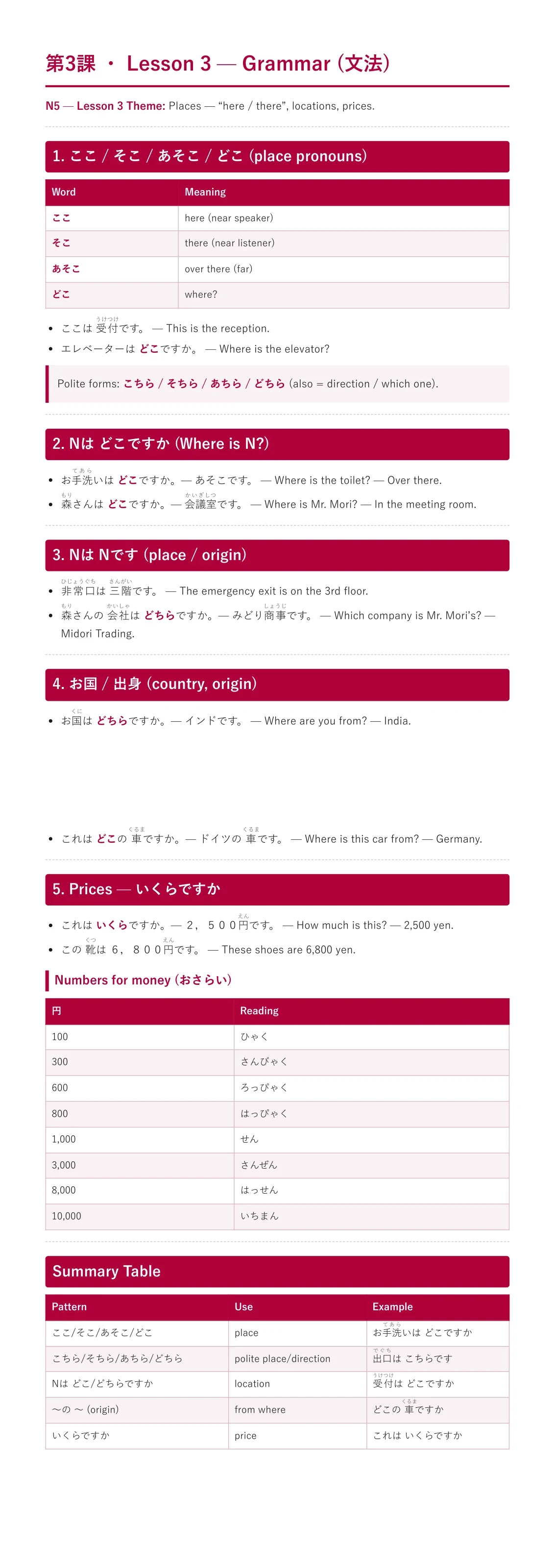
Lesson 3
A: Excuse me. Where is the umbrella department?
Covers: ここ / そこ / あそこ / どこ (place pronouns) · Nは どこですか (Where is N?) · Nは Nです (place / origin) · お国 / 出身 (country, origin) · Prices — いくらですか · Numbers for money (おさらい) · Summary Table · Key Vocabulary (単語) · Example Sentences (例文) · Model Conversation (会話) — デパートで · Mini Practice (練習)
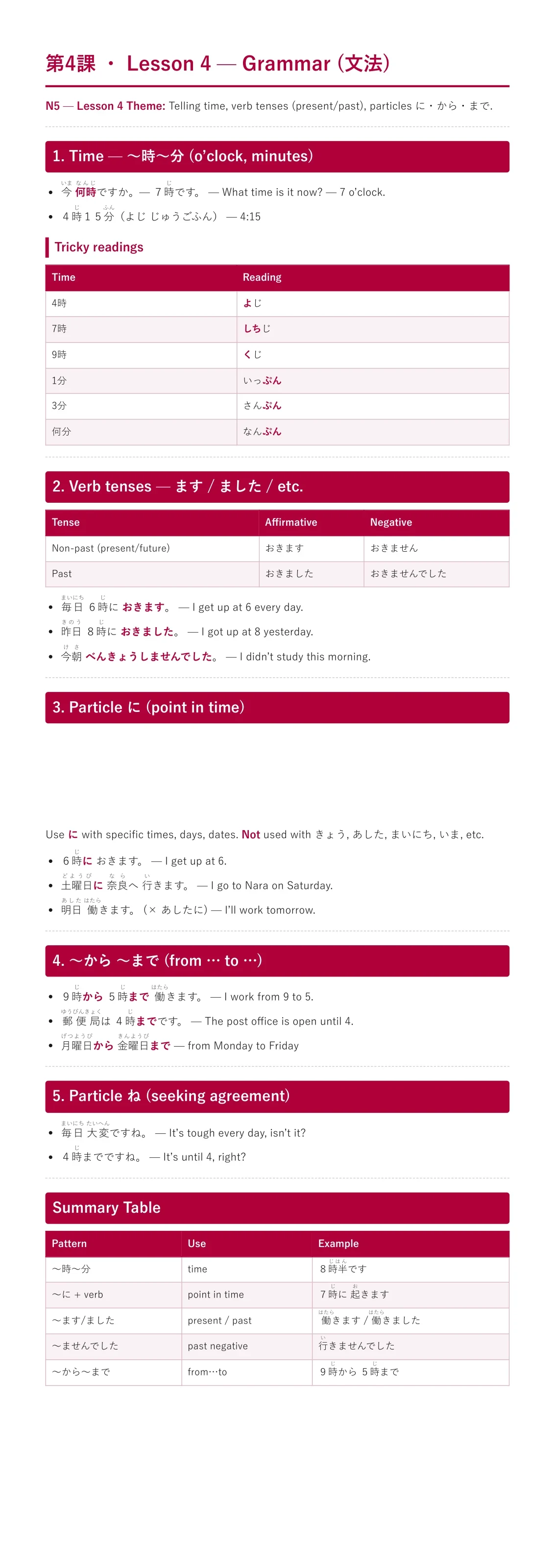
Lesson 4
Use に with specific times, days, dates. Not used with きょう, あした, まいにち, いま, etc.
Covers: Time — 〜時〜分 (o'clock, minutes) · Tricky readings · Verb tenses — ます / ました / etc. · Particle に (point in time) · 〜から 〜まで (from … to …) · Particle ね (seeking agreement) · Summary Table · Key Vocabulary (単語) · Days of the week (曜日) · Example Sentences (例文) · Model Conversation (会話) — 電話で · Mini Practice (練習)
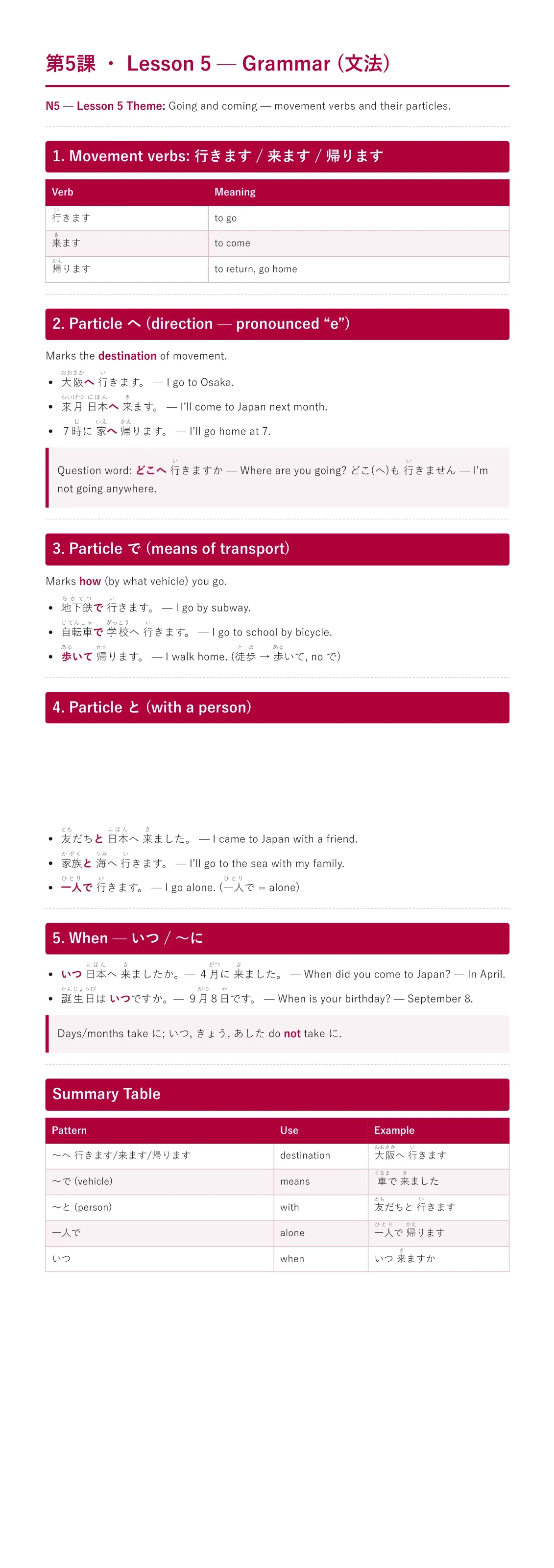
Lesson 5
A: Mr. Mori, where are you going tomorrow?
Covers: Movement verbs: 行きます / 来ます / 帰ります · Particle へ (direction — pronounced "e") · Particle で (means of transport) · Particle と (with a person) · When — いつ / 〜に · Summary Table · Key Vocabulary (単語) · Example Sentences (例文) · Model Conversation (会話) — 週末の予定 · Mini Practice (練習)
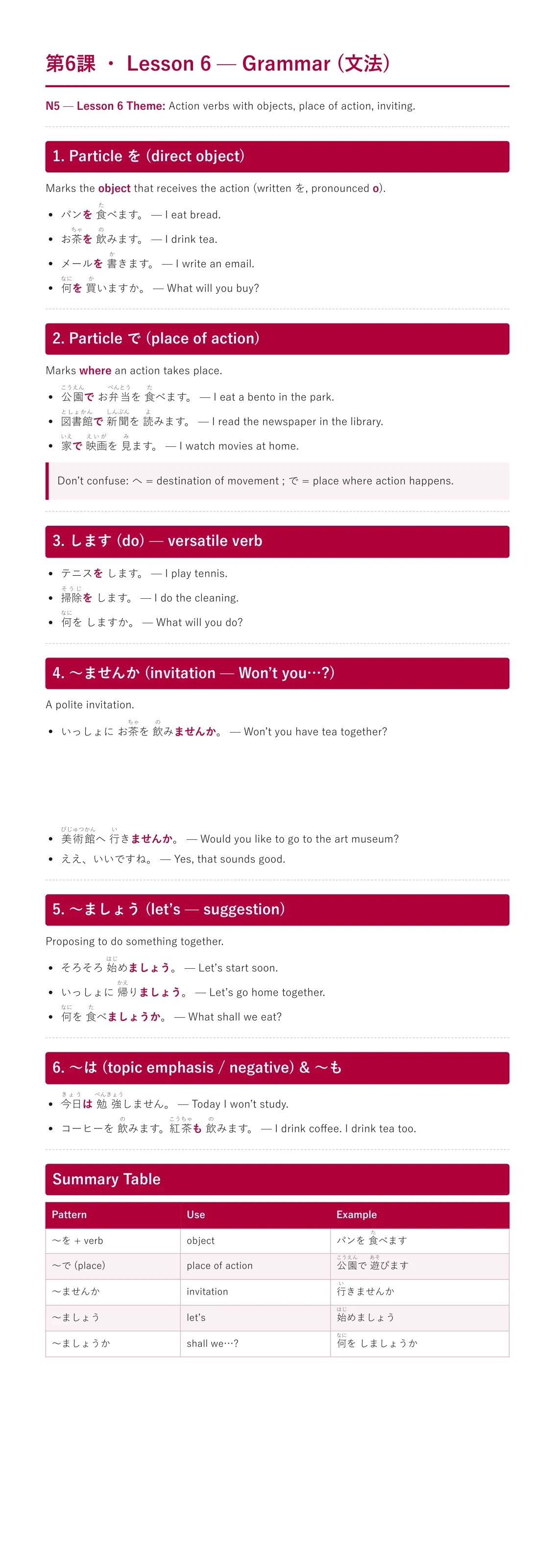
Lesson 6
Marks the object that receives the action (written を, pronounced o).
Covers: Particle を (direct object) · Particle で (place of action) · します (do) — versatile verb · 〜ませんか (invitation — Won't you…?) · 〜ましょう (let's — suggestion) · 〜は (topic emphasis / negative) & 〜も · Summary Table · Key Vocabulary (単語) · Example Sentences (例文) · Model Conversation (会話) — 食事の誘い · Mini Practice (練習)
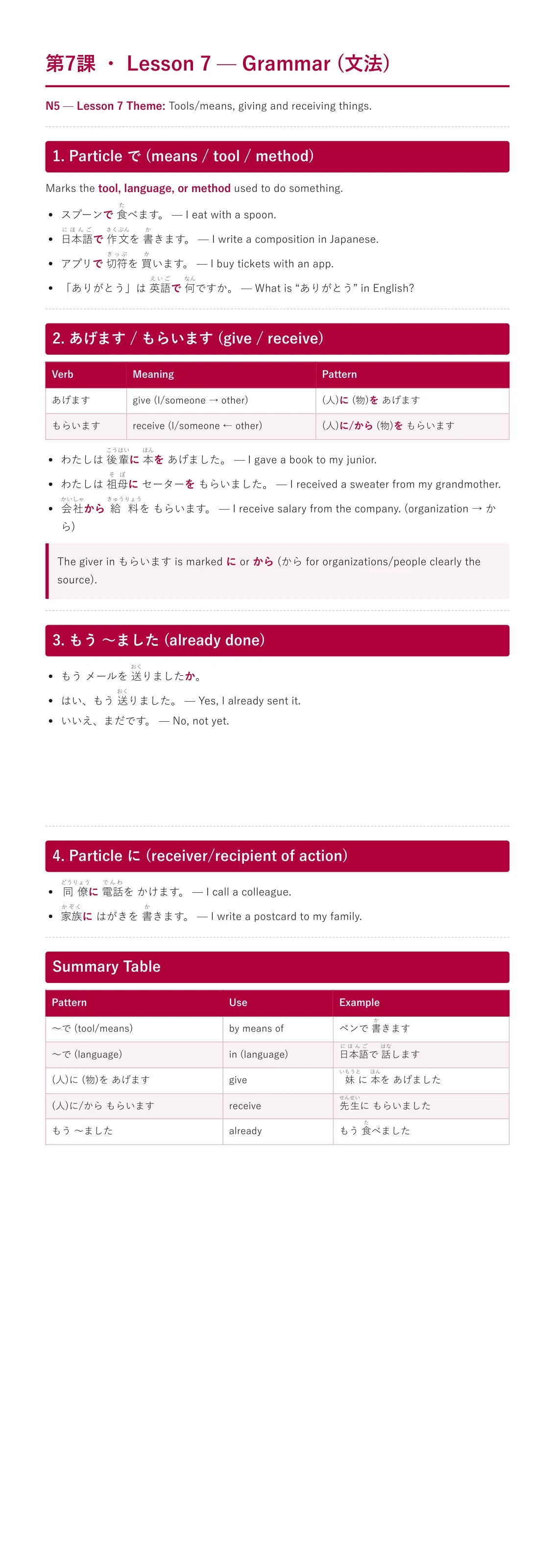
Lesson 7
Marks the tool, language, or method used to do something.
Covers: Particle で (means / tool / method) · あげます / もらいます (give / receive) · もう 〜ました (already done) · Particle に (receiver/recipient of action) · Summary Table · Key Vocabulary (単語) · Example Sentences (例文) · Model Conversation (会話) — お土産 · Mini Practice (練習)
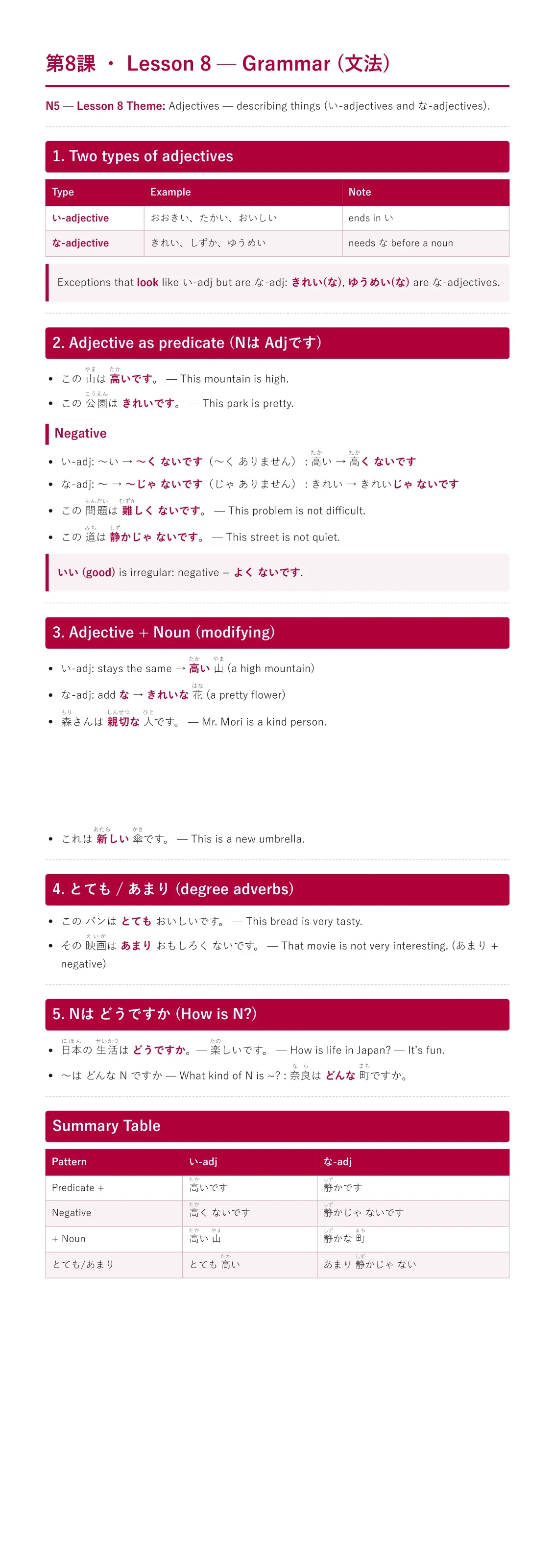
Lesson 8
B: I'm busy every day, but it's very fun.
Covers: Two types of adjectives · Adjective as predicate (Nは Adjです) · Negative · Adjective + Noun (modifying) · とても / あまり (degree adverbs) · Nは どうですか (How is N?) · Summary Table · Key Vocabulary (単語) · い-adjectives · な-adjectives · Example Sentences (例文) · Model Conversation (会話) — 日本の生活 · Mini Practice (練習)
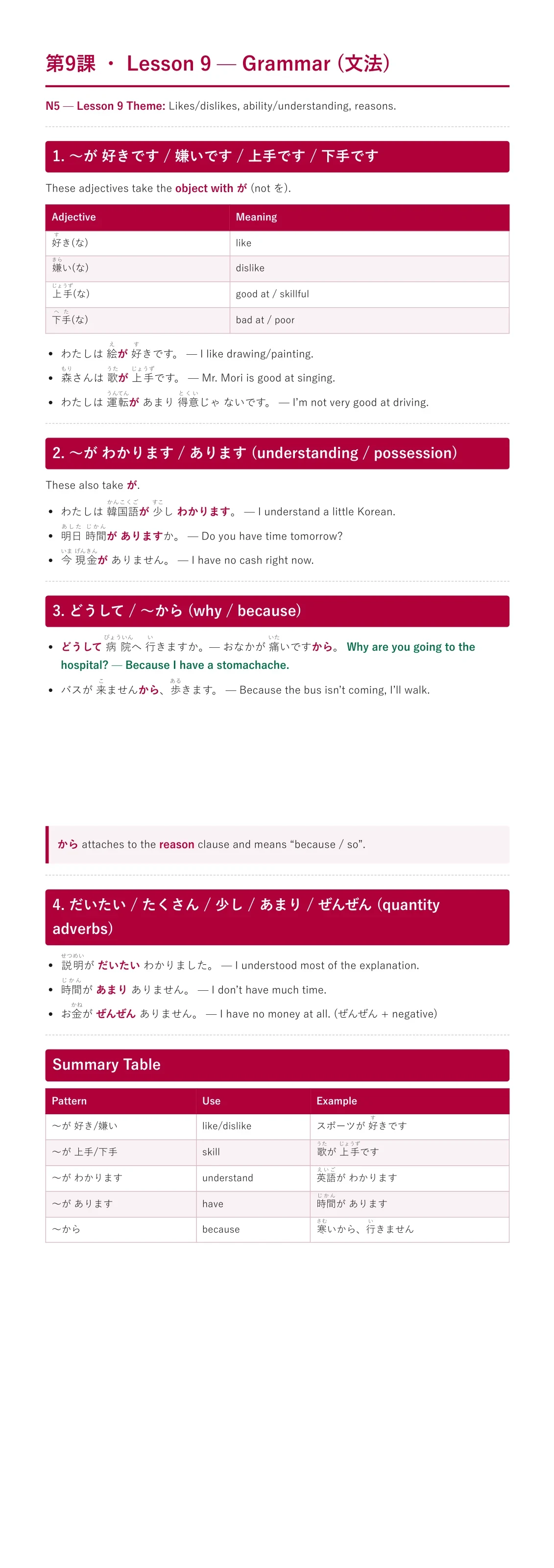
Lesson 9
These adjectives take the object with が (not を).
Covers: 〜が 好きです / 嫌いです / 上手です / 下手です · 〜が わかります / あります (understanding / possession) · どうして / 〜から (why / because) · だいたい / たくさん / 少し / あまり / ぜんぜん (quantity adverbs) · Summary Table · Key Vocabulary (単語) · Example Sentences (例文) · Model Conversation (会話) — 趣味と理由 · Mini Practice (練習)
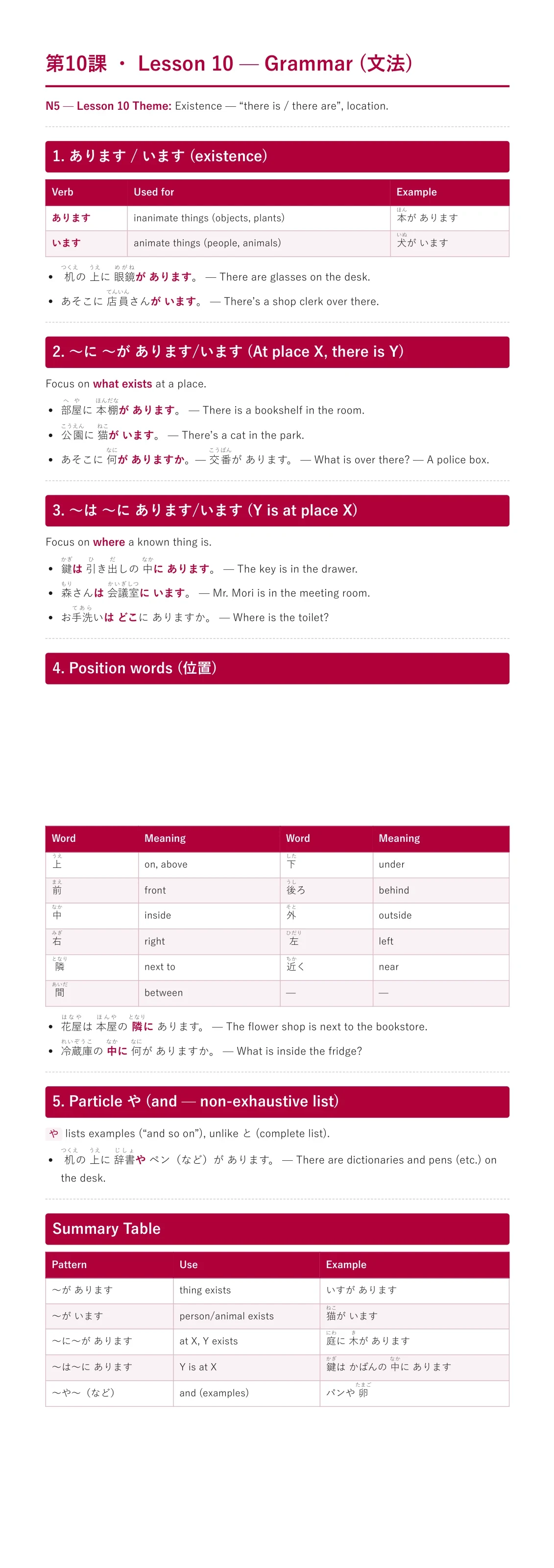
Lesson 10
A: Excuse me. Is there a pharmacy near here?
Covers: あります / います (existence) · 〜に 〜が あります/います (At place X, there is Y) · 〜は 〜に あります/います (Y is at place X) · Particle や (and — non-exhaustive list) · Summary Table · Key Vocabulary (単語) · Example Sentences (例文) · Model Conversation (会話) — 道案内 · Mini Practice (練習)
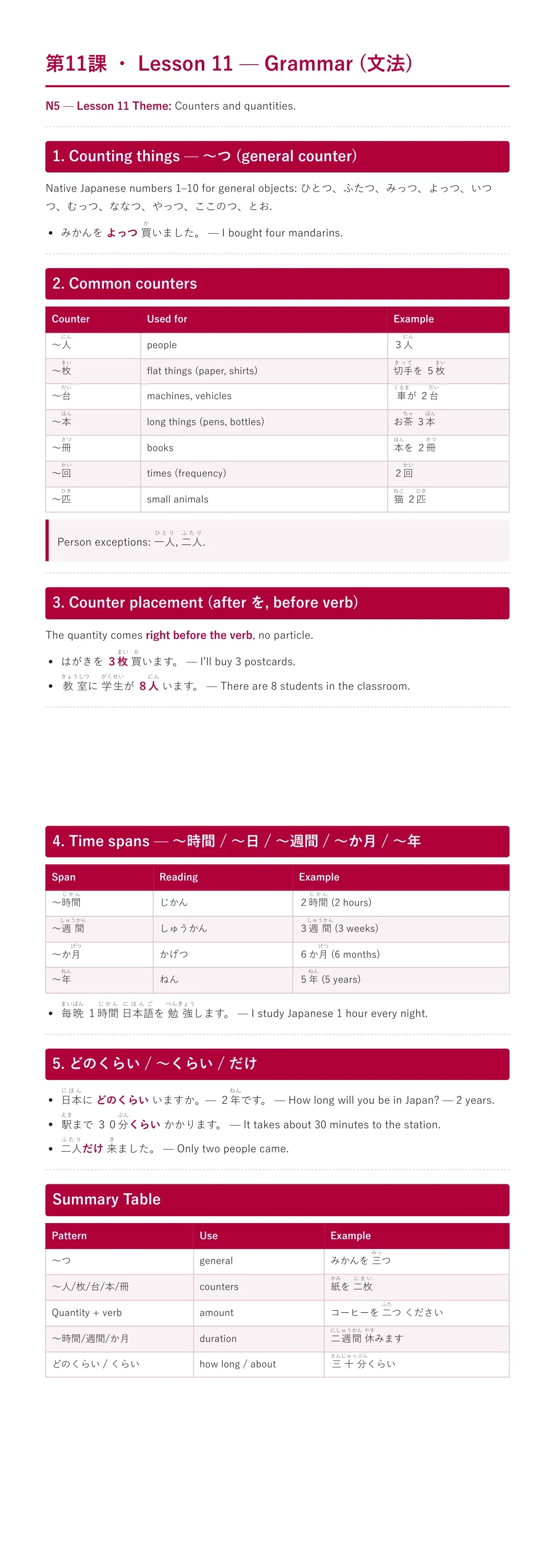
Lesson 11
Native Japanese numbers 1–10 for general objects:
Covers: Counting things — 〜つ (general counter) · Common counters · Counter placement (after を, before verb) · Time spans — 〜時間 / 〜日 / 〜週間 / 〜か月 / 〜年 · どのくらい / 〜くらい / だけ · Summary Table · Key Vocabulary (単語) · Example Sentences (例文) · Model Conversation (会話) — 郵便局で · Mini Practice (練習)
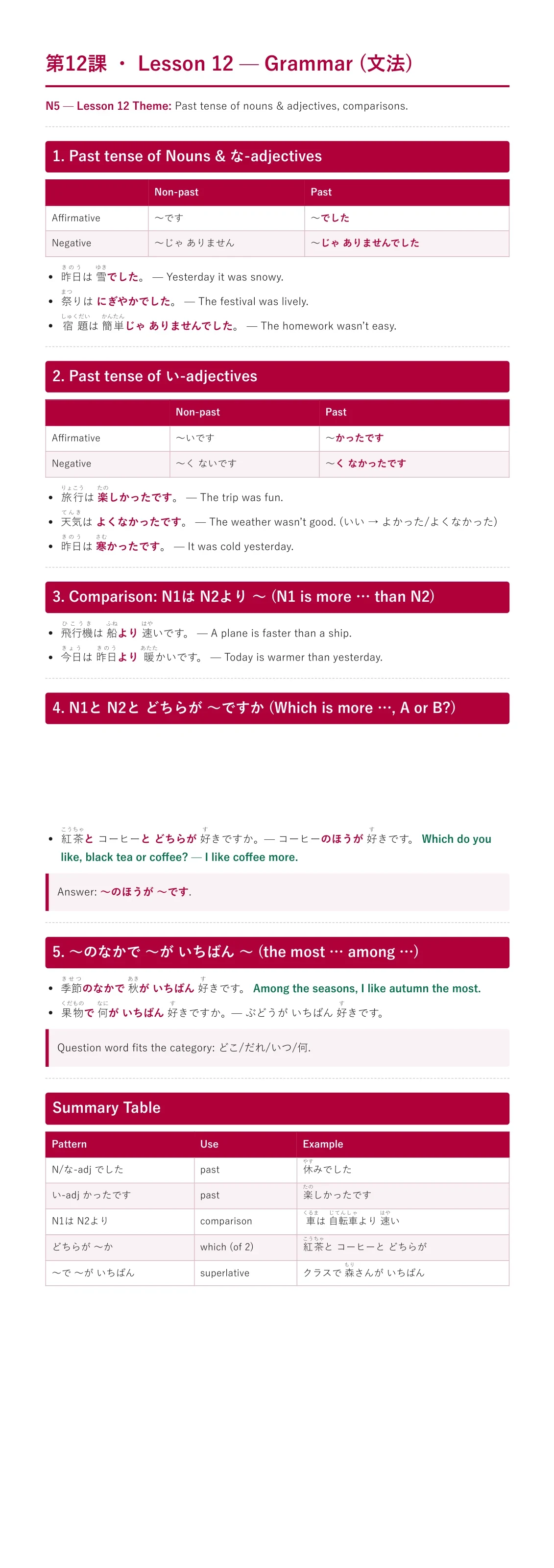
Lesson 12
A: On Saturday I went to the town's summer festival.
Covers: Past tense of Nouns & な-adjectives · Past tense of い-adjectives · Comparison: N1は N2より 〜 (N1 is more … than N2) · N1と N2と どちらが 〜ですか (Which is more …, A or B?) · 〜のなかで 〜が いちばん 〜 (the most … among …) · Summary Table · Key Vocabulary (単語) · Example Sentences (例文) · Model Conversation (会話) — 夏祭り · Mini Practice (練習)
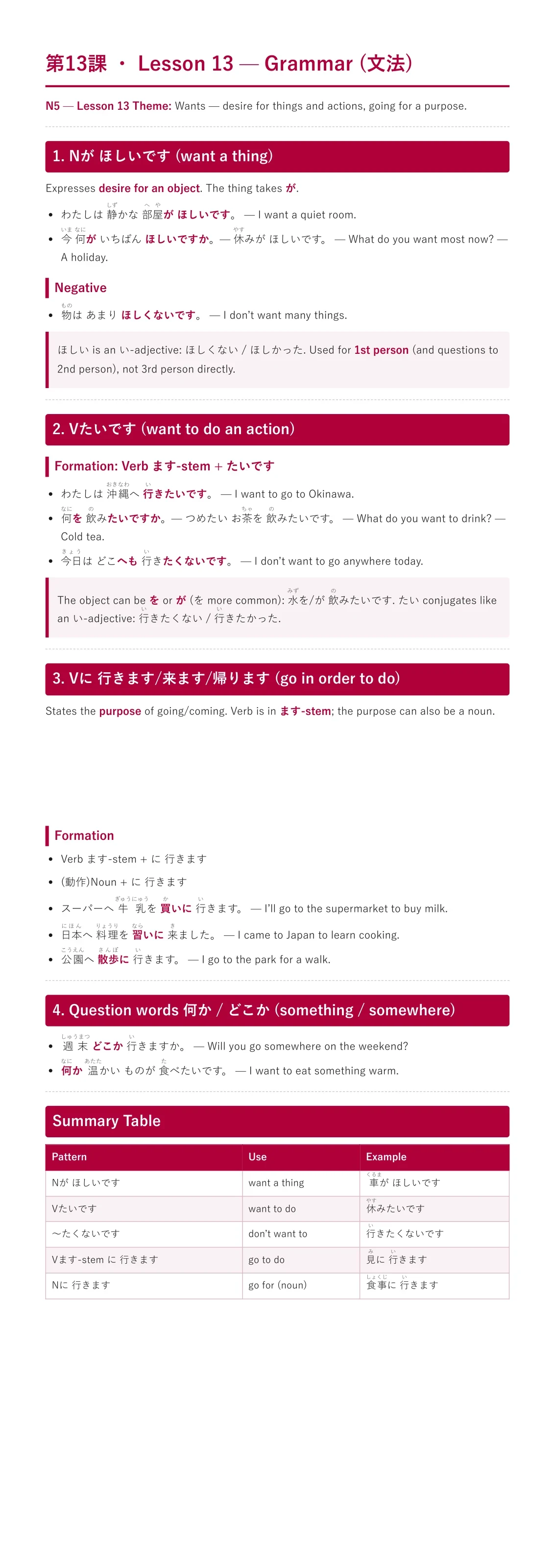
Lesson 13
Expresses desire for an object. The thing takes が.
Covers: Nが ほしいです (want a thing) · Negative · Vたいです (want to do an action) · Formation: Verb ます-stem + たいです · Vに 行きます/来ます/帰ります (go in order to do) · Formation · Summary Table · Key Vocabulary (単語) · Example Sentences (例文) · Model Conversation (会話) — 週末の計画 · Mini Practice (練習)
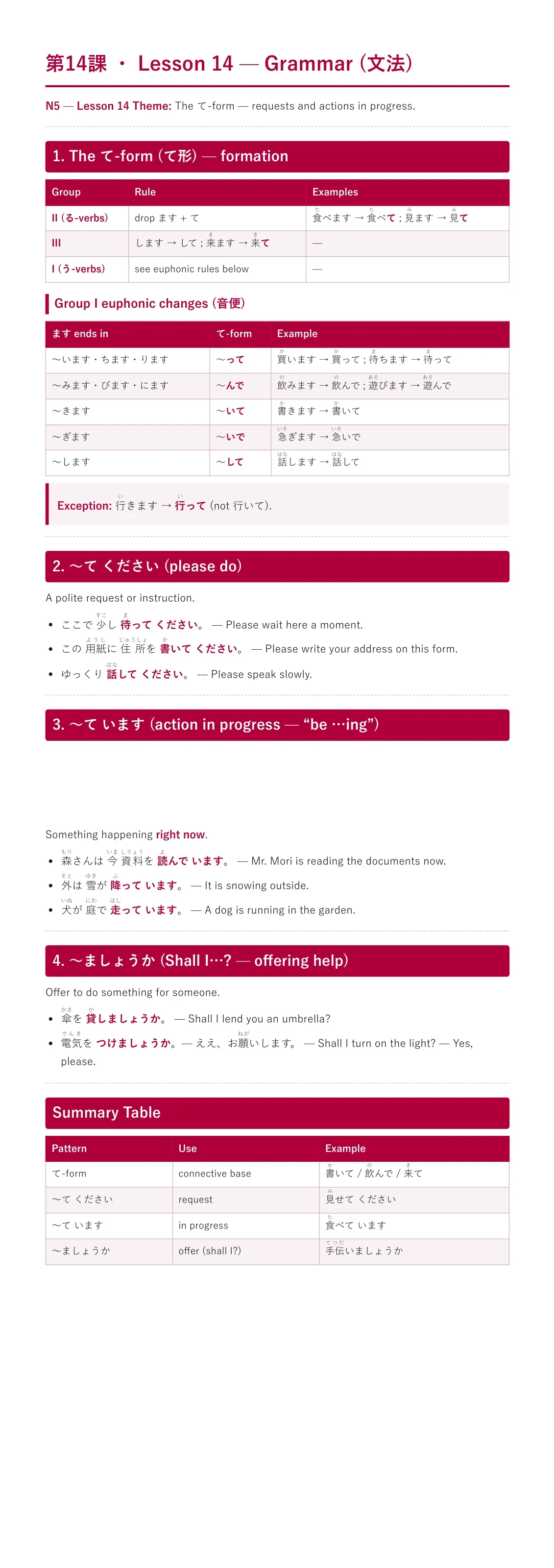
Lesson 14
A: Excuse me, I'd like to go to the library…
Covers: The て-form (て形) — formation · Group I euphonic changes (音便) · 〜て ください (please do) · 〜て います (action in progress — "be …ing") · 〜ましょうか (Shall I…? — offering help) · Summary Table · Key Vocabulary (単語) · Example Sentences (例文) · Model Conversation (会話) — 道で · Mini Practice (練習)
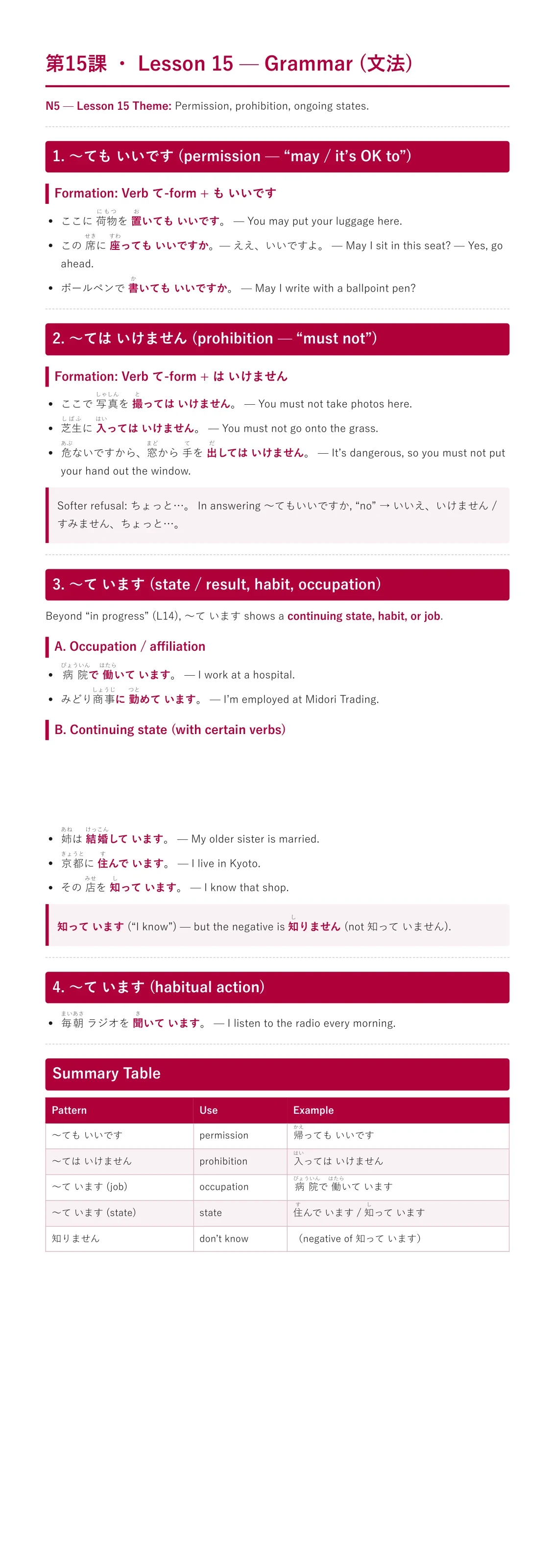
Lesson 15
Beyond "in progress" (L14), 〜て います shows a continuing state, habit, or job.
Covers: 〜ても いいです (permission — "may / it's OK to") · Formation: Verb て-form + も いいです · 〜ては いけません (prohibition — "must not") · Formation: Verb て-form + は いけません · 〜て います (state / result, habit, occupation) · A. Occupation / affiliation · B. Continuing state (with certain verbs) · 〜て います (habitual action) · Summary Table · Key Vocabulary (単語) · Example Sentences (例文) · Model Conversation (会話) — 面接 · Mini Practice (練習)
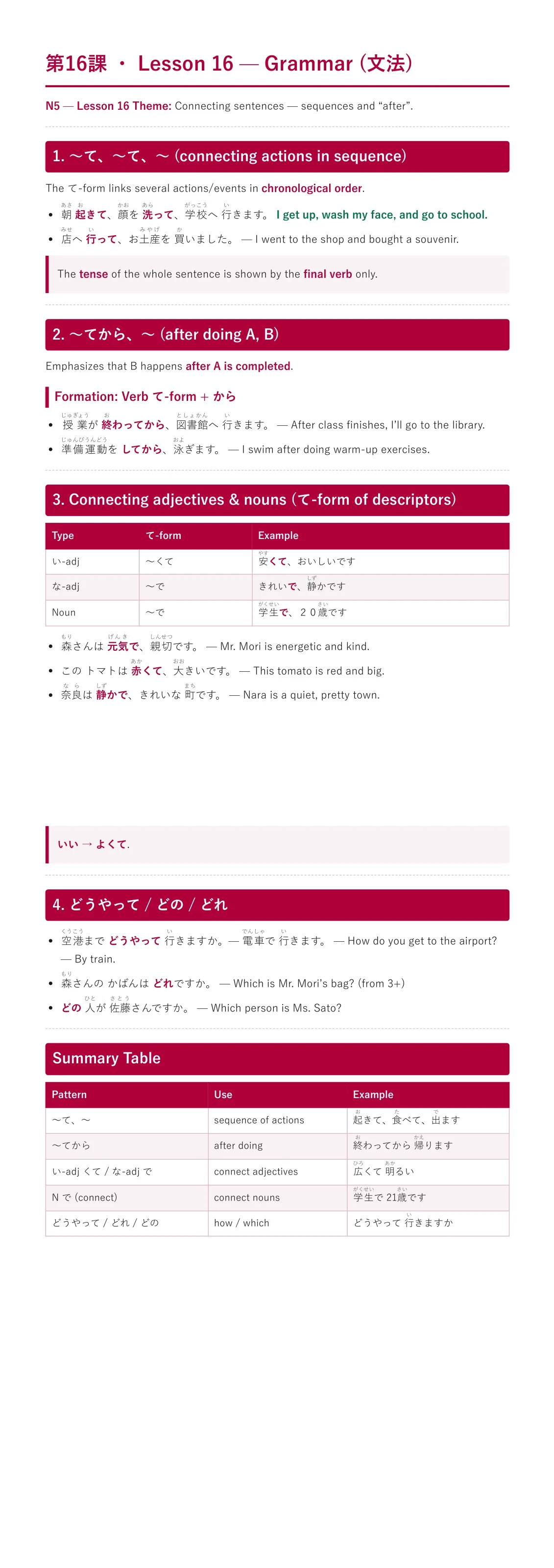
Lesson 16
The て-form links several actions/events in chronological order.
Covers: 〜て、〜て、〜 (connecting actions in sequence) · 〜てから、〜 (after doing A, B) · Formation: Verb て-form + から · Connecting adjectives & nouns (て-form of descriptors) · どうやって / どの / どれ · Summary Table · Key Vocabulary (単語) · Example Sentences (例文) · Model Conversation (会話) — 券売機の使い方 · Mini Practice (練習)
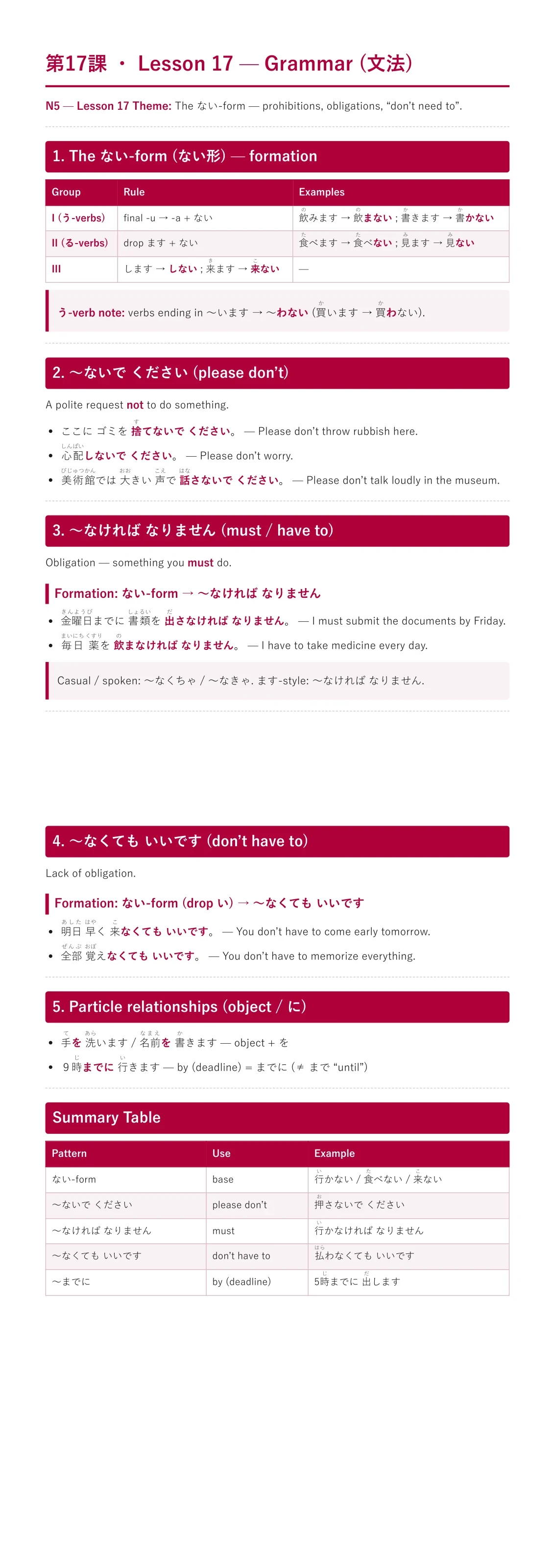
Lesson 17
A polite request not to do something.
Covers: The ない-form (ない形) — formation · 〜ないで ください (please don't) · 〜なければ なりません (must / have to) · Formation: ない-form → 〜なければ なりません · 〜なくても いいです (don't have to) · Formation: ない-form (drop い) → 〜なくても いいです · Particle relationships (object / に) · Summary Table · Key Vocabulary (単語) · Example Sentences (例文) · Model Conversation (会話) — 病院で · Mini Practice (練習)
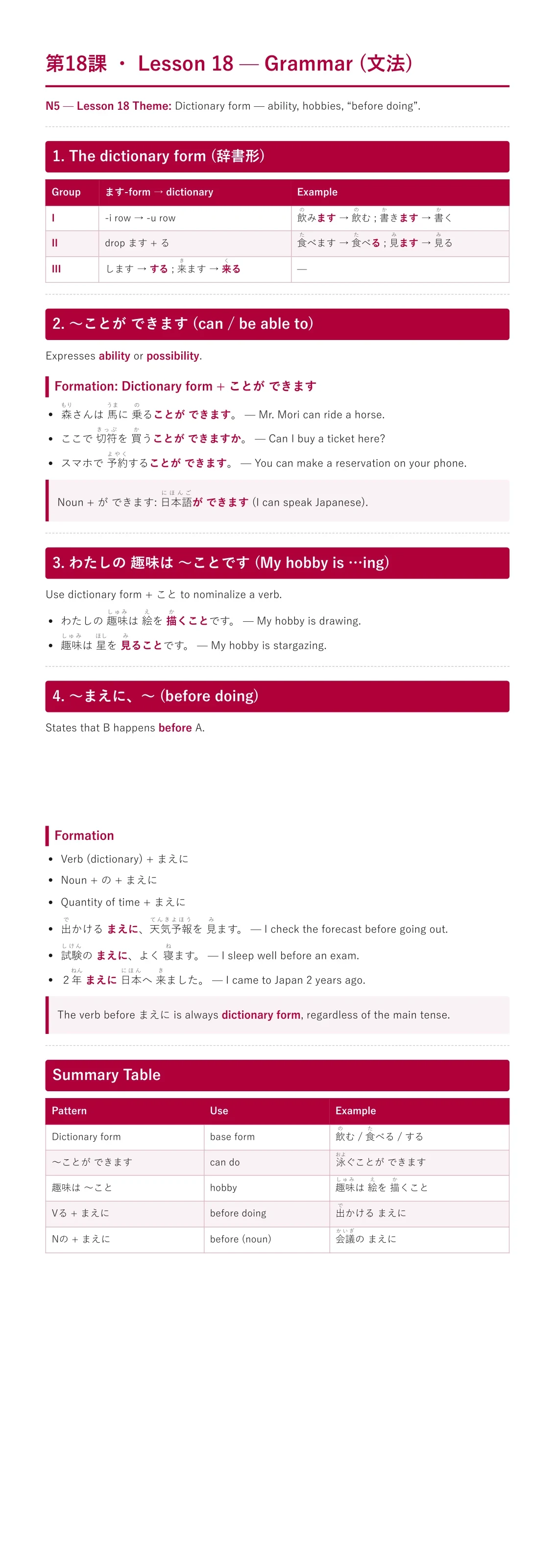
Lesson 18
Expresses ability or possibility.
Covers: The dictionary form (辞書形) · 〜ことが できます (can / be able to) · Formation: Dictionary form + ことが できます · わたしの 趣味は 〜ことです (My hobby is …ing) · 〜まえに、〜 (before doing) · Formation · Summary Table · Key Vocabulary (単語) · Example Sentences (例文) · Model Conversation (会話) — 趣味の話 · Mini Practice (練習)
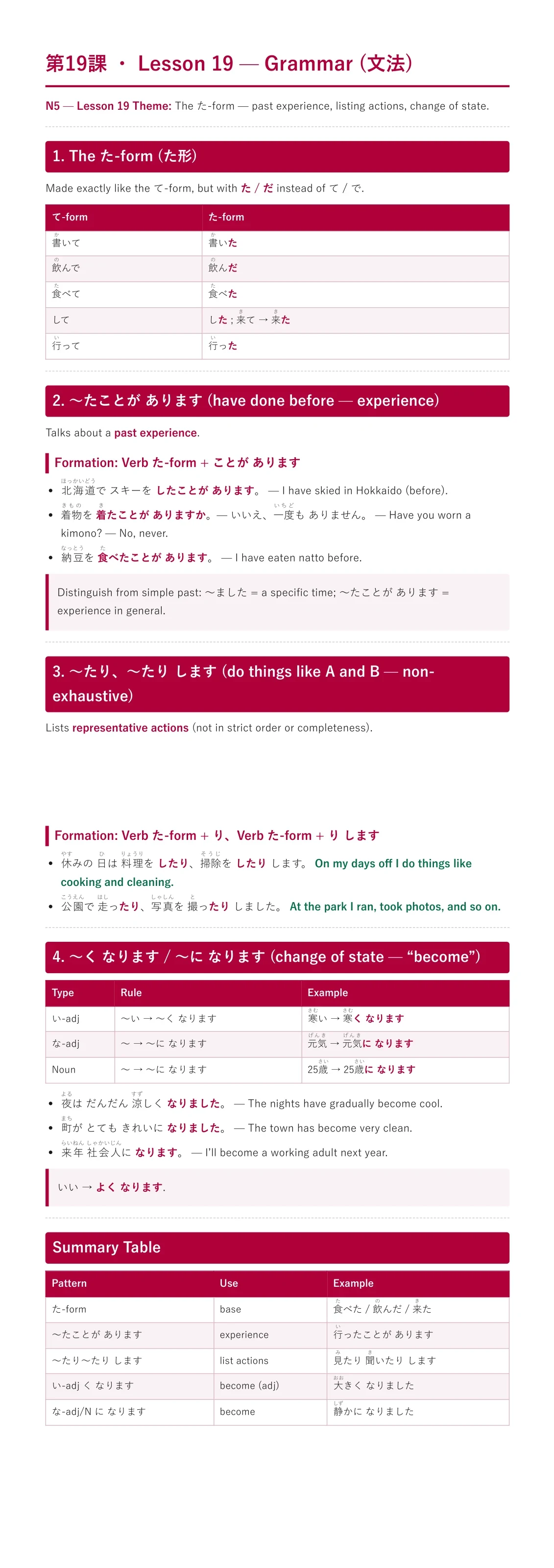
Lesson 19
Made exactly like the て-form, but with た / だ instead of て / で.
Covers: The た-form (た形) · 〜たことが あります (have done before — experience) · Formation: Verb た-form + ことが あります · 〜たり、〜たり します (do things like A and B — non-exhaustive) · Formation: Verb た-form + り、Verb た-form + り します · 〜く なります / 〜に なります (change of state — "become") · Summary Table · Key Vocabulary (単語) · Example Sentences (例文) · Model Conversation (会話) — ダイエット · Mini Practice (練習)
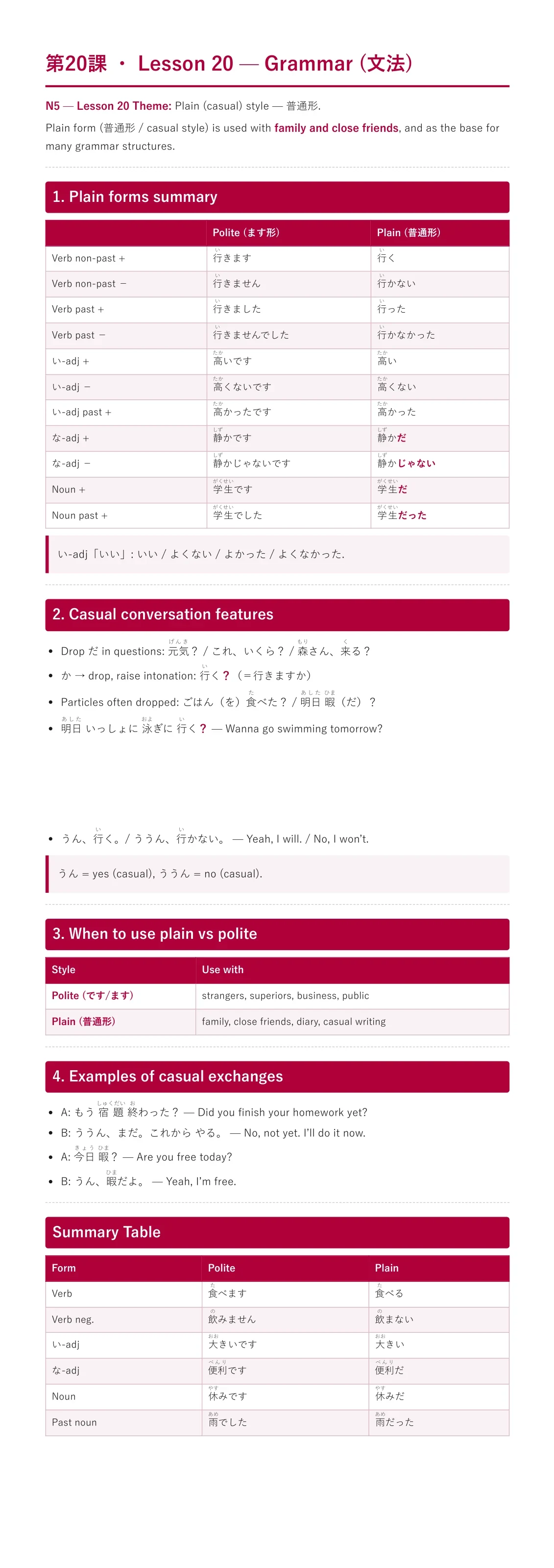
Lesson 20
Plain form (普通形 / casual style) is used with family and close friends, and as the base for many grammar structures.
Covers: Plain forms summary · Casual conversation features · When to use plain vs polite · Examples of casual exchanges · Summary Table · Key Vocabulary (単語) · Example Sentences (例文) · Model Conversation (会話) — 友達と · Mini Practice (練習)
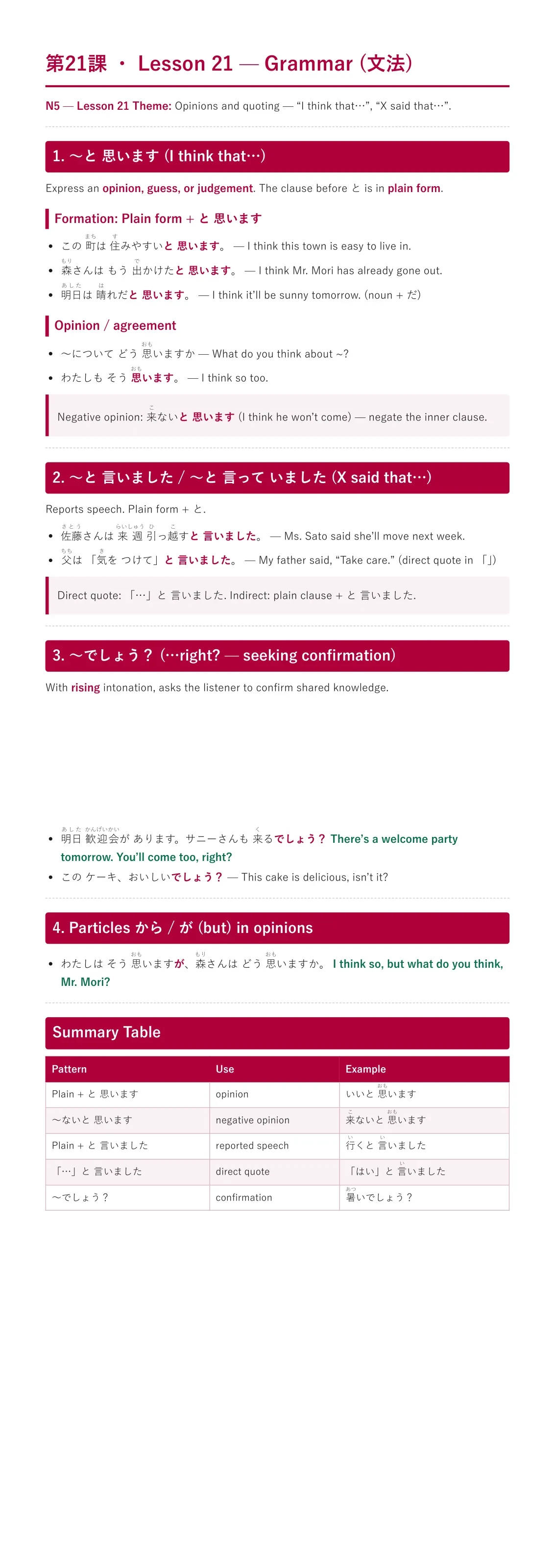
Lesson 21
Express an opinion, guess, or judgement. The clause before と is in plain form.
Covers: 〜と 思います (I think that…) · Formation: Plain form + と 思います · Opinion / agreement · 〜と 言いました / 〜と 言って いました (X said that…) · 〜でしょう? (…right? — seeking confirmation) · Particles から / が (but) in opinions · Summary Table · Key Vocabulary (単語) · Example Sentences (例文) · Model Conversation (会話) — ニュースについて · Mini Practice (練習)
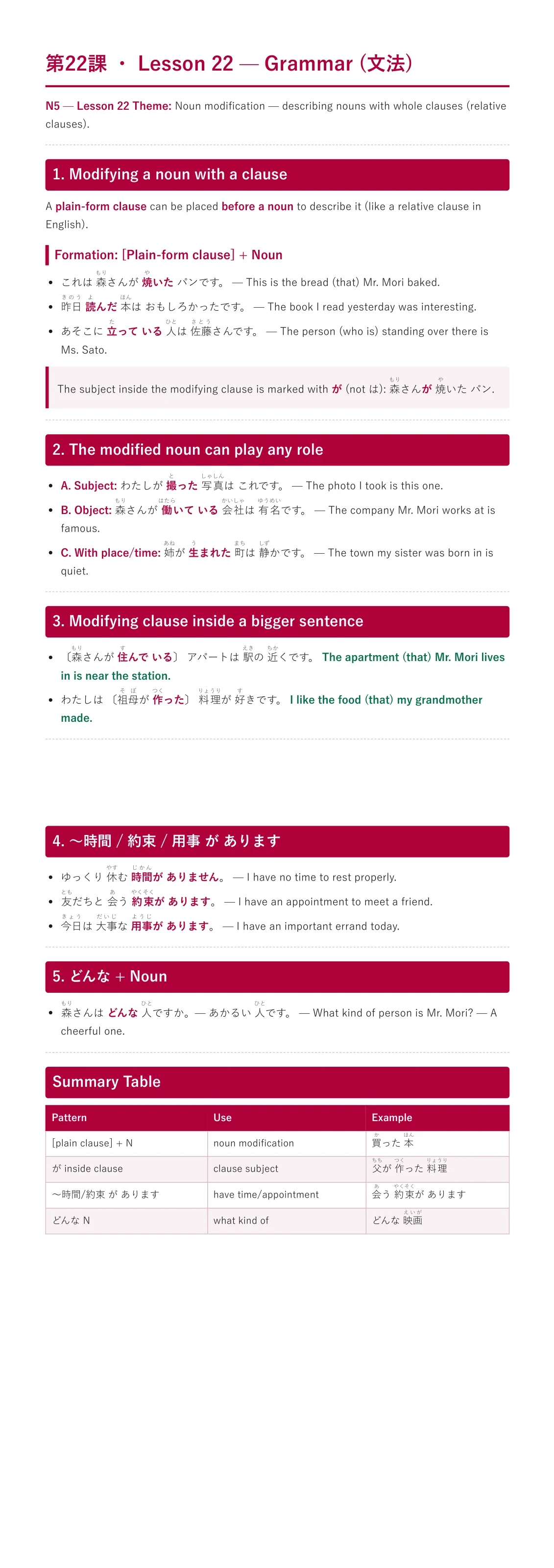
Lesson 22
A plain-form clause can be placed before a noun to describe it (like a relative clause in English).
Covers: Modifying a noun with a clause · Formation: [Plain-form clause] + Noun · The modified noun can play any role · Modifying clause inside a bigger sentence · 〜時間 / 約束 / 用事 が あります · どんな + Noun · Summary Table · Key Vocabulary (単語) · Example Sentences (例文) · Model Conversation (会話) — 写真を見ながら · Mini Practice (練習)
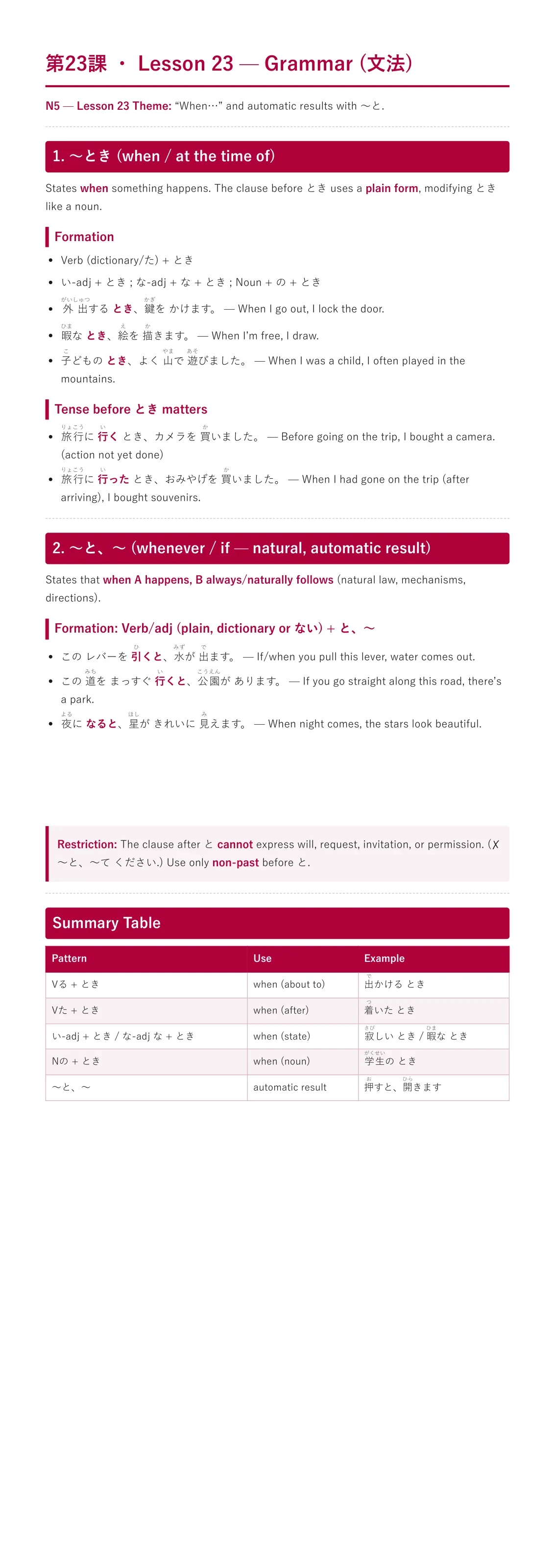
Lesson 23
States when something happens. The clause before とき uses a plain form, modifying とき like a noun.
Covers: 〜とき (when / at the time of) · Formation · Tense before とき matters · 〜と、〜 (whenever / if — natural, automatic result) · Formation: Verb/adj (plain, dictionary or ない) + と、〜 · Summary Table · Key Vocabulary (単語) · Example Sentences (例文) · Model Conversation (会話) — 道を聞く · Mini Practice (練習)
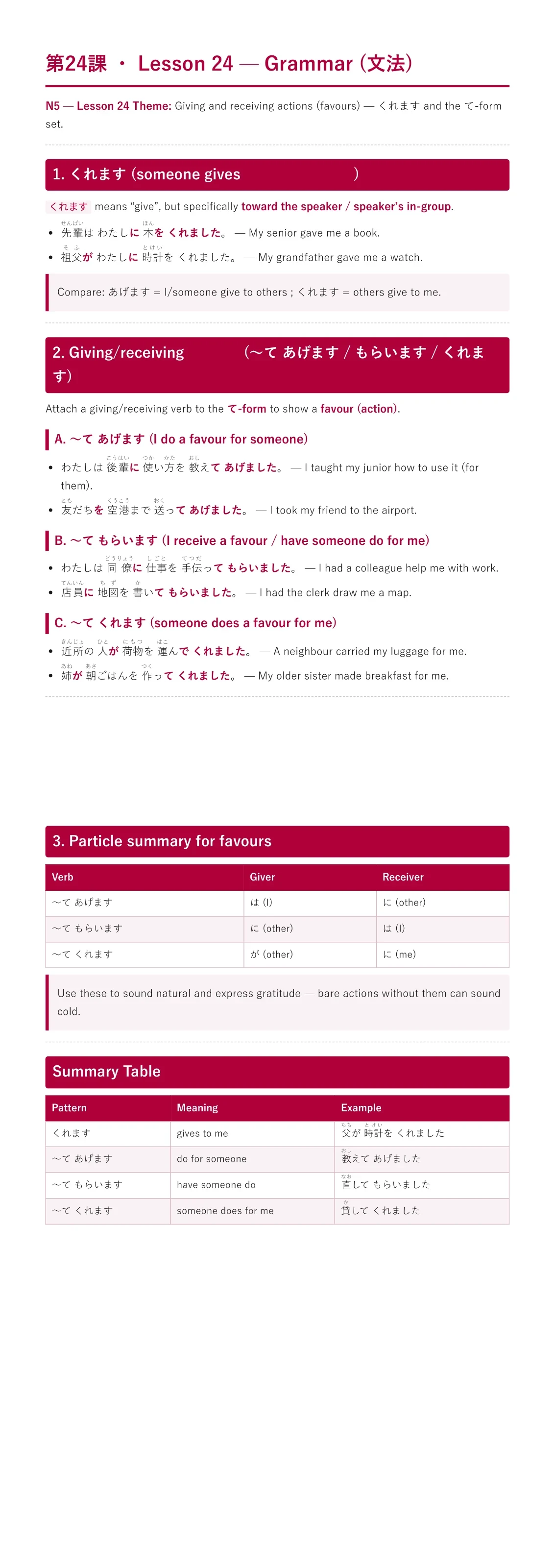
Lesson 24
Attach a giving/receiving verb to the て-form to show a favour (action).
Covers: くれます (someone gives to me / my side) · Giving/receiving actions (〜て あげます / もらいます / くれます) · A. 〜て あげます (I do a favour for someone) · B. 〜て もらいます (I receive a favour / have someone do for me) · C. 〜て くれます (someone does a favour for me) · Particle summary for favours · Summary Table · Key Vocabulary (単語) · Example Sentences (例文) · Model Conversation (会話) — ホームステイ · Mini Practice (練習)
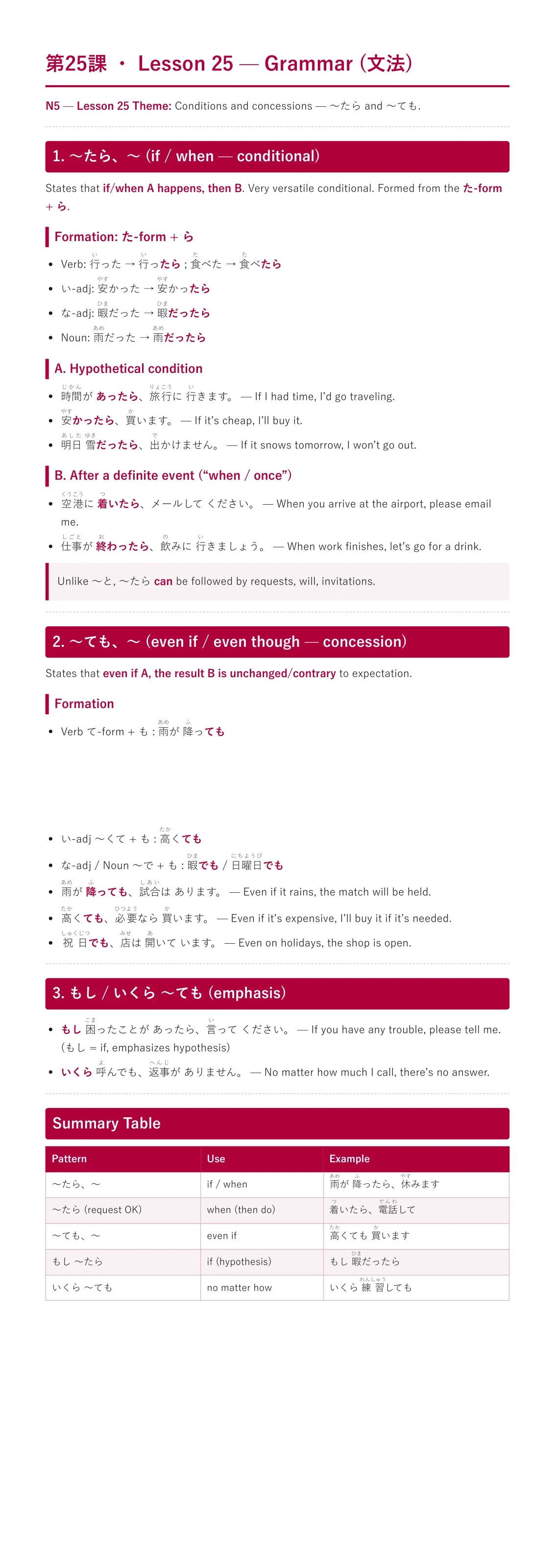
Lesson 25
States that if/when A happens, then B. Very versatile conditional. Formed from the た-form + ら.
Covers: 〜たら、〜 (if / when — conditional) · Formation: た-form + ら · A. Hypothetical condition · B. After a definite event ("when / once") · 〜ても、〜 (even if / even though — concession) · Formation · もし / いくら 〜ても (emphasis) · Summary Table · Key Vocabulary (単語) · Example Sentences (例文) · Model Conversation (会話) — 送別会 · Mini Practice (練習)