
JLPT N2 notes prepared and maintained by the NihongoDoya Editorial Team.
Lesson summaries and study cards last reviewed 17 July 2026. These are independent learning materials, not official examination content. Report a correction.
Introduction
This page covers JLPT N2 grammar by function, combining the comprehensive grammar track's functional units (lessons 1–13) with the weekly-summary track 8-week set (lessons 14–21). N2 adds many formal and written patterns, so each card includes formation, confusable-grammar (比較) tables, a short reading and exam-style practice.
What you will learn
- Time & occasion: 〜際, 〜にあたって, 〜か〜ないかのうちに, 〜次第
- Cause & basis: 〜ことから, 〜だけに, 〜だけあって, 〜以上
- Condition & concession: 〜ない限り, 〜ものなら, 〜ものの, 〜にもかかわらず
- Potential & tendency: 〜きる, 〜得る, 〜かねる, 〜かねない, 〜つつある, 〜がち
- Conjecture: 〜に違いない, 〜に決まっている, 〜恐れがある, 〜かのようだ
- Viewpoint: 〜にとって, 〜として, 〜において, 〜に応じて, 〜に伴って
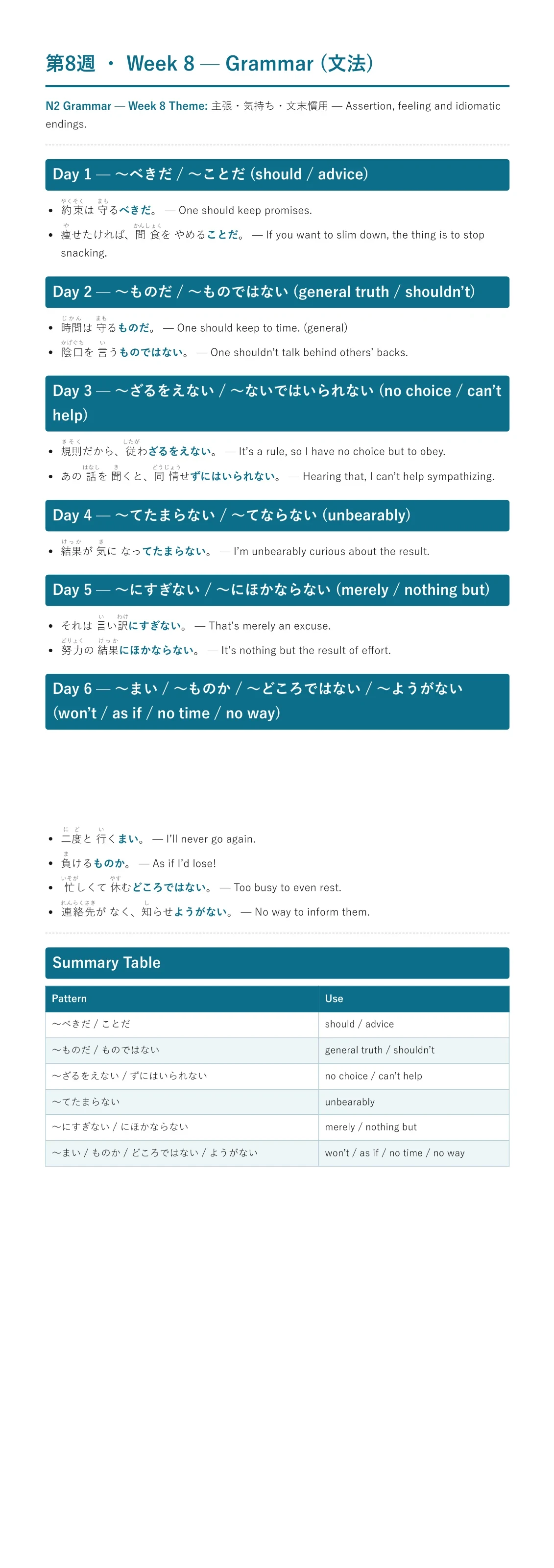
- Assertion & endings: 〜べきだ, 〜ざるをえない, 〜にすぎない, 〜どころではない
Who this level is for
Best for learners who have cleared N3 and want upper-intermediate grammar, including the formal written patterns common in the JLPT N2 reading section.
A study cycle for N2 grammar
- Read the functional unit and flag the formal / written-only patterns.
- Separate nuance-heavy pairs (かねる/かねない, だけに/だけあって) with the 比較 table.
- Drill the connection rules — N2 patterns attach to specific forms.
- Read the example 読解 passage aloud to absorb the formal register.
- Test yourself with the practice items before moving to the next unit.
Common mistakes to avoid
- Confusing 〜かねる (can't) with 〜かねない (might, badly).
- Using 〜だけに (all the more) where 〜だけあって (as expected of) is meant.
- Forgetting that 〜得る / 〜得ない are read うる / えない / えます.
- Treating formal patterns (〜にもかかわらず, 〜ものの) as casual speech.
Related study materials
Build a joined-up study cycle by combining this page with the matching JLPT N2 grammar guide and the JLPT N2 Japanese word list.
Frequently asked questions
How much harder is N2 grammar than N3?
N2 roughly doubles the formal and written patterns and adds nuance-heavy pairs (かねる/かねない, だけに/だけあって). The 比較 tables on each card are built to separate them.
How are the two books combined here?
Lessons 1–13 are the comprehensive grammar track's functional units; lessons 14–21 are the weekly-summary track 8-week plan. They cover the same N2 grammar from two angles.
Do I need N2 grammar for work in Japan?
Many employers treat N2 as a working benchmark. The viewpoint and assertion patterns here (〜として, 〜べきだ, 〜ざるをえない) appear constantly in business Japanese.
How should I practise for the N2 grammar section?
Use the practice questions on each card, then read the short 読解 passage to see the patterns in context.
What should I do after finishing this level?
Move to the JLPT N1 grammar guide for the most formal and literary patterns (〜が早いか, 〜をおいて, 〜ざるを得ない).
JLPT N2 lesson-by-lesson syllabus
Every lesson on this page includes handwritten study cards with full written explanations. Here is what each lesson covers:
Lesson 1
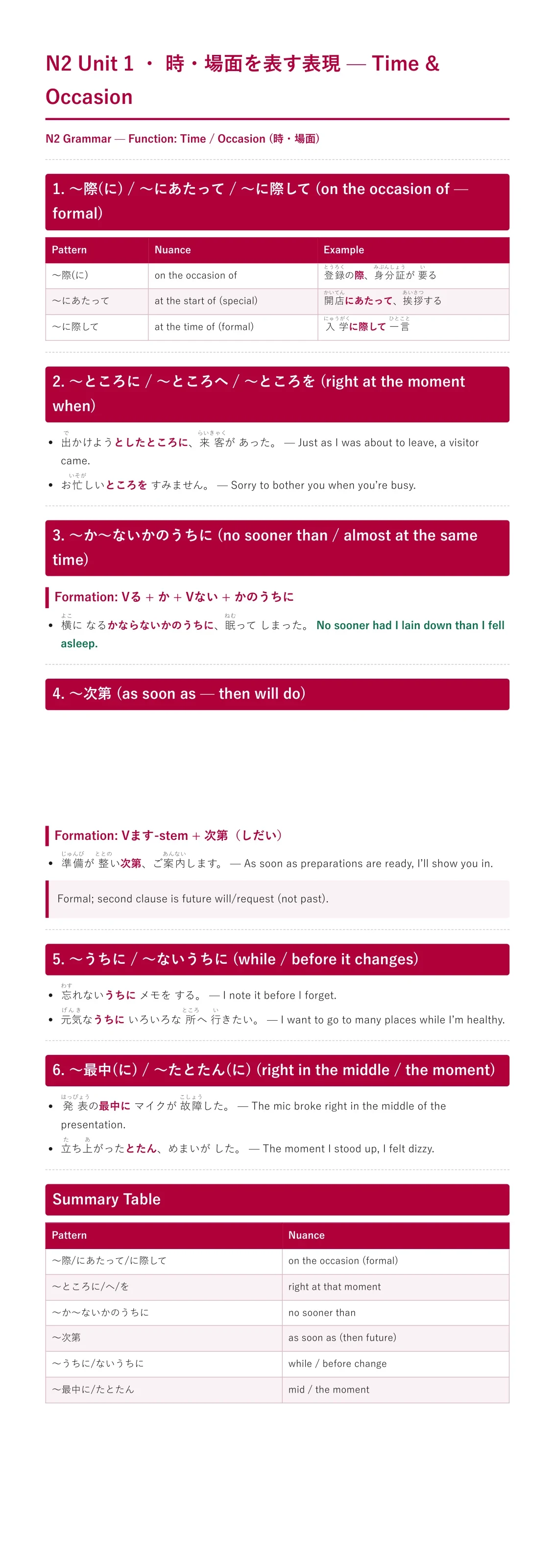
Covers: 〜際(に) / 〜にあたって / 〜に際して (on the occasion of — formal) · 〜ところに / 〜ところへ / 〜ところを (right at the moment when) · 〜か〜ないかのうちに (no sooner than / almost at the same time) · Formation: Vる + か + Vない + かのうちに · 〜次第 (as soon as — then will do) · Formation: Vます-stem + 次第(しだい) · 〜うちに / 〜ないうちに (while / before it changes) · 〜最中(に) / 〜たとたん(に) (right in the middle / the moment) · Summary Table · Quick reference (接続) · Example Sentences (例文) · Short Reading (読解) · Practice (練習) · Mini Production (作文)
Lesson 2
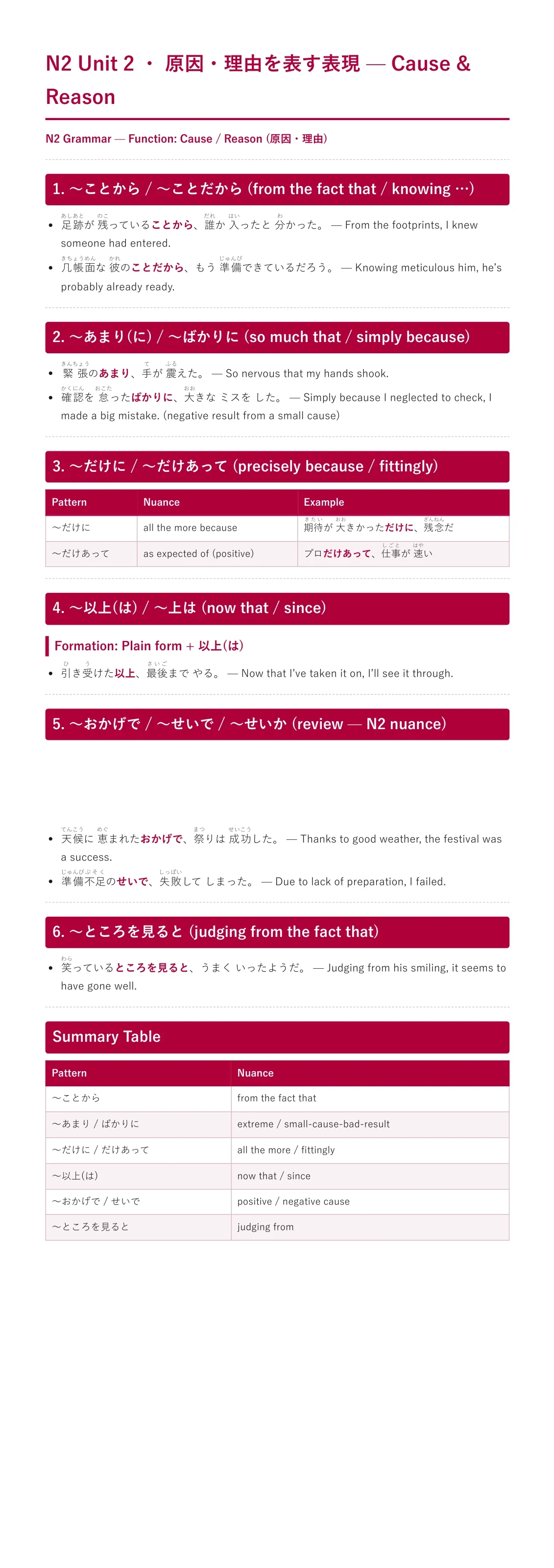
Covers: 〜ことから / 〜ことだから (from the fact that / knowing …) · 〜あまり(に) / 〜ばかりに (so much that / simply because) · 〜だけに / 〜だけあって (precisely because / fittingly) · 〜以上(は) / 〜上は (now that / since) · Formation: Plain form + 以上(は) · 〜おかげで / 〜せいで / 〜せいか (review — N2 nuance) · 〜ところを見ると (judging from the fact that) · Summary Table · Quick reference (接続) · Example Sentences (例文) · Short Reading (読解) · Practice (練習) · だけに vs だけあって drill · Mini Production (作文)
Lesson 3
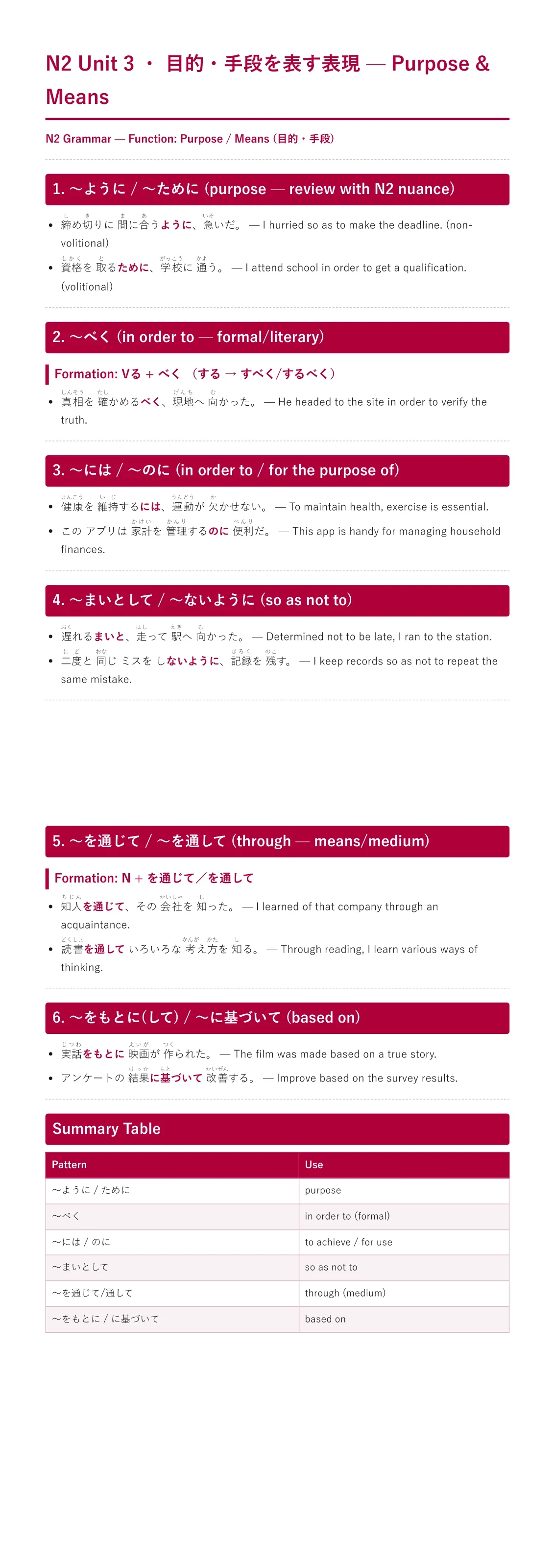
Covers: 〜ように / 〜ために (purpose — review with N2 nuance) · 〜べく (in order to — formal/literary) · Formation: Vる + べく (する → すべく/するべく) · 〜には / 〜のに (in order to / for the purpose of) · 〜まいとして / 〜ないように (so as not to) · 〜を通じて / 〜を通して (through — means/medium) · Formation: N + を通じて/を通して · 〜をもとに(して) / 〜に基づいて (based on) · Summary Table · Quick reference (接続) · Example Sentences (例文) · Short Reading (読解) · Practice (練習) · Mini Production (作文)
Lesson 4
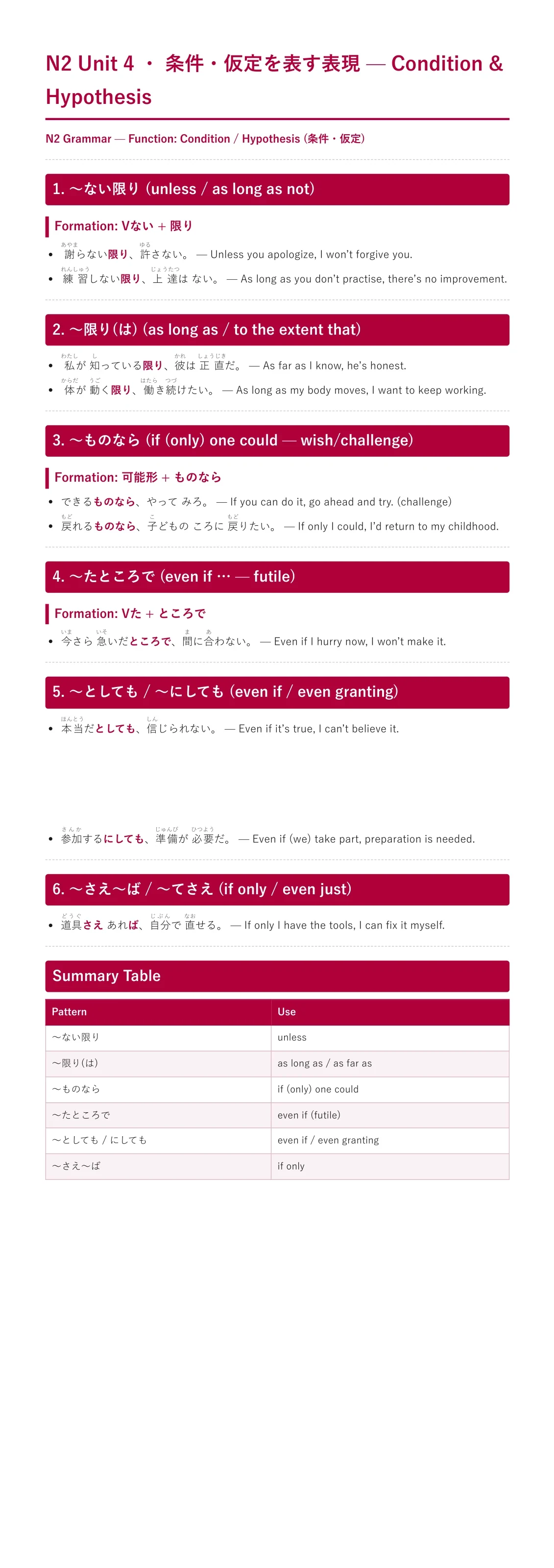
Covers: 〜ない限り (unless / as long as not) · Formation: Vない + 限り · 〜限り(は) (as long as / to the extent that) · 〜ものなら (if (only) one could — wish/challenge) · Formation: 可能形 + ものなら · 〜たところで (even if … — futile) · Formation: Vた + ところで · 〜としても / 〜にしても (even if / even granting) · 〜さえ〜ば / 〜てさえ (if only / even just) · Summary Table · Quick reference (接続) · Example Sentences (例文) · Short Reading (読解) · Practice (練習) · Mini Production (作文)
Lesson 5
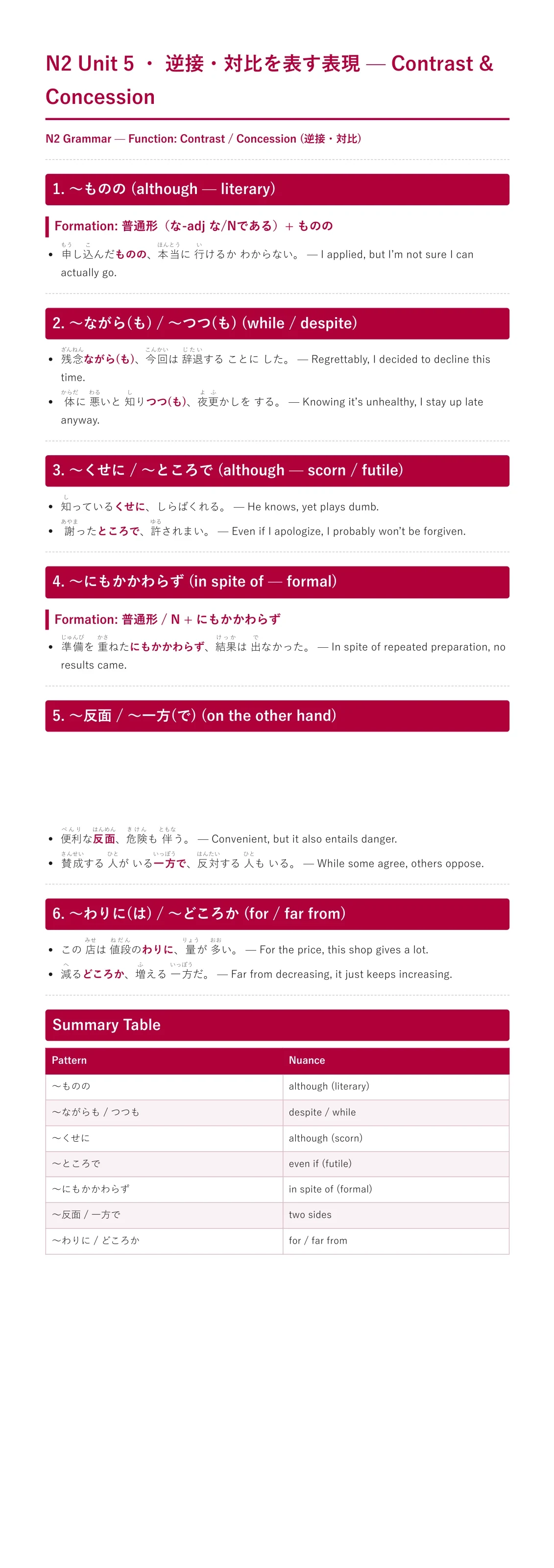
Covers: 〜ものの (although — literary) · Formation: 普通形(な-adj な/Nである)+ ものの · 〜ながら(も) / 〜つつ(も) (while / despite) · 〜くせに / 〜ところで (although — scorn / futile) · 〜にもかかわらず (in spite of — formal) · Formation: 普通形 / N + にもかかわらず · 〜反面 / 〜一方(で) (on the other hand) · 〜わりに(は) / 〜どころか (for / far from) · Summary Table · Quick reference (ニュアンス) · Example Sentences (例文) · Short Reading (読解) · Practice (練習) · Mini Production (作文)
Lesson 6
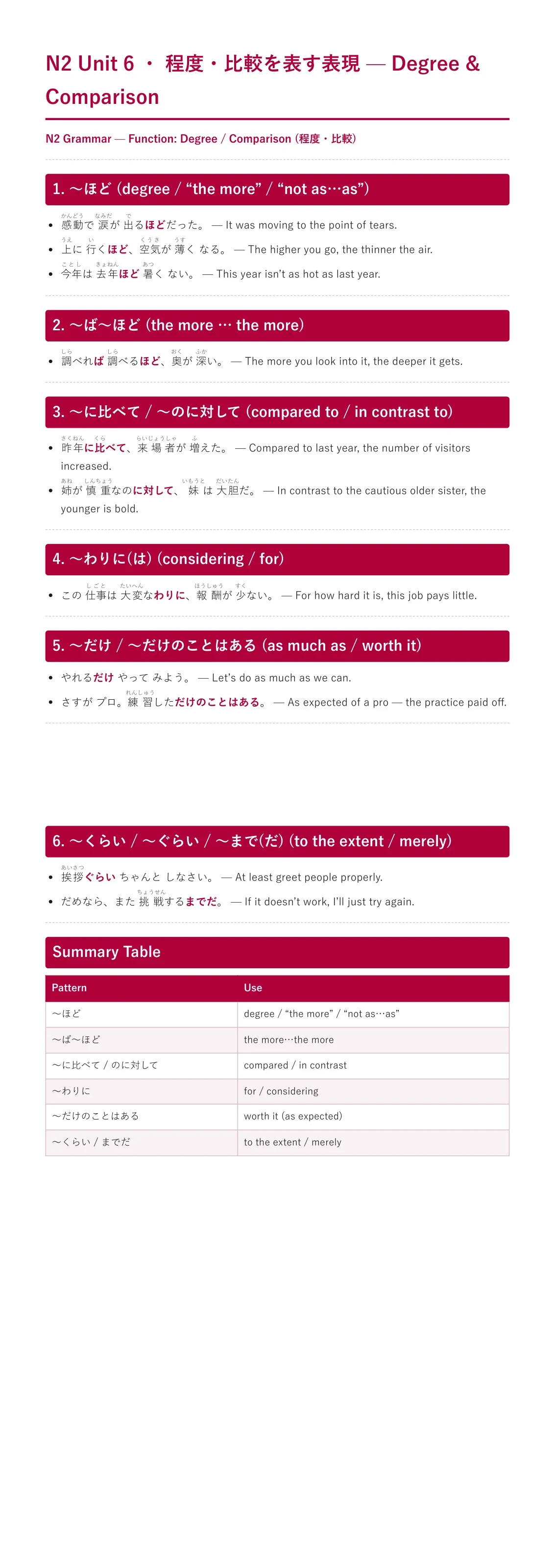
Covers: 〜ほど (degree / "the more" / "not as…as") · 〜ば〜ほど (the more … the more) · 〜に比べて / 〜のに対して (compared to / in contrast to) · 〜わりに(は) (considering / for) · 〜だけ / 〜だけのことはある (as much as / worth it) · 〜くらい / 〜ぐらい / 〜まで(だ) (to the extent / merely) · Summary Table · Quick reference (接続) · Example Sentences (例文) · Short Reading (読解) · Practice (練習) · Mini Production (作文)
Lesson 7
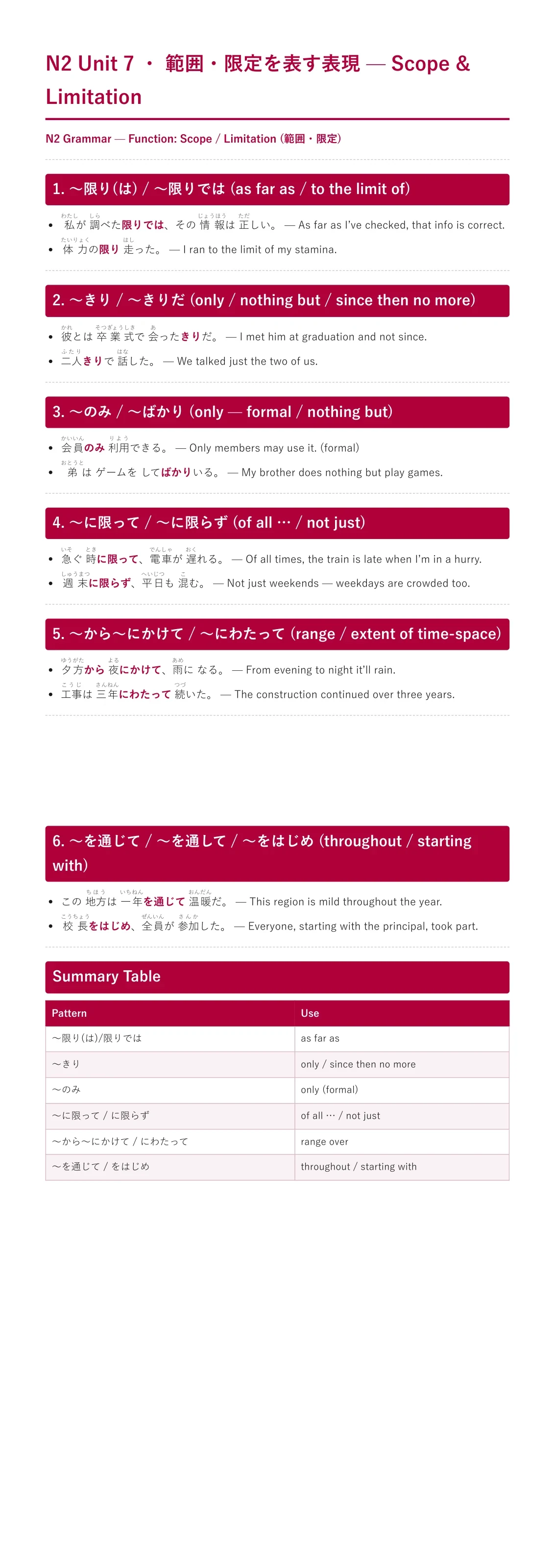
Covers: 〜限り(は) / 〜限りでは (as far as / to the limit of) · 〜きり / 〜きりだ (only / nothing but / since then no more) · 〜のみ / 〜ばかり (only — formal / nothing but) · 〜に限って / 〜に限らず (of all … / not just) · 〜から〜にかけて / 〜にわたって (range / extent of time-space) · 〜を通じて / 〜を通して / 〜をはじめ (throughout / starting with) · Summary Table · Quick reference (接続) · Example Sentences (例文) · Short Reading (読解) · Practice (練習) · Mini Production (作文)
Lesson 8
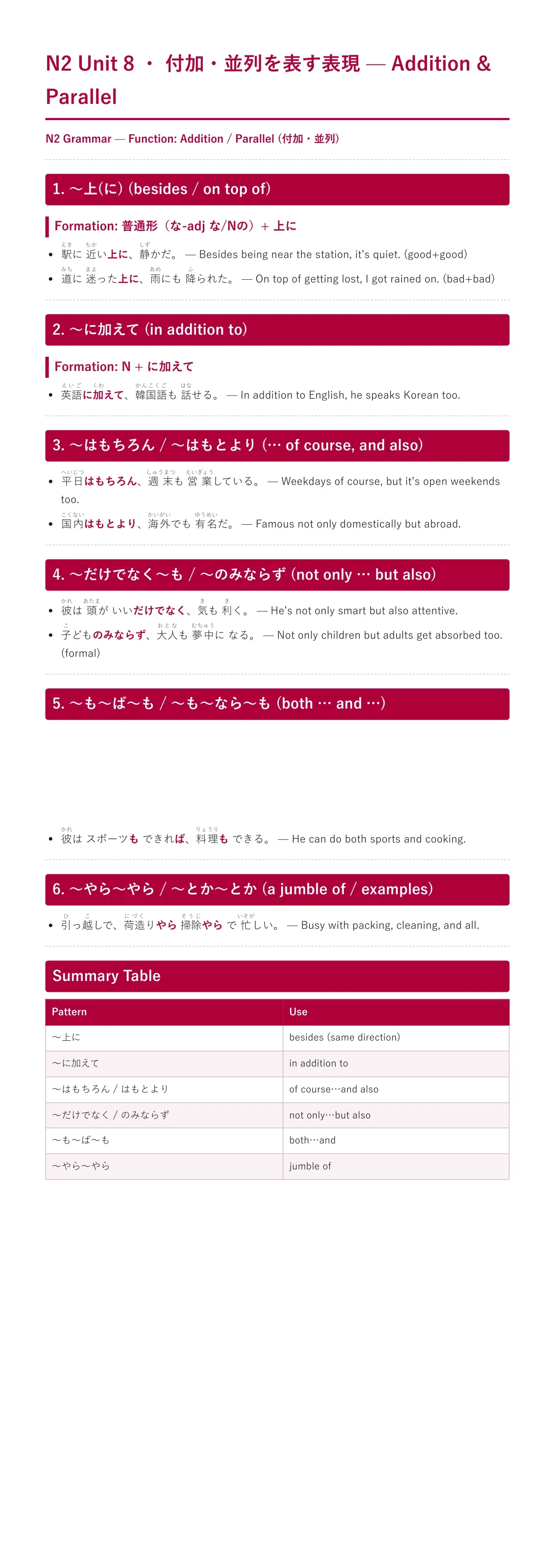
Covers: 〜上(に) (besides / on top of) · Formation: 普通形(な-adj な/Nの)+ 上に · 〜に加えて (in addition to) · Formation: N + に加えて · 〜はもちろん / 〜はもとより (… of course, and also) · 〜だけでなく〜も / 〜のみならず (not only … but also) · 〜も〜ば〜も / 〜も〜なら〜も (both … and …) · 〜やら〜やら / 〜とか〜とか (a jumble of / examples) · Summary Table · Quick reference (接続) · Example Sentences (例文) · Short Reading (読解) · Practice (練習) · Mini Production (作文)
Lesson 9
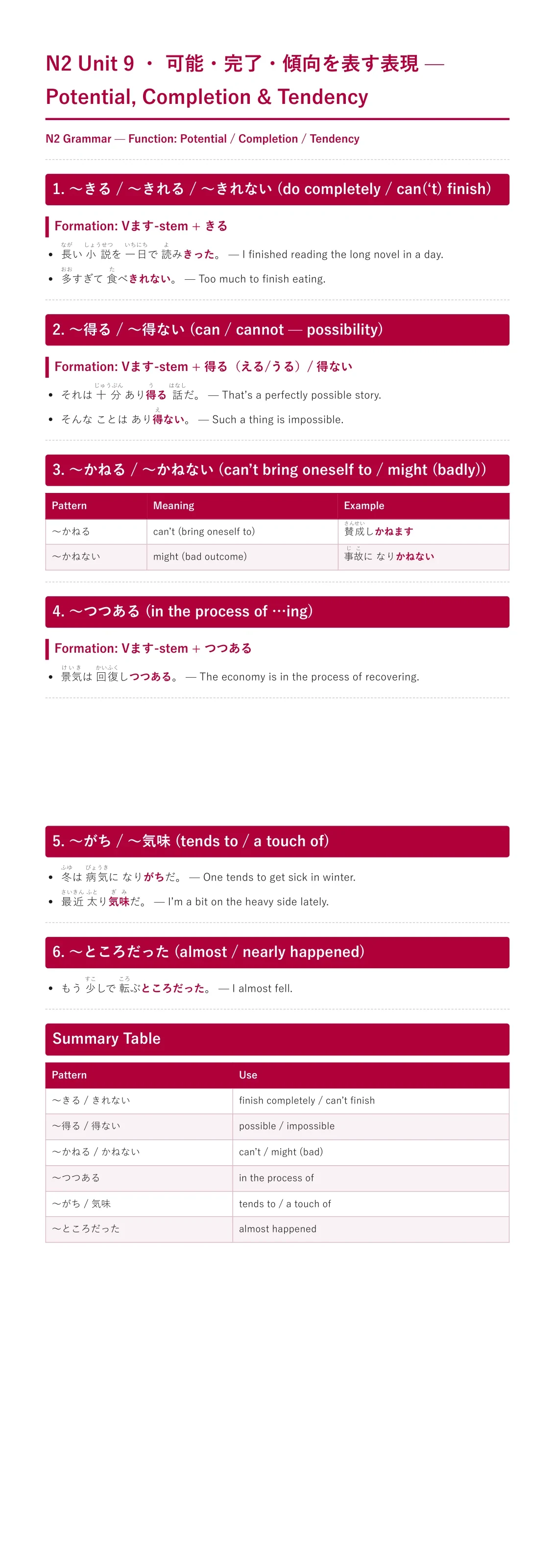
Covers: 〜きる / 〜きれる / 〜きれない (do completely / can('t) finish) · Formation: Vます-stem + きる · 〜得る / 〜得ない (can / cannot — possibility) · Formation: Vます-stem + 得る(える/うる)/ 得ない · 〜かねる / 〜かねない (can't bring oneself to / might (badly)) · 〜つつある (in the process of …ing) · Formation: Vます-stem + つつある · 〜がち / 〜気味 (tends to / a touch of) · 〜ところだった (almost / nearly happened) · Summary Table · Quick reference (接続) · Example Sentences (例文) · Short Reading (読解) · Practice (練習) · かねる vs かねない drill · Mini Production (作文)
Lesson 10
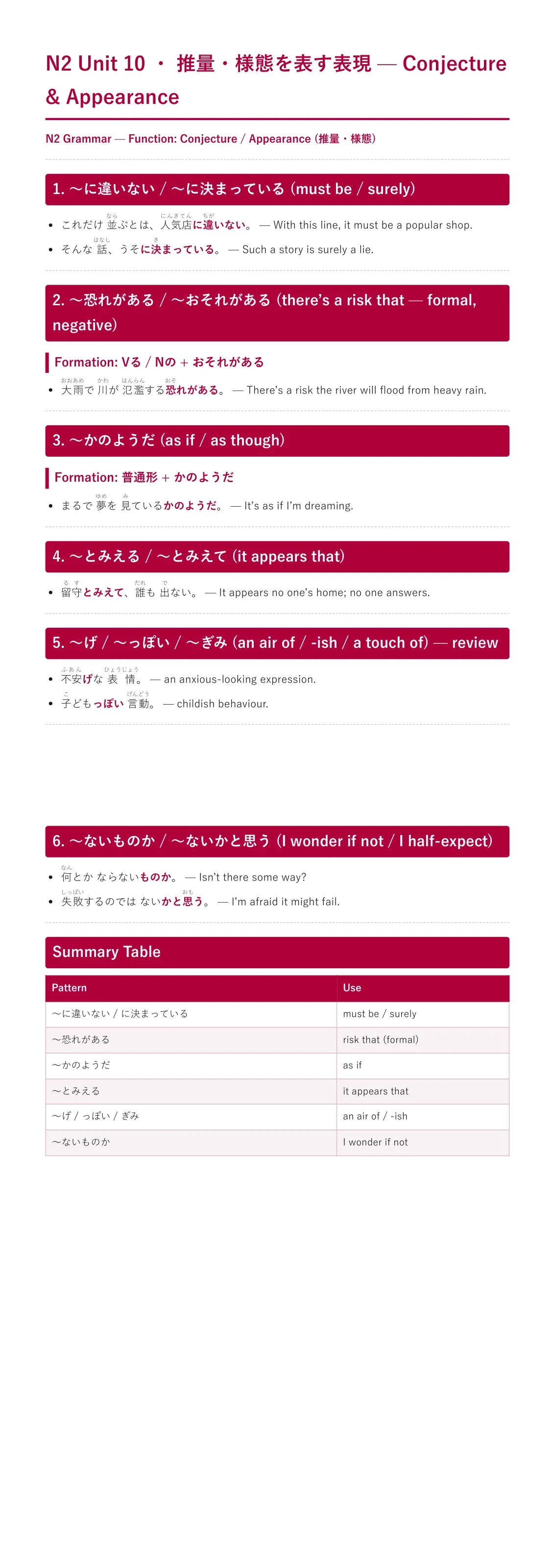
Covers: 〜に違いない / 〜に決まっている (must be / surely) · 〜恐れがある / 〜おそれがある (there's a risk that — formal, negative) · Formation: Vる / Nの + おそれがある · 〜かのようだ (as if / as though) · Formation: 普通形 + かのようだ · 〜とみえる / 〜とみえて (it appears that) · 〜げ / 〜っぽい / 〜ぎみ (an air of / -ish / a touch of) — review · 〜ないものか / 〜ないかと思う (I wonder if not / I half-expect) · Summary Table · Quick reference (接続) · Example Sentences (例文) · Short Reading (読解) · Practice (練習) · Mini Production (作文)
Lesson 11
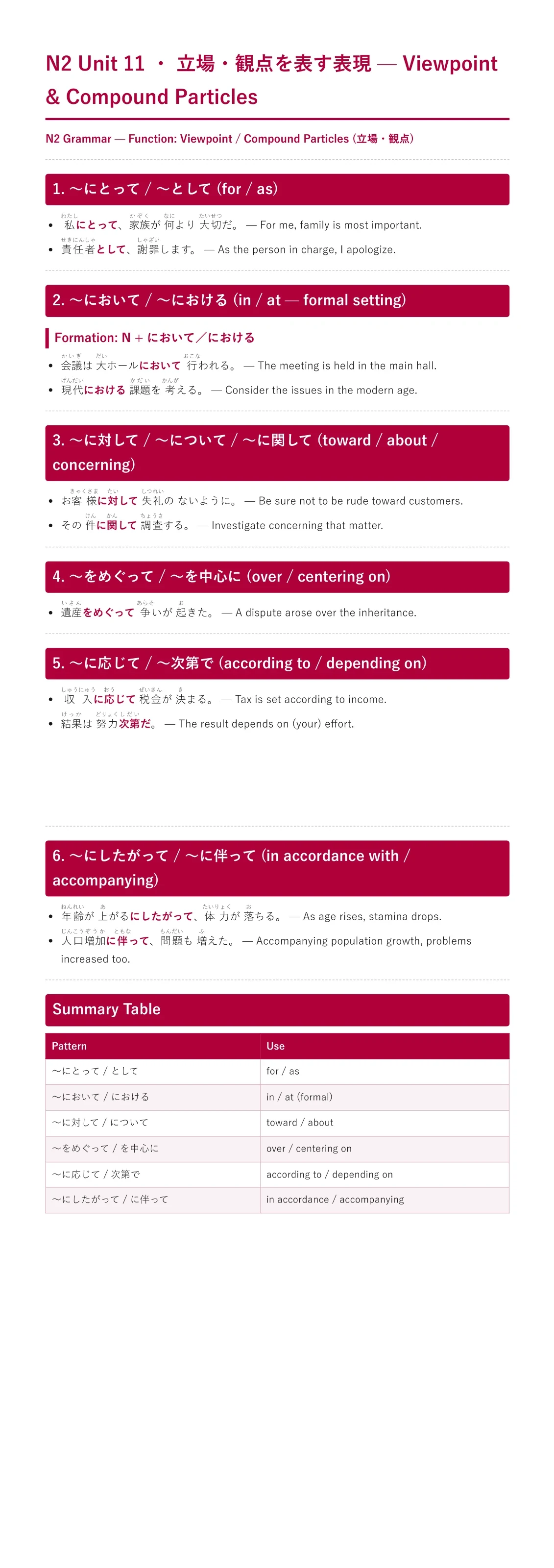
Covers: 〜にとって / 〜として (for / as) · 〜において / 〜における (in / at — formal setting) · Formation: N + において/における · 〜に対して / 〜について / 〜に関して (toward / about / concerning) · 〜をめぐって / 〜を中心に (over / centering on) · 〜に応じて / 〜次第で (according to / depending on) · 〜にしたがって / 〜に伴って (in accordance with / accompanying) · Summary Table · Quick reference (all attach to a Noun) · Example Sentences (例文) · Short Reading (読解) · Practice (練習) · Mini Production (作文)
Lesson 12
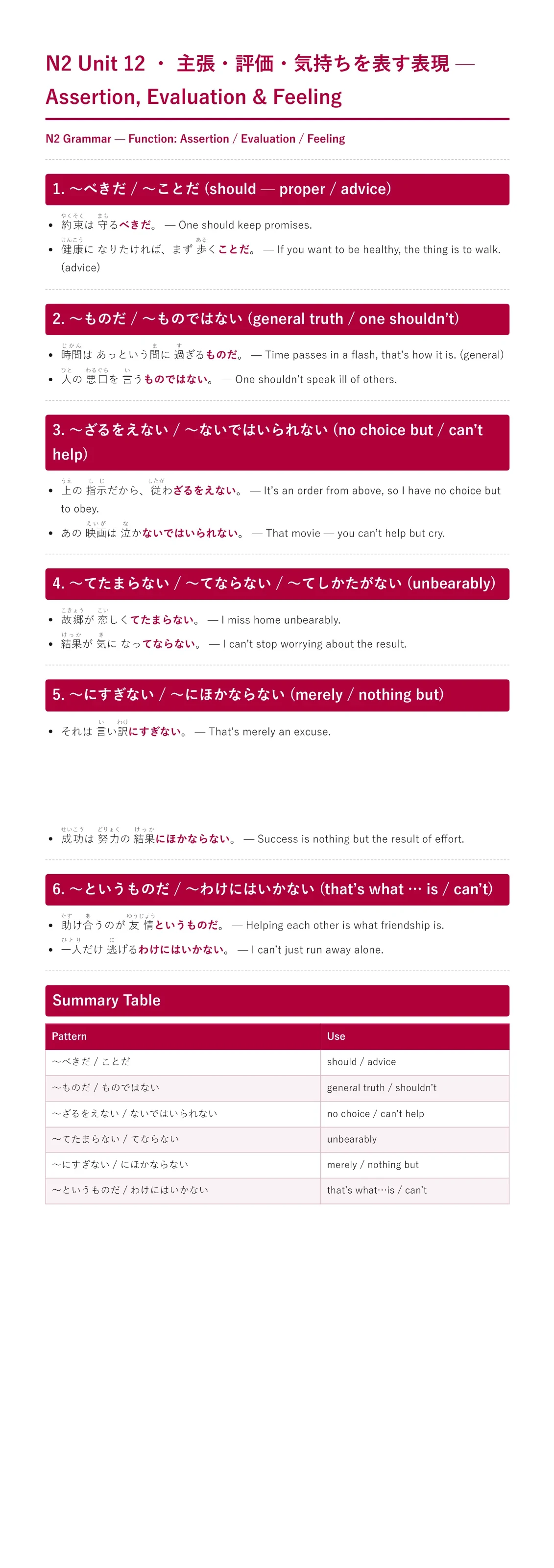
Covers: 〜べきだ / 〜ことだ (should — proper / advice) · 〜ものだ / 〜ものではない (general truth / one shouldn't) · 〜ざるをえない / 〜ないではいられない (no choice but / can't help) · 〜てたまらない / 〜てならない / 〜てしかたがない (unbearably) · 〜にすぎない / 〜にほかならない (merely / nothing but) · 〜というものだ / 〜わけにはいかない (that's what … is / can't) · Summary Table · Quick reference (接続) · Example Sentences (例文) · Short Reading (読解) · Practice (練習) · Mini Production (作文)
Lesson 13
You've covered the core N2 grammar across 13 functional units. Pair this with reading (読解), vocabulary (語彙), kanji (漢字), and listening (聴解) practice for full exam coverage.
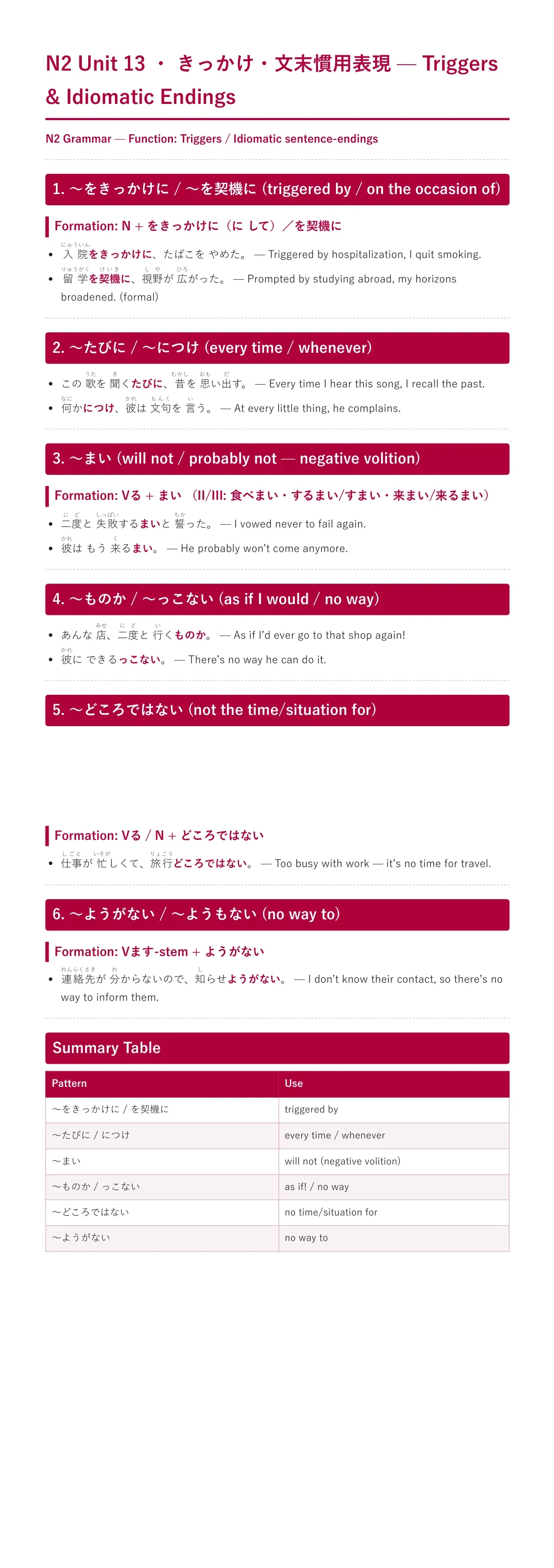
Covers: 〜をきっかけに / 〜を契機に (triggered by / on the occasion of) · Formation: N + をきっかけに(に して)/を契機に · 〜たびに / 〜につけ (every time / whenever) · 〜まい (will not / probably not — negative volition) · Formation: Vる + まい (II/III: 食べまい・するまい/すまい・来まい/来るまい) · 〜ものか / 〜っこない (as if I would / no way) · 〜どころではない (not the time/situation for) · Formation: Vる / N + どころではない · 〜ようがない / 〜ようもない (no way to) · Formation: Vます-stem + ようがない · Summary Table · Quick reference (接続) · Example Sentences (例文) · Short Reading (読解) · Practice (練習) · Mini Production (作文)
Lesson 14
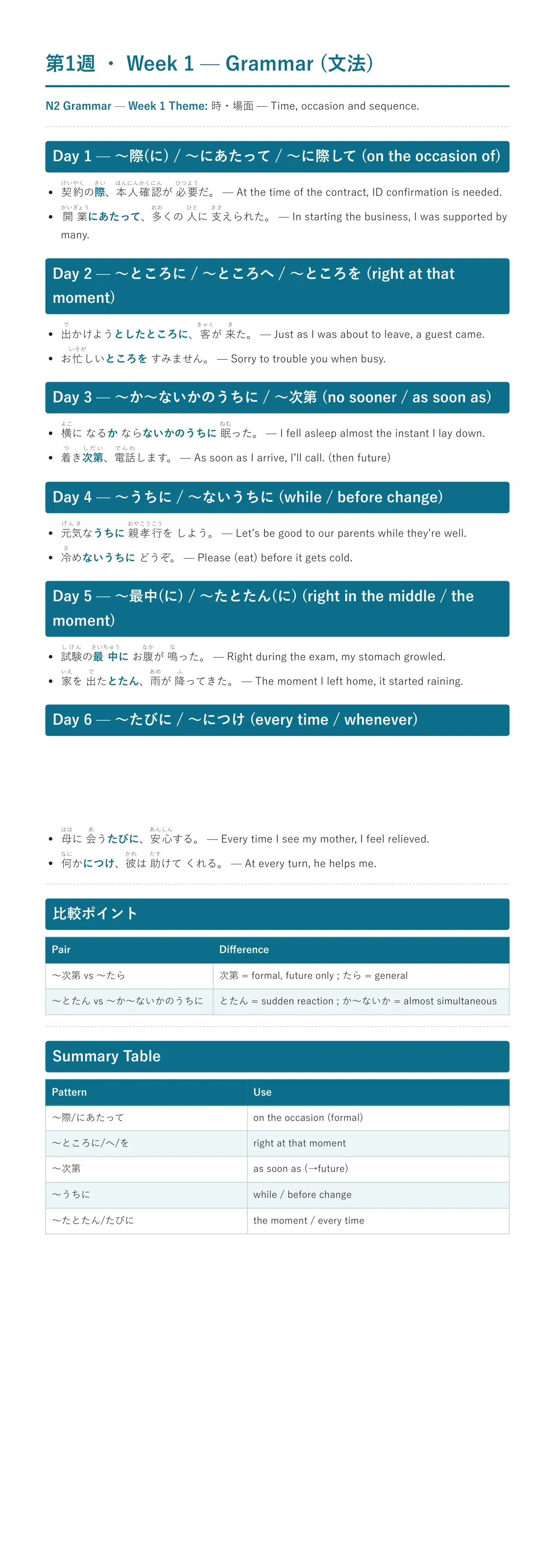
Covers: Day 1 — 〜際(に) / 〜にあたって / 〜に際して (on the occasion of) · Day 2 — 〜ところに / 〜ところへ / 〜ところを (right at that moment) · Day 3 — 〜か〜ないかのうちに / 〜次第 (no sooner / as soon as) · Day 4 — 〜うちに / 〜ないうちに (while / before change) · Day 5 — 〜最中(に) / 〜たとたん(に) (right in the middle / the moment) · Day 6 — 〜たびに / 〜につけ (every time / whenever) · 比較ポイント · Summary Table · Example Sentences (例文) · Short Reading (読解) · Practice (練習) · Mini Production (作文)
Lesson 15
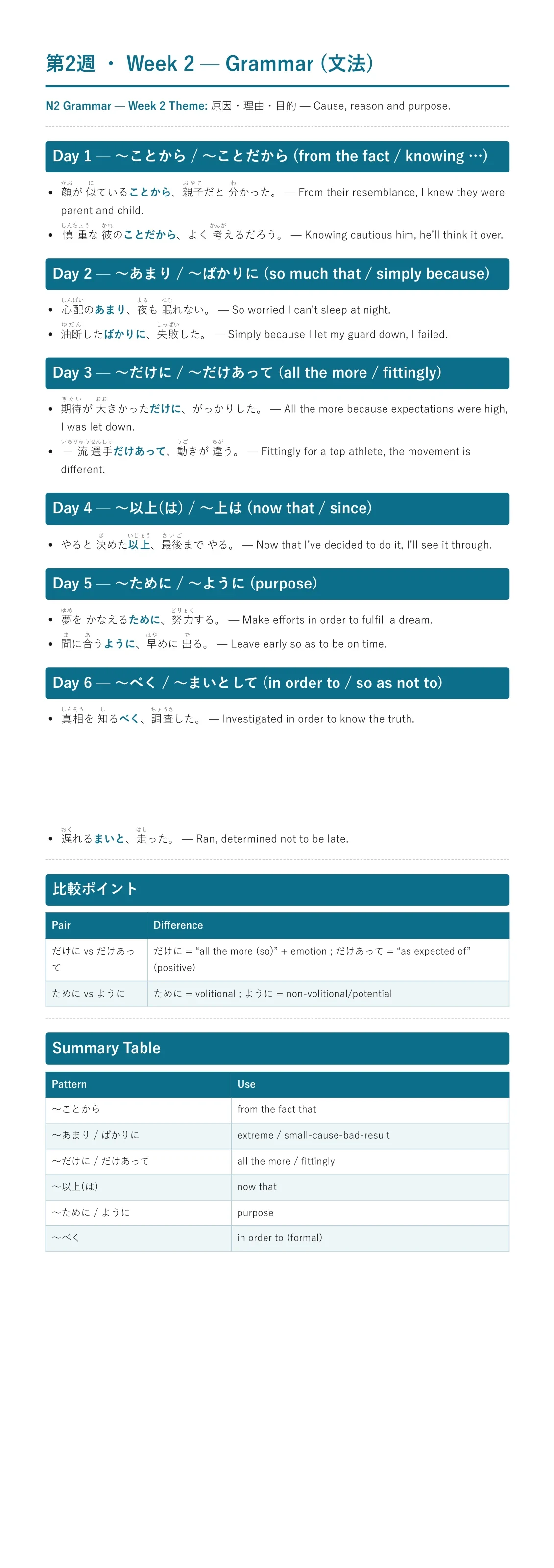
Covers: Day 1 — 〜ことから / 〜ことだから (from the fact / knowing …) · Day 2 — 〜あまり / 〜ばかりに (so much that / simply because) · Day 3 — 〜だけに / 〜だけあって (all the more / fittingly) · Day 4 — 〜以上(は) / 〜上は (now that / since) · Day 5 — 〜ために / 〜ように (purpose) · Day 6 — 〜べく / 〜まいとして (in order to / so as not to) · 比較ポイント · Summary Table · Example Sentences (例文) · Short Reading (読解) · Practice (練習) · だけに vs だけあって drill · Mini Production (作文)
Lesson 16
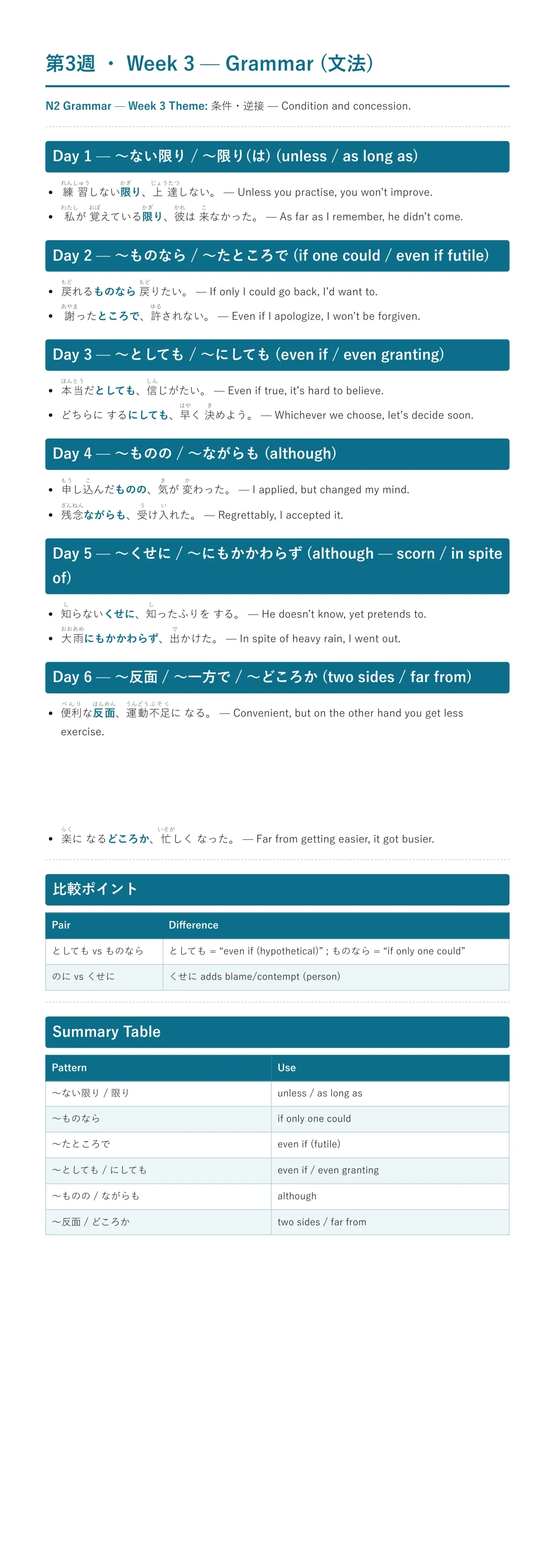
Covers: Day 1 — 〜ない限り / 〜限り(は) (unless / as long as) · Day 2 — 〜ものなら / 〜たところで (if one could / even if futile) · Day 3 — 〜としても / 〜にしても (even if / even granting) · Day 4 — 〜ものの / 〜ながらも (although) · Day 5 — 〜くせに / 〜にもかかわらず (although — scorn / in spite of) · Day 6 — 〜反面 / 〜一方で / 〜どころか (two sides / far from) · 比較ポイント · Summary Table · Example Sentences (例文) · Short Reading (読解) · Practice (練習) · Mini Production (作文)
Lesson 17
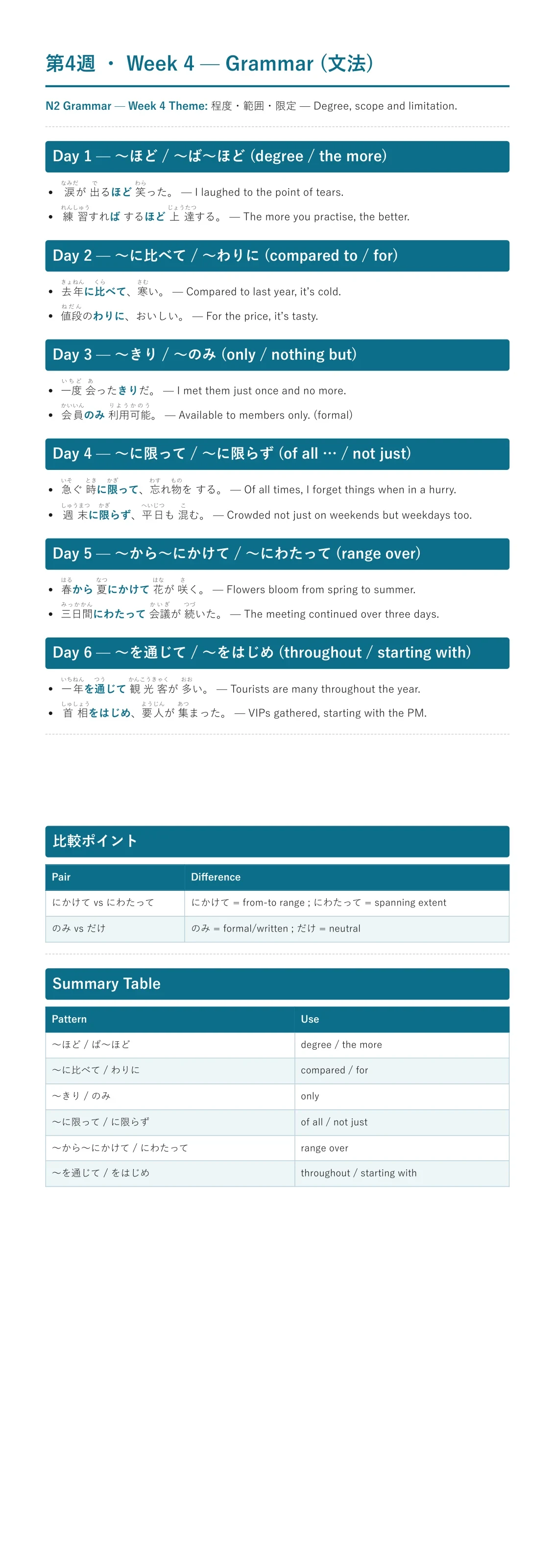
Covers: Day 1 — 〜ほど / 〜ば〜ほど (degree / the more) · Day 2 — 〜に比べて / 〜わりに (compared to / for) · Day 3 — 〜きり / 〜のみ (only / nothing but) · Day 4 — 〜に限って / 〜に限らず (of all … / not just) · Day 5 — 〜から〜にかけて / 〜にわたって (range over) · Day 6 — 〜を通じて / 〜をはじめ (throughout / starting with) · 比較ポイント · Summary Table · Example Sentences (例文) · Short Reading (読解) · Practice (練習) · Mini Production (作文)
Lesson 18
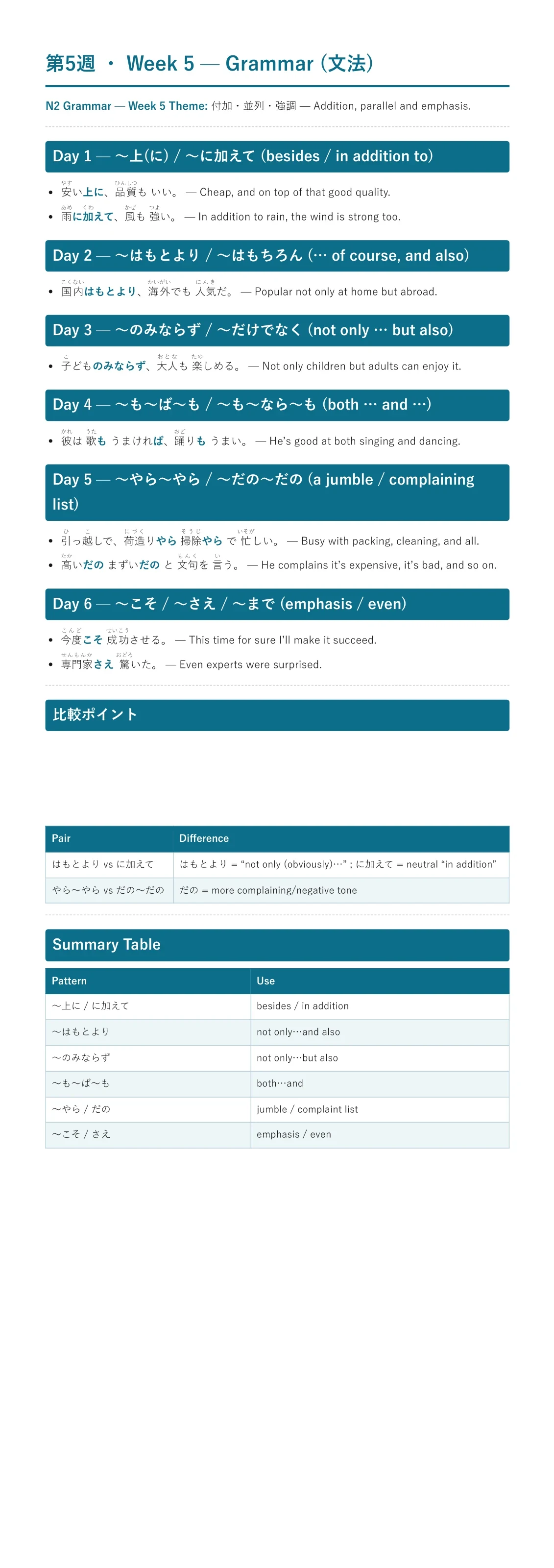
Covers: Day 1 — 〜上(に) / 〜に加えて (besides / in addition to) · Day 2 — 〜はもとより / 〜はもちろん (… of course, and also) · Day 3 — 〜のみならず / 〜だけでなく (not only … but also) · Day 4 — 〜も〜ば〜も / 〜も〜なら〜も (both … and …) · Day 5 — 〜やら〜やら / 〜だの〜だの (a jumble / complaining list) · Day 6 — 〜こそ / 〜さえ / 〜まで (emphasis / even) · 比較ポイント · Summary Table · Example Sentences (例文) · Short Reading (読解) · Practice (練習) · Mini Production (作文)
Lesson 19
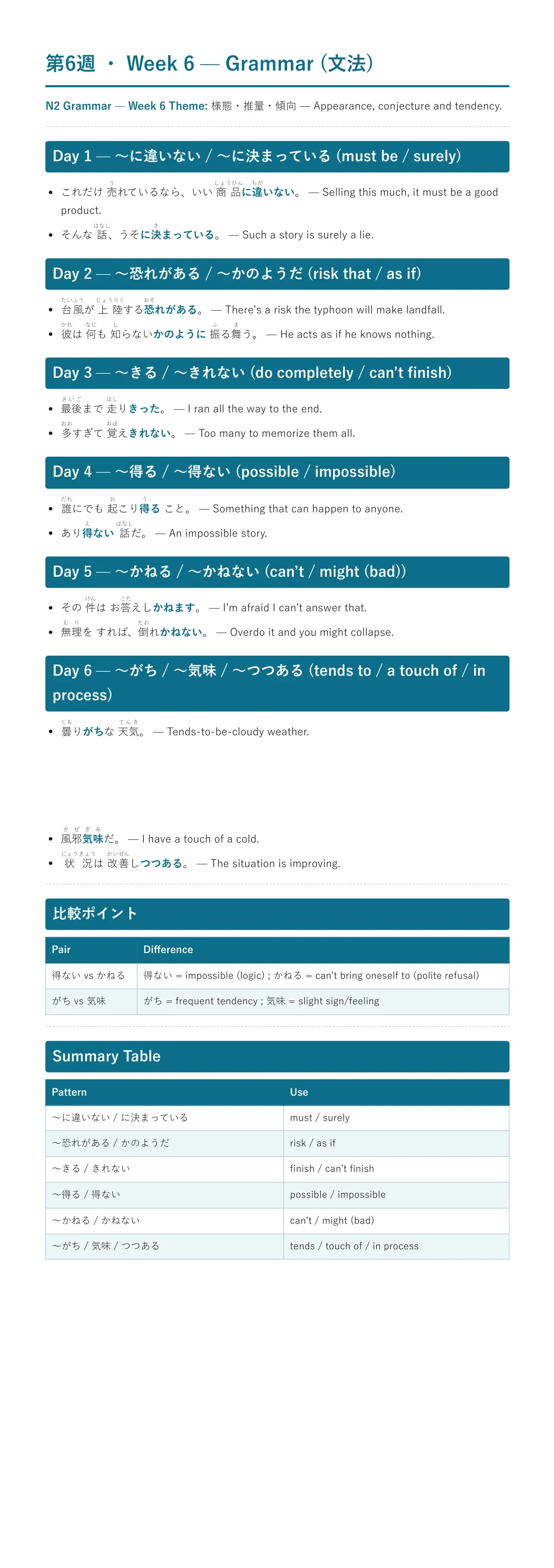
Covers: Day 1 — 〜に違いない / 〜に決まっている (must be / surely) · Day 2 — 〜恐れがある / 〜かのようだ (risk that / as if) · Day 3 — 〜きる / 〜きれない (do completely / can't finish) · Day 4 — 〜得る / 〜得ない (possible / impossible) · Day 5 — 〜かねる / 〜かねない (can't / might (bad)) · Day 6 — 〜がち / 〜気味 / 〜つつある (tends to / a touch of / in process) · 比較ポイント · Summary Table · Example Sentences (例文) · Short Reading (読解) · Practice (練習) · かねる vs かねない drill · Mini Production (作文)
Lesson 20
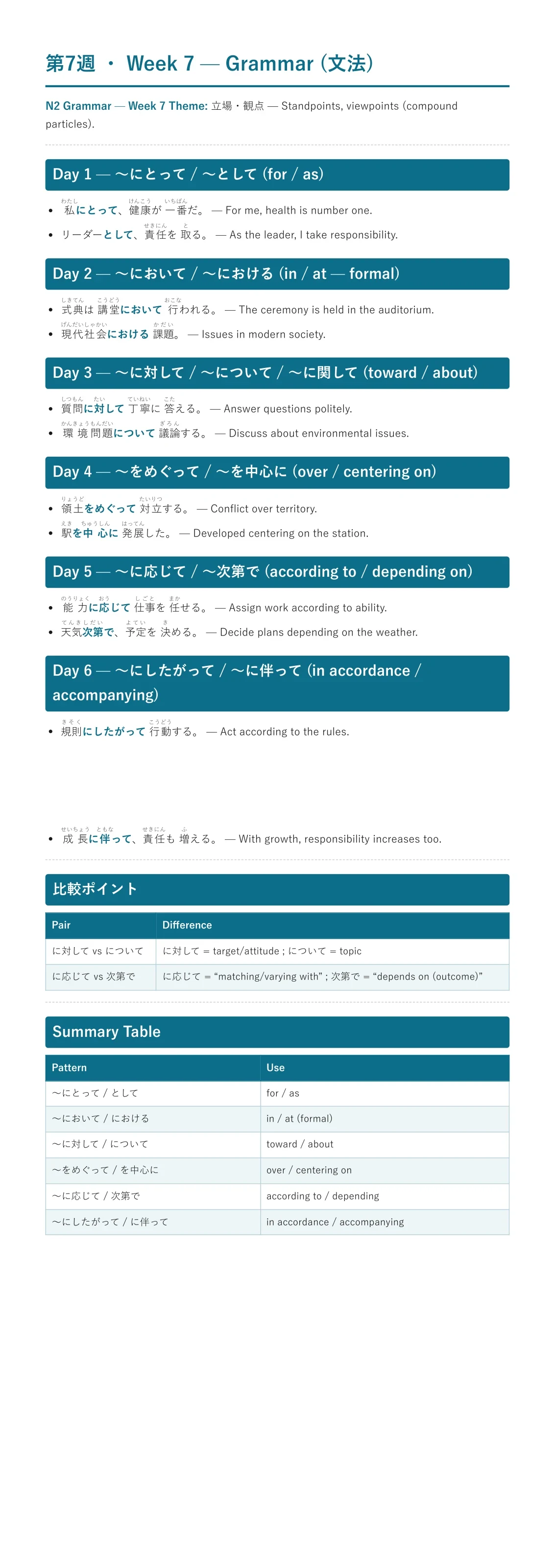
Covers: Day 1 — 〜にとって / 〜として (for / as) · Day 2 — 〜において / 〜における (in / at — formal) · Day 3 — 〜に対して / 〜について / 〜に関して (toward / about) · Day 4 — 〜をめぐって / 〜を中心に (over / centering on) · Day 5 — 〜に応じて / 〜次第で (according to / depending on) · Day 6 — 〜にしたがって / 〜に伴って (in accordance / accompanying) · 比較ポイント · Summary Table · Example Sentences (例文) · Short Reading (読解) · Practice (練習) · に対して vs について drill · Mini Production (作文)
Lesson 21
You've covered the core N2 grammar across 8 weeks. Next: pair with Summary Grammar N2 漢字・語彙・読解・聴解, then move toward N1. お疲れさまでした!
Covers: Day 1 — 〜べきだ / 〜ことだ (should / advice) · Day 2 — 〜ものだ / 〜ものではない (general truth / shouldn't) · Day 3 — 〜ざるをえない / 〜ないではいられない (no choice / can't help) · Day 4 — 〜てたまらない / 〜てならない (unbearably) · Day 5 — 〜にすぎない / 〜にほかならない (merely / nothing but) · Day 6 — 〜まい / 〜ものか / 〜どころではない / 〜ようがない (won't / as if / no time / no way) · Summary Table · Example Sentences (例文) · Short Reading (読解) · Practice (練習) · Mini Production (作文) · 🎉 8週間 修了 (Course complete!)