
JLPT N3 notes prepared and maintained by the NihongoDoya Editorial Team.
Lesson summaries and study cards last reviewed 17 July 2026. These are independent learning materials, not official examination content. Report a correction.
Introduction
This page brings the core JLPT N3 grammar together by function — the way the comprehensive grammar track groups it — followed by the weekly-summary track week-by-week set. Lessons 1–13 are the comprehensive track functional units; lessons 14–19 are the weekly-summary track weeks. Each card gives formation, meaning, confusable-grammar (比較) tables, a short reading and practice.
What you will learn
- Time: 〜たところ, 〜たばかり, 〜うちに, 〜まま, 〜とたん
- Cause & reason: 〜おかげで, 〜せいで, 〜ものだから, 〜ために, 〜あまり
- Condition: 〜ば / たら / と / なら, 〜さえ〜ば, 〜ないことには
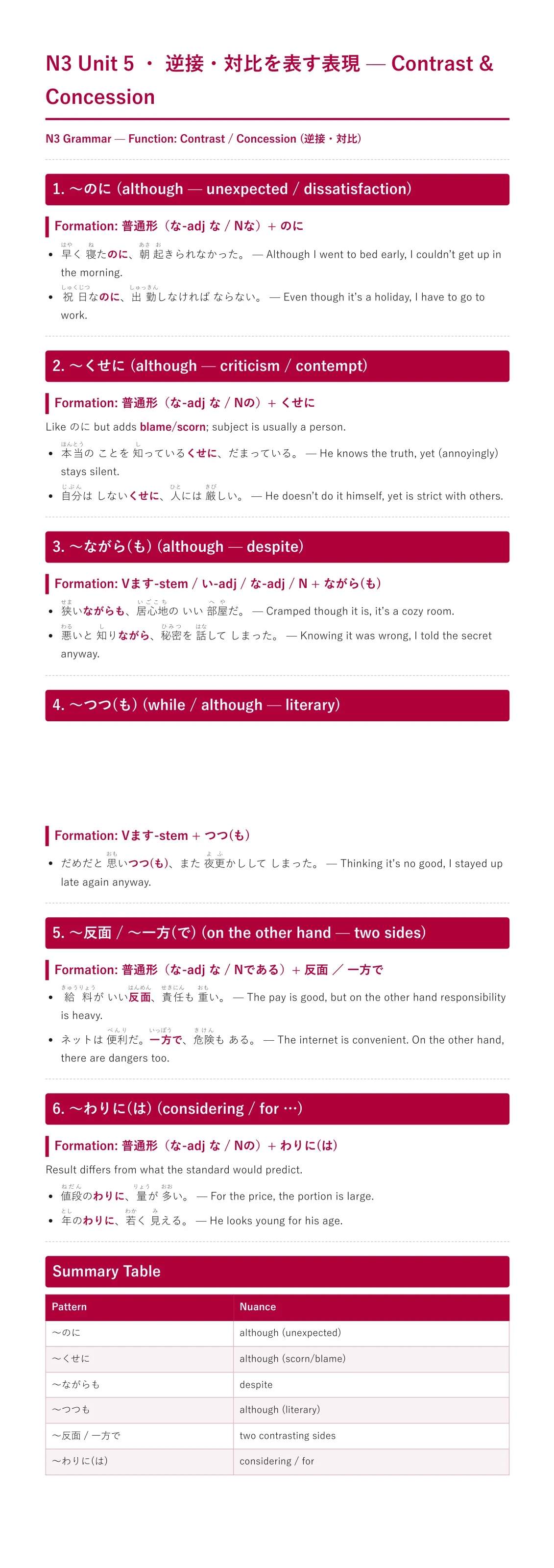
- Contrast: 〜のに, 〜くせに, 〜反面, 〜わりに
- Conjecture & hearsay: 〜そうだ, 〜ようだ, 〜らしい, 〜にちがいない, 〜はずだ
- Compound particles: 〜について, 〜に対して, 〜にとって, 〜として, 〜によって
- Focus & spoken forms: 〜こそ, 〜さえ, 〜どころか, 〜ちゃう, 〜なきゃ, 〜って
Who this level is for
Best for learners who have cleared N4 and want the bridge into intermediate Japanese — ideal for self-study toward the JLPT N3 exam.
How to work through N3 by function
- Read one functional unit and note which patterns compete for the same meaning.
- Study the 比較 (comparison) table until you can state how each option differs.
- Write one sentence per pattern so the nuance, not just the form, sticks.
- Read the short 読解 passage to see the patterns working in context.
- Answer the practice questions, then revisit any pair you confused.
Common mistakes to avoid
- Treating similar patterns as identical — use the 比較 tables (e.g. たところ vs たばかり).
- Mixing appearance 〜そう (stem) with hearsay 〜そうだ (plain form).
- Confusing のに (although) with のに (in order to) — the connection differs.
- Ignoring spoken contractions (〜ちゃう, 〜とく, 〜なきゃ) that dominate N3 listening.
Related study materials
Build a joined-up study cycle by combining this page with the matching JLPT N3 grammar guide, the JLPT N3 Japanese word list
Frequently asked questions
Why is N3 grammar organised by function instead of by lesson?
Because N3 is where many patterns start to overlap in meaning. Grouping by function — time, cause, condition, contrast — shows which structures compete, exactly how the comprehensive grammar track teaches it.
What is the difference between the two halves of this page?
Lessons 1–13 follow the comprehensive track's functional units; lessons 14–19 follow the weekly-summary track's gentler week-by-week plan with comparison tables. Use the weekly-summary track for a first pass and the comprehensive track to master.
How many grammar points are on N3?
Around 150. They are spread across the functional units here, each with formation, meaning and JLPT-style practice.
Is standard beginner textbooks enough for N3?
Minna's Chūkyū bridges toward N3, but most learners switch to dedicated JLPT-prep series (the comprehensive track, the weekly-summary track) from N3 upward — which is what this guide uses.
What should I do after finishing this level?
Move to the JLPT N2 grammar guide, which adds formal and written patterns such as 〜際, 〜ものの and 〜かねない.
JLPT N3 lesson-by-lesson syllabus
Every lesson on this page includes handwritten study cards with full written explanations. Here is what each lesson covers:
Lesson 1
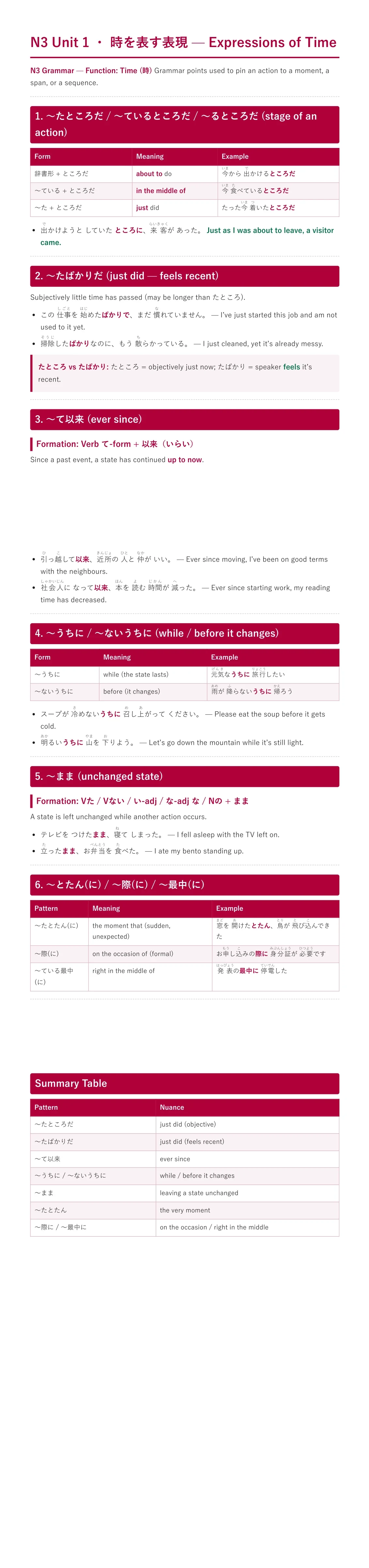
Grammar points used to pin an action to a moment, a span, or a sequence.
Covers: 〜たところだ / 〜ているところだ / 〜るところだ (stage of an action) · 〜たばかりだ (just did — feels recent) · 〜て以来 (ever since) · Formation: Verb て-form + 以来(いらい) · 〜うちに / 〜ないうちに (while / before it changes) · 〜まま (unchanged state) · Formation: Vた / Vない / い-adj / な-adj な / Nの + まま · 〜とたん(に) / 〜際(に) / 〜最中(に) · Summary Table · Example Sentences (例文) · Short Reading (読解) · Practice (練習) — Choose the best option · Mini Production (作文)
Lesson 2
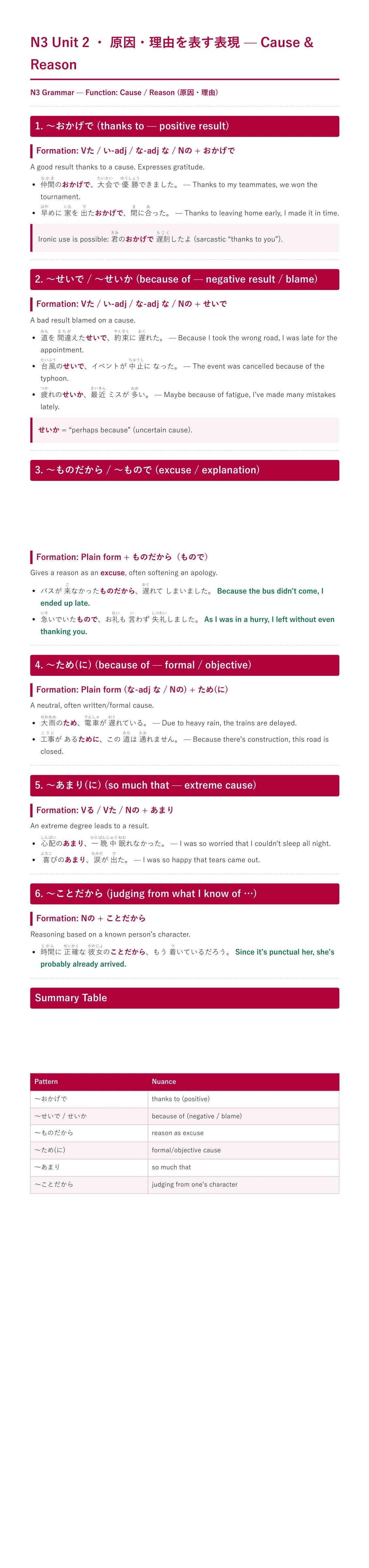
A good result thanks to a cause. Expresses gratitude.
Covers: 〜おかげで (thanks to — positive result) · Formation: Vた / い-adj / な-adj な / Nの + おかげで · 〜せいで / 〜せいか (because of — negative result / blame) · Formation: Vた / い-adj / な-adj な / Nの + せいで · 〜ものだから / 〜もので (excuse / explanation) · Formation: Plain form + ものだから(もので) · 〜ため(に) (because of — formal / objective) · Formation: Plain form (な-adj な / Nの) + ため(に) · 〜あまり(に) (so much that — extreme cause) · Formation: Vる / Vた / Nの + あまり · 〜ことだから (judging from what I know of …) · Formation: Nの + ことだから · Summary Table · Quick reference (接続・ニュアンス) · Example Sentences (例文) · Short Reading (読解) · Practice (練習) — Fill the best option · Mini Production (作文)
Lesson 3
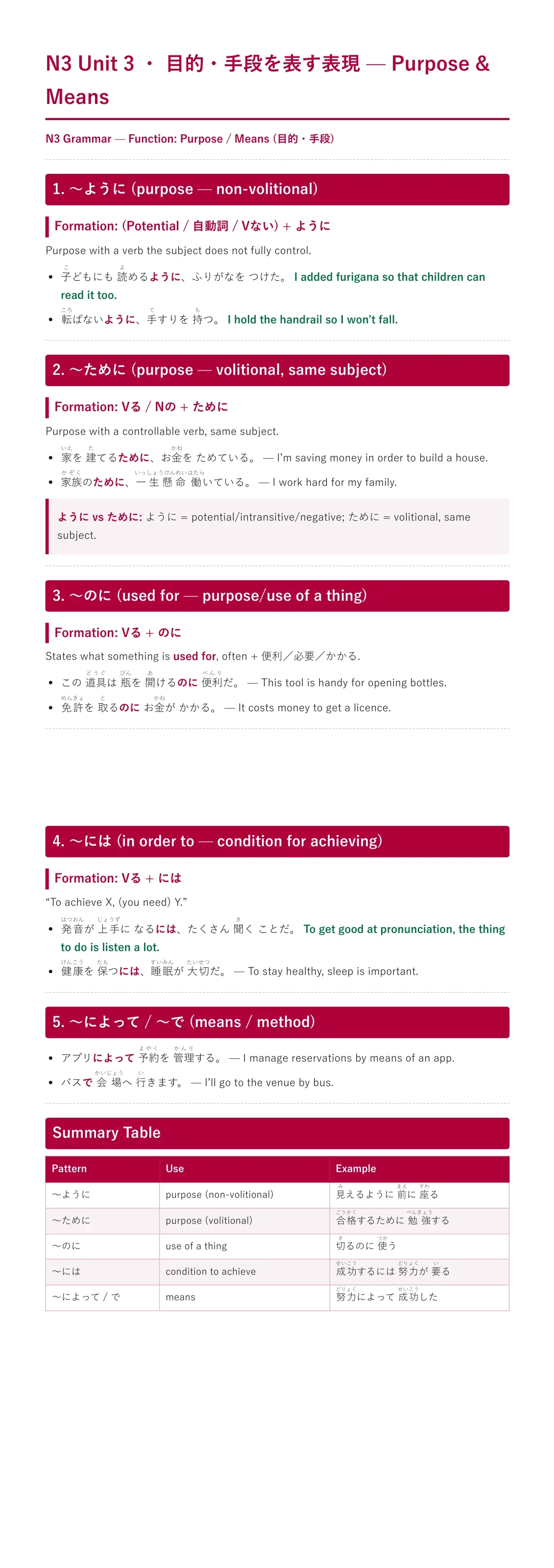
Purpose with a verb the subject does not fully control.
Covers: 〜ように (purpose — non-volitional) · Formation: (Potential / 自動詞 / Vない) + ように · 〜ために (purpose — volitional, same subject) · Formation: Vる / Nの + ために · 〜のに (used for — purpose/use of a thing) · Formation: Vる + のに · 〜には (in order to — condition for achieving) · Formation: Vる + には · 〜によって / 〜で (means / method) · Summary Table · Quick reference (接続) · Example Sentences (例文) · Short Reading (読解) · Practice (練習) · Mini Production (作文)
Lesson 4
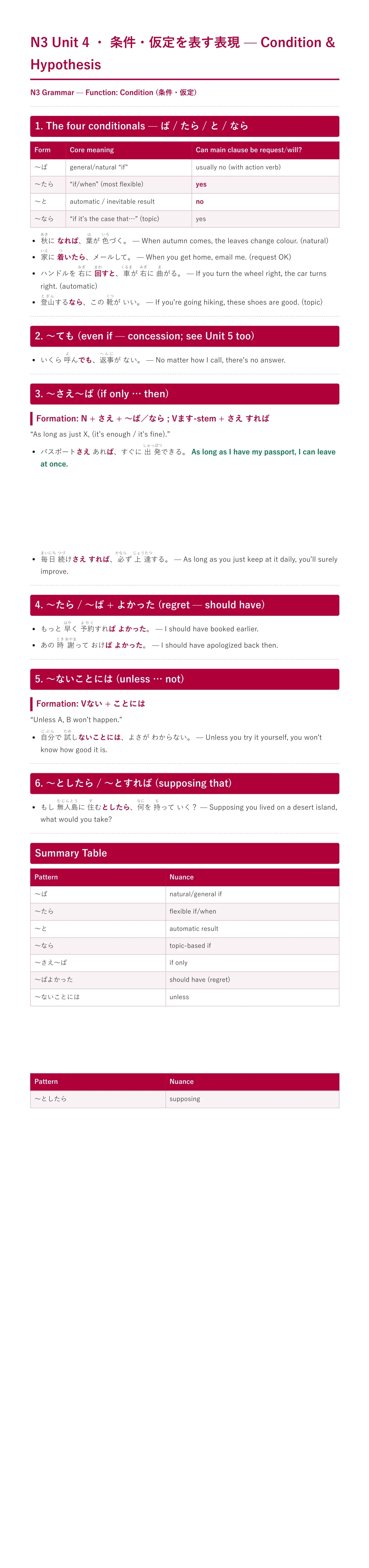
"As long as just X, (it's enough / it's fine)."
Covers: The four conditionals — ば / たら / と / なら · 〜ても (even if — concession; see Unit 5 too) · 〜さえ〜ば (if only … then) · Formation: N + さえ + 〜ば/なら ; Vます-stem + さえ すれば · 〜たら / 〜ば + よかった (regret — should have) · 〜ないことには (unless … not) · Formation: Vない + ことには · 〜としたら / 〜とすれば (supposing that) · Summary Table · Choosing the right conditional · Example Sentences (例文) · Short Reading (読解) · Practice (練習) · Mini Production (作文)
Lesson 5
Like のに but adds blame/scorn; subject is usually a person.
Covers: 〜のに (although — unexpected / dissatisfaction) · Formation: 普通形(な-adj な / Nな)+ のに · 〜くせに (although — criticism / contempt) · Formation: 普通形(な-adj な / Nの)+ くせに · 〜ながら(も) (although — despite) · Formation: Vます-stem / い-adj / な-adj / N + ながら(も) · 〜つつ(も) (while / although — literary) · Formation: Vます-stem + つつ(も) · 〜反面 / 〜一方(で) (on the other hand — two sides) · Formation: 普通形(な-adj な / Nである)+ 反面 / 一方で · 〜わりに(は) (considering / for …) · Formation: 普通形(な-adj な / Nの)+ わりに(は) · Summary Table · Quick reference (ニュアンス) · Example Sentences (例文) · Short Reading (読解) · Practice (練習) · Mini Production (作文)
Lesson 6
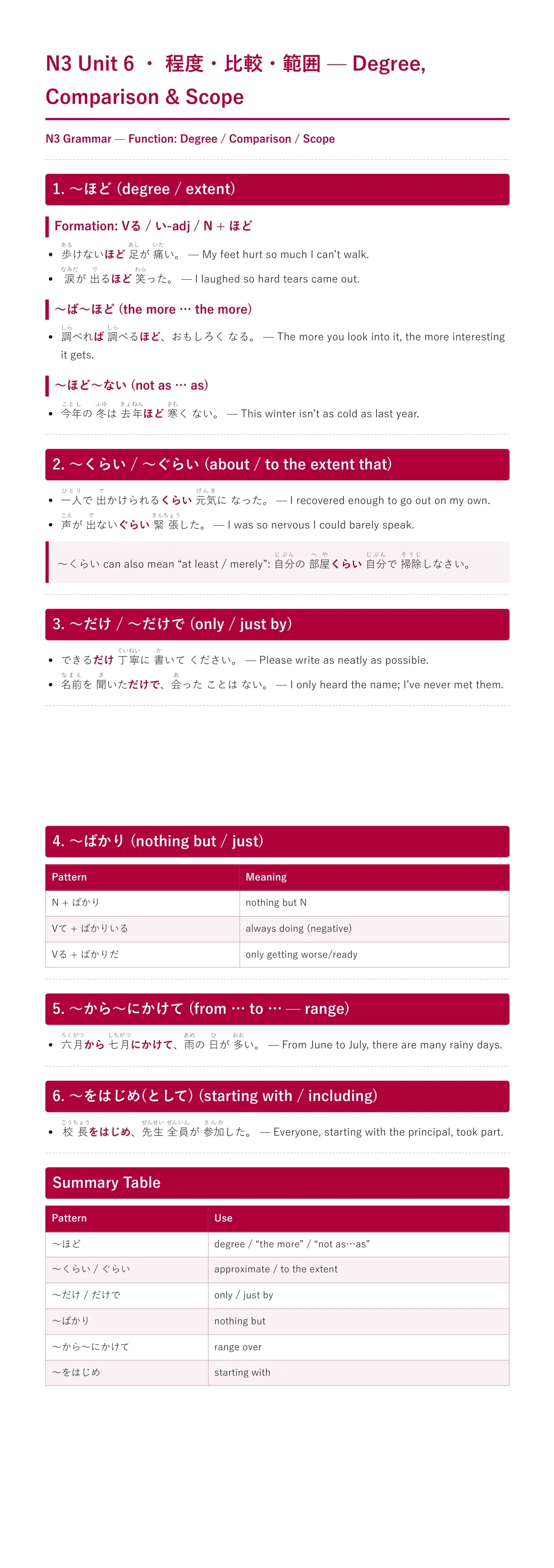
a. から/にかけて b. ほど/くらい c. だけ/ばかり d. をはじめ/ほど
Covers: 〜ほど (degree / extent) · Formation: Vる / い-adj / N + ほど · 〜ば〜ほど (the more … the more) · 〜ほど〜ない (not as … as) · 〜くらい / 〜ぐらい (about / to the extent that) · 〜だけ / 〜だけで (only / just by) · 〜ばかり (nothing but / just) · 〜から〜にかけて (from … to … — range) · 〜をはじめ(として) (starting with / including) · Summary Table · Quick reference (接続) · Example Sentences (例文) · Short Reading (読解) · Practice (練習) · Mini Production (作文)
Lesson 7
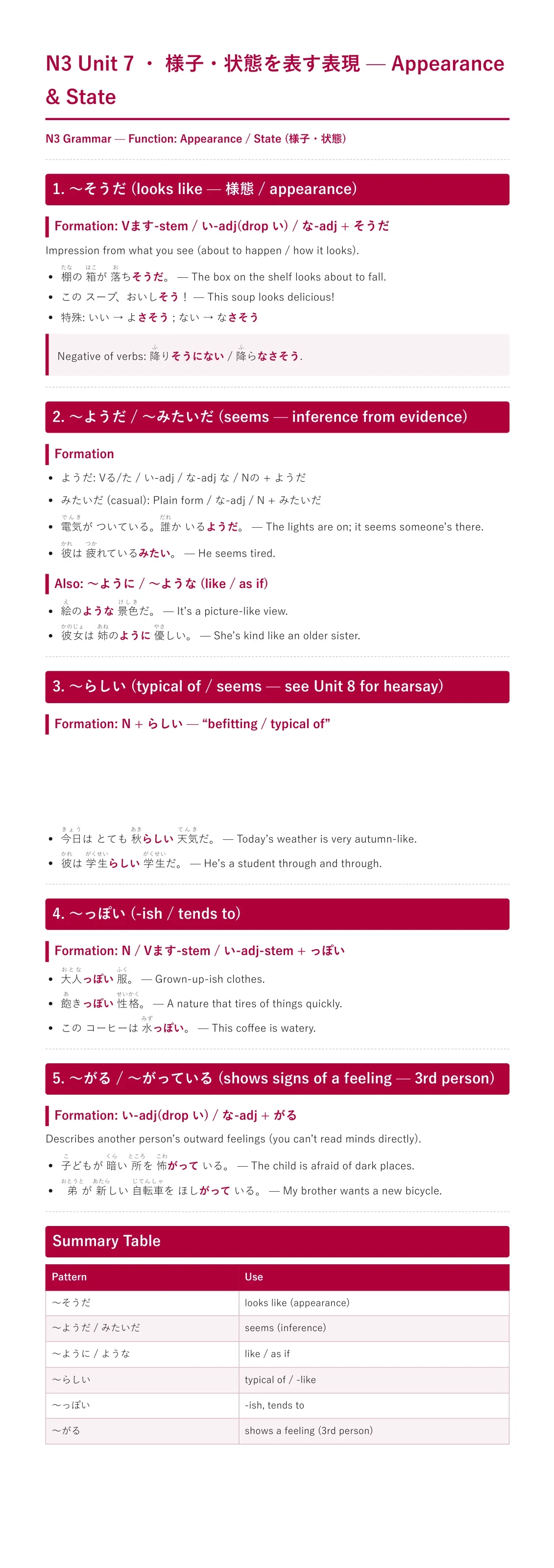
Impression from what you see (about to happen / how it looks).
Covers: 〜そうだ (looks like — 様態 / appearance) · Formation: Vます-stem / い-adj(drop い) / な-adj + そうだ · 〜ようだ / 〜みたいだ (seems — inference from evidence) · Formation · Also: 〜ように / 〜ような (like / as if) · 〜らしい (typical of / seems — see Unit 8 for hearsay) · Formation: N + らしい — "befitting / typical of" · 〜っぽい (-ish / tends to) · Formation: N / Vます-stem / い-adj-stem + っぽい · 〜がる / 〜がっている (shows signs of a feeling — 3rd person) · Formation: い-adj(drop い) / な-adj + がる · Summary Table · 〜そうだ vs 〜ようだ vs 〜らしい (key distinction) · Example Sentences (例文) · Short Reading (読解) · Practice (練習) · Mini Production (作文)
Lesson 8
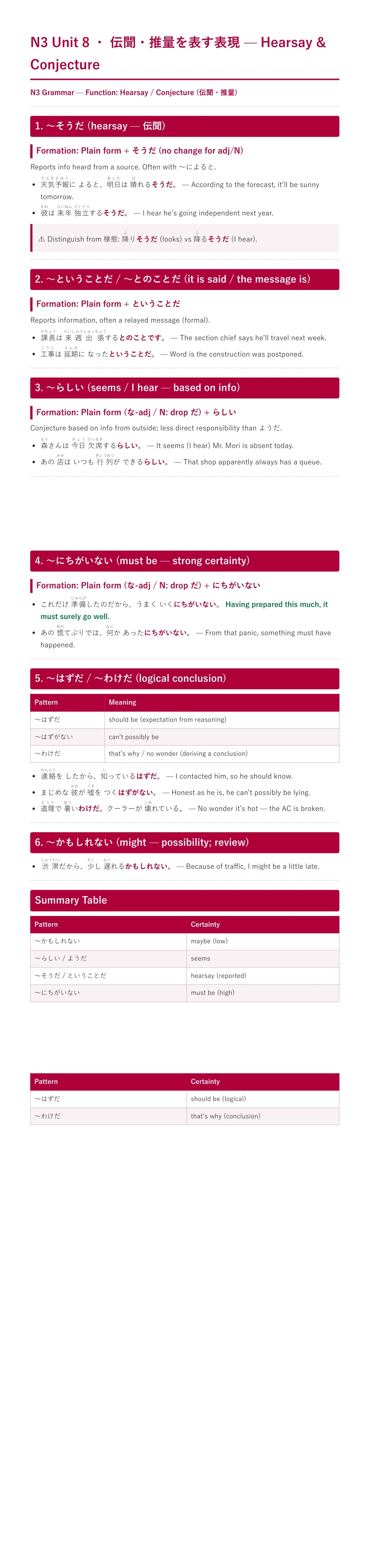
Reports info heard from a source. Often with 〜によると.
Covers: 〜そうだ (hearsay — 伝聞) · Formation: Plain form + そうだ (no change for adj/N) · 〜ということだ / 〜とのことだ (it is said / the message is) · Formation: Plain form + ということだ · 〜らしい (seems / I hear — based on info) · Formation: Plain form (な-adj / N: drop だ) + らしい · 〜にちがいない (must be — strong certainty) · Formation: Plain form (な-adj / N: drop だ) + にちがいない · 〜はずだ / 〜わけだ (logical conclusion) · 〜かもしれない (might — possibility; review) · Summary Table · Certainty ladder · Example Sentences (例文) · Short Reading (読解) · Practice (練習) · Mini Production (作文)
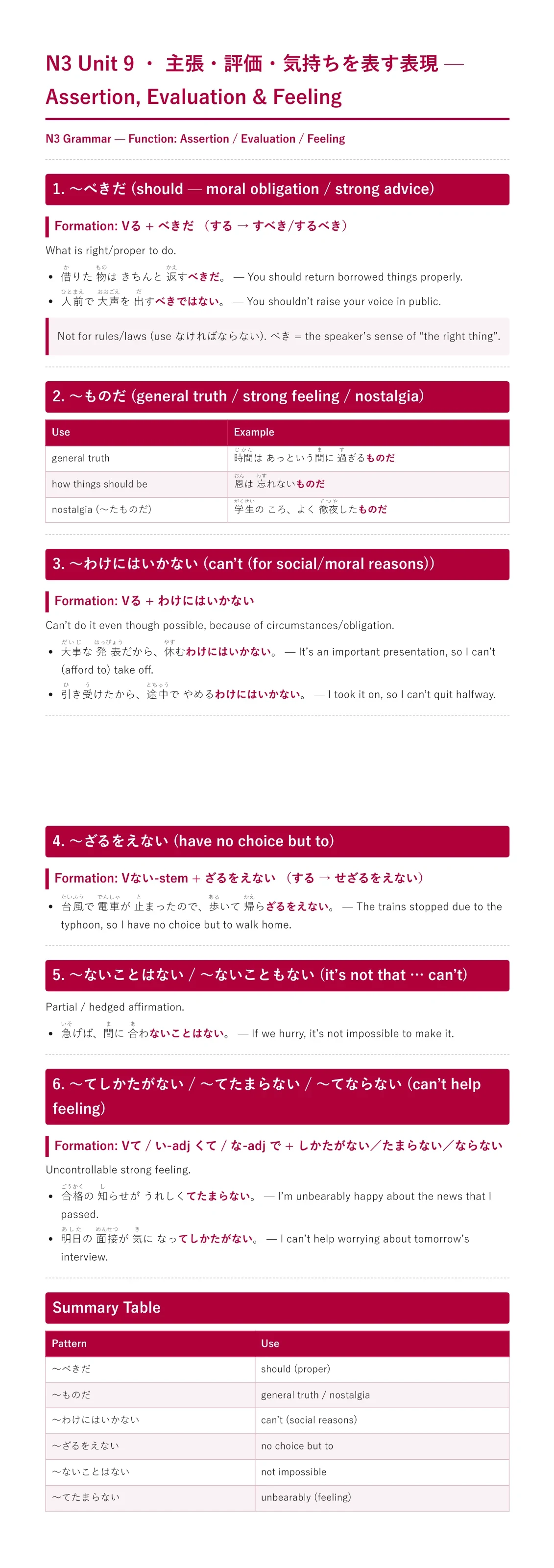
Lesson 9
Can't do it even though possible, because of circumstances/obligation.
Covers: 〜べきだ (should — moral obligation / strong advice) · Formation: Vる + べきだ (する → すべき/するべき) · 〜ものだ (general truth / strong feeling / nostalgia) · 〜わけにはいかない (can't (for social/moral reasons)) · Formation: Vる + わけにはいかない · 〜ざるをえない (have no choice but to) · Formation: Vない-stem + ざるをえない (する → せざるをえない) · 〜ないことはない / 〜ないこともない (it's not that … can't) · 〜てしかたがない / 〜てたまらない / 〜てならない (can't help feeling) · Formation: Vて / い-adj くて / な-adj で + しかたがない/たまらない/ならない · Summary Table · Quick reference (接続) · Example Sentences (例文) · Short Reading (読解) · Practice (練習) · Mini Production (作文)
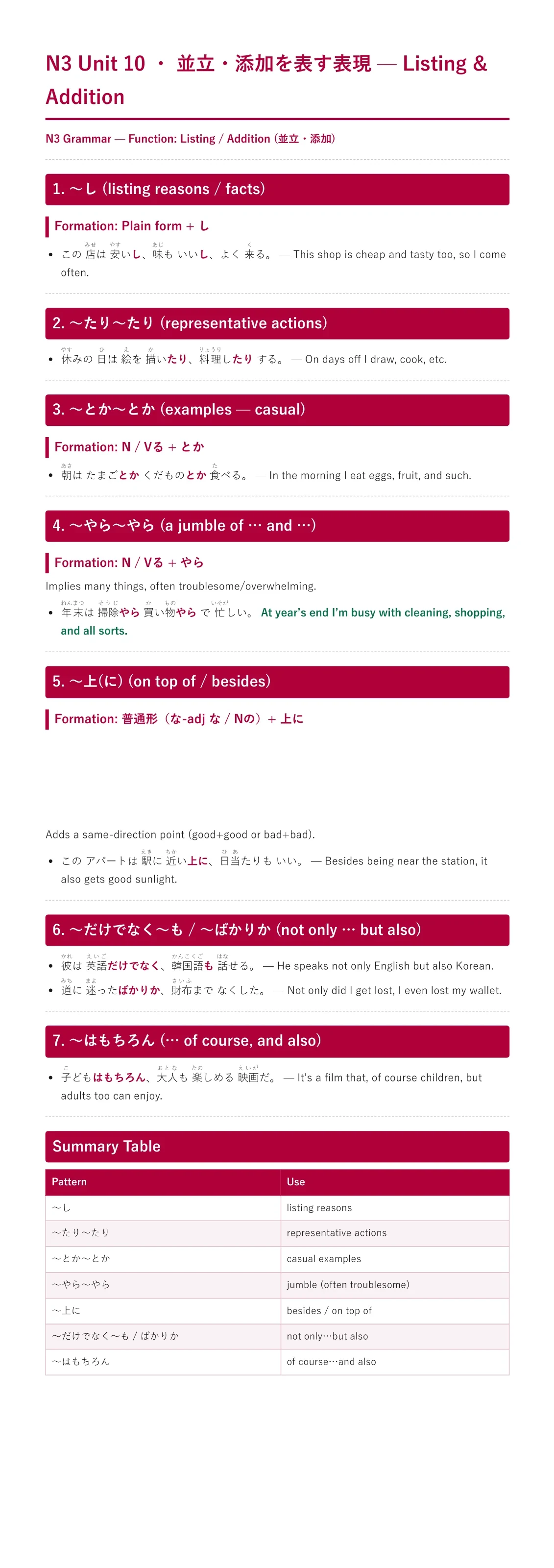
Lesson 10
Implies many things, often troublesome/overwhelming.
Covers: 〜し (listing reasons / facts) · Formation: Plain form + し · 〜たり〜たり (representative actions) · 〜とか〜とか (examples — casual) · Formation: N / Vる + とか · 〜やら〜やら (a jumble of … and …) · Formation: N / Vる + やら · 〜上(に) (on top of / besides) · Formation: 普通形(な-adj な / Nの)+ 上に · 〜だけでなく〜も / 〜ばかりか (not only … but also) · 〜はもちろん (… of course, and also) · Summary Table · Quick reference · Example Sentences (例文) · Short Reading (読解) · Practice (練習) · Mini Production (作文)
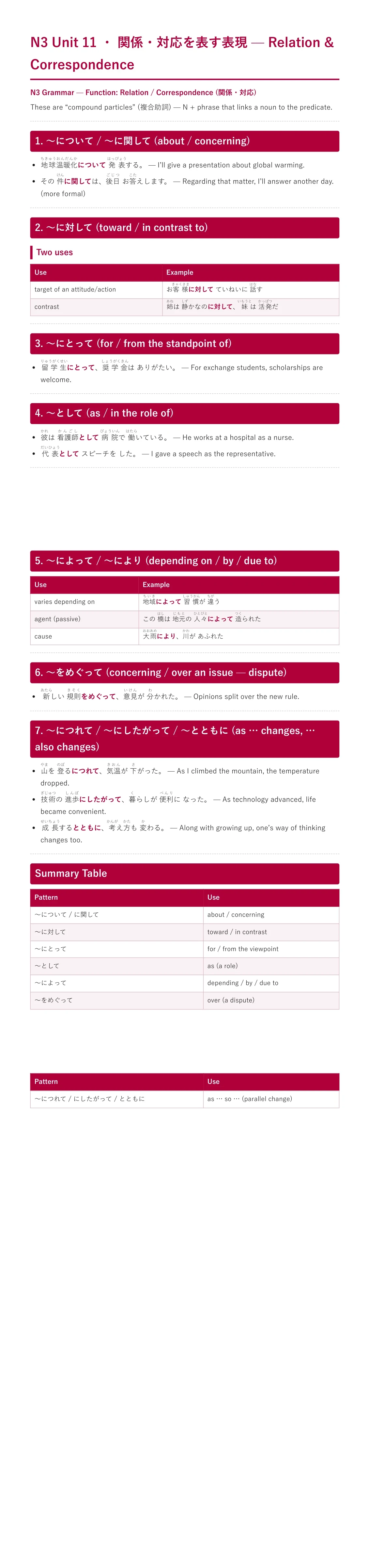
Lesson 11
These are "compound particles" (複合助詞) — N + phrase that links a noun to the predicate.
Covers: 〜について / 〜に関して (about / concerning) · 〜に対して (toward / in contrast to) · Two uses · 〜にとって (for / from the standpoint of) · 〜として (as / in the role of) · 〜によって / 〜により (depending on / by / due to) · 〜をめぐって (concerning / over an issue — dispute) · 〜につれて / 〜にしたがって / 〜とともに (as … changes, … also changes) · Summary Table · Quick reference (all attach to a Noun) · Example Sentences (例文) · Short Reading (読解) · Practice (練習) · Mini Production (作文)
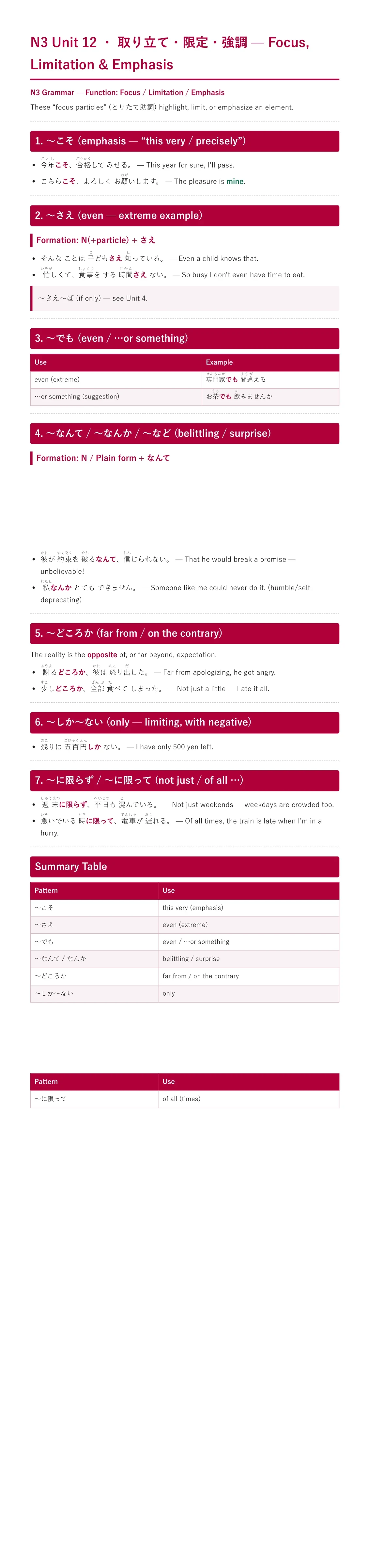
Lesson 12
These "focus particles" (とりたて助詞) highlight, limit, or emphasize an element.
Covers: 〜こそ (emphasis — "this very / precisely") · 〜さえ (even — extreme example) · Formation: N(+particle) + さえ · 〜でも (even / …or something) · 〜なんて / 〜なんか / 〜など (belittling / surprise) · Formation: N / Plain form + なんて · 〜どころか (far from / on the contrary) · 〜しか〜ない (only — limiting, with negative) · 〜に限らず / 〜に限って (not just / of all …) · Summary Table · Quick reference (ニュアンス) · Example Sentences (例文) · Short Reading (読解) · Practice (練習) · Mini Production (作文)
Lesson 13
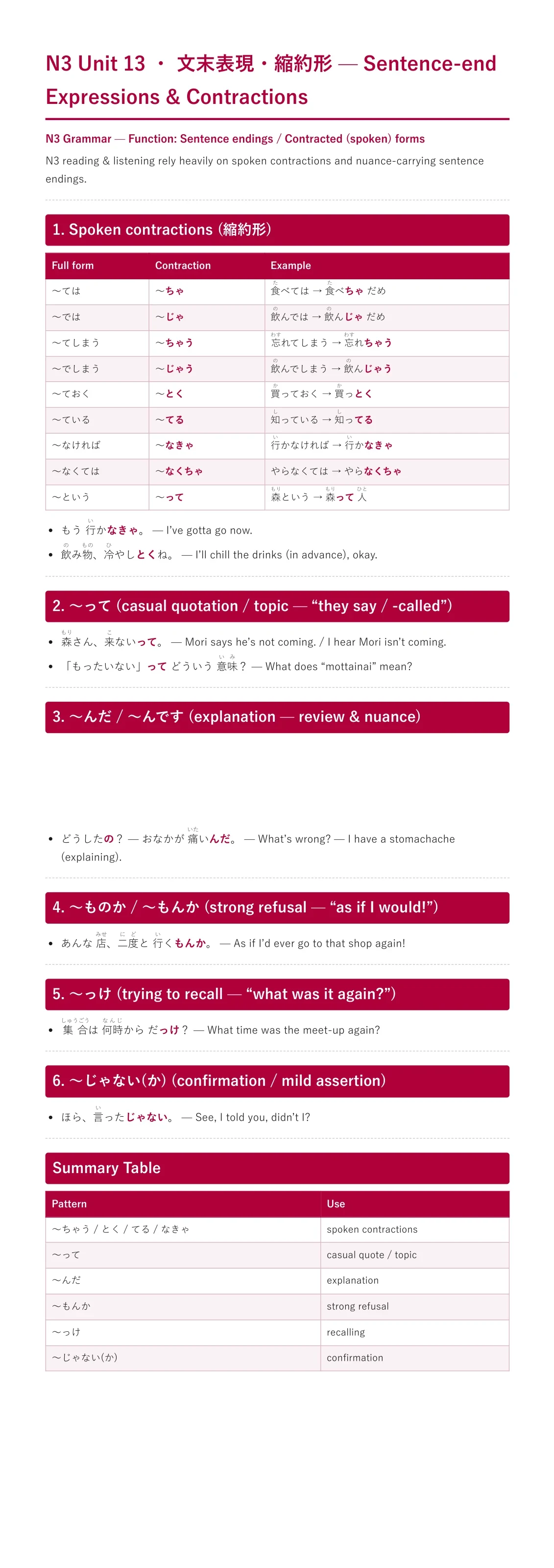
N3 reading & listening rely heavily on spoken contractions and nuance-carrying sentence endings.
Covers: Spoken contractions (縮約形) · 〜って (casual quotation / topic — "they say / -called") · 〜んだ / 〜んです (explanation — review & nuance) · 〜ものか / 〜もんか (strong refusal — "as if I would!") · 〜っけ (trying to recall — "what was it again?") · 〜じゃない(か) (confirmation / mild assertion) · Summary Table · Contraction decode table (聞き取り用) · Example Sentences (例文) · Short Dialogue (会話) · Practice (練習) — Convert to full form · Mini Production (作文)
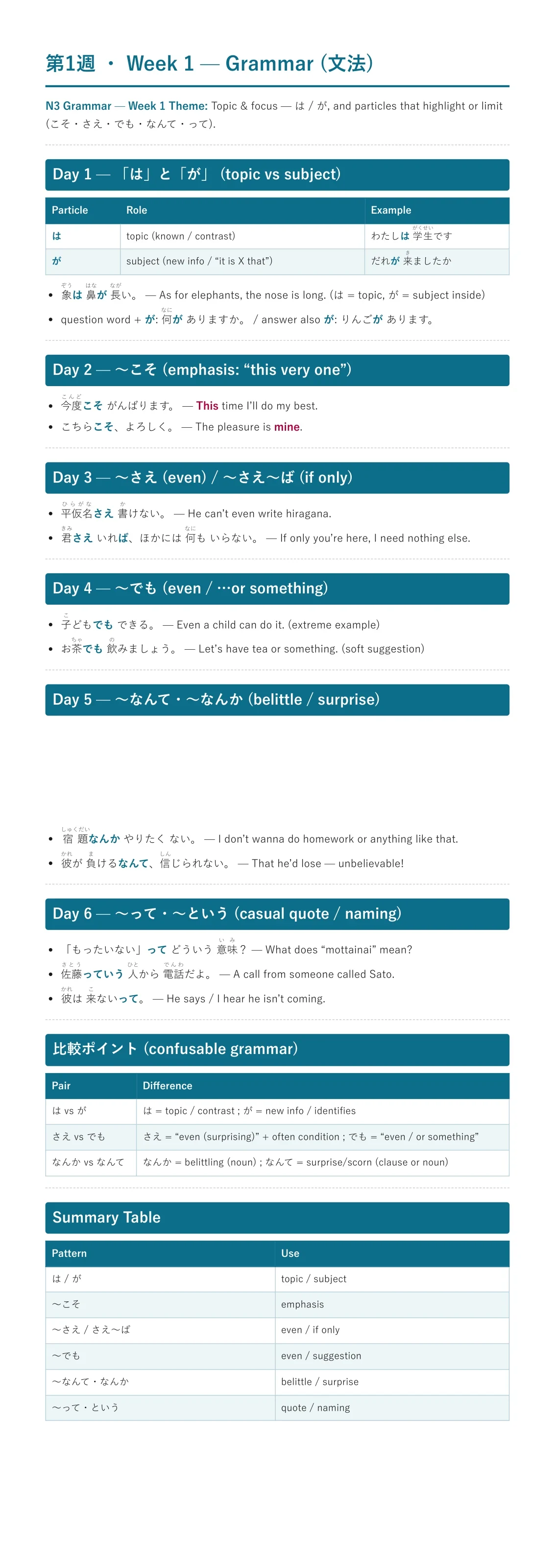
Lesson 14
Covers: Day 1 — 「は」と「が」 (topic vs subject) · Day 2 — 〜こそ (emphasis: "this very one") · Day 3 — 〜さえ (even) / 〜さえ〜ば (if only) · Day 4 — 〜でも (even / …or something) · Day 5 — 〜なんて・〜なんか (belittle / surprise) · Day 6 — 〜って・〜という (casual quote / naming) · Summary Table · Example Sentences (例文) · Short Reading (読解) · Practice (練習) — Choose the best option · は vs が drill · Mini Production (作文)
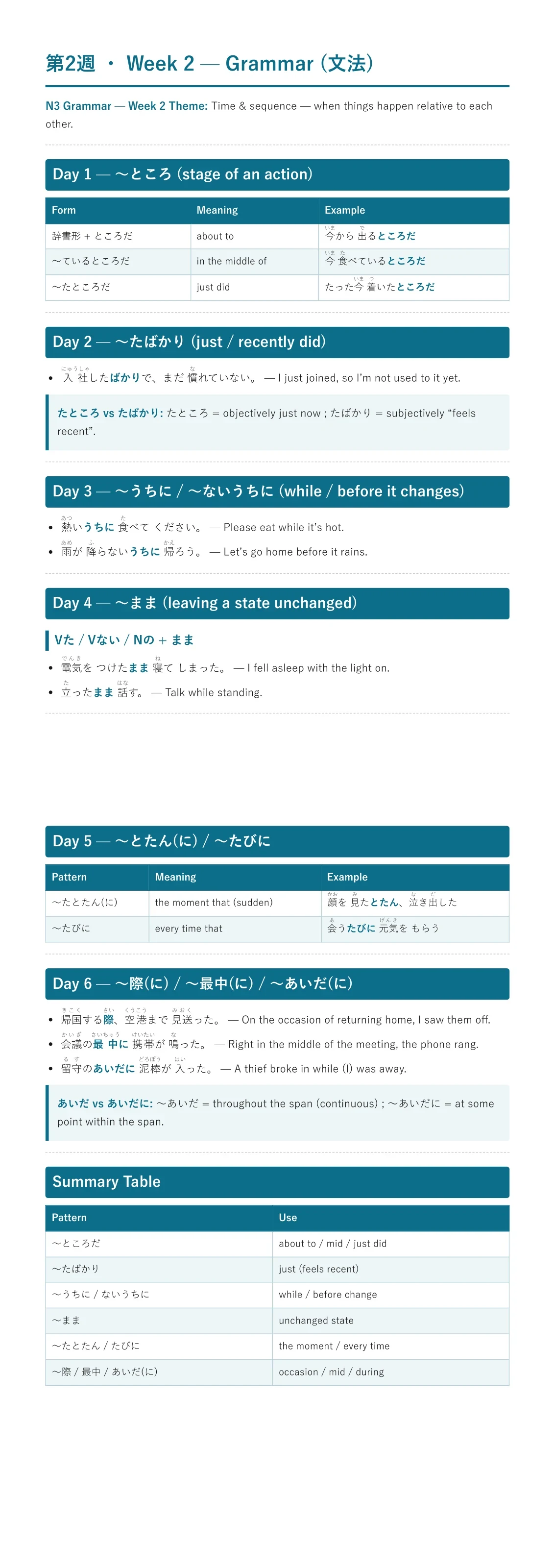
Lesson 15
Covers: Day 1 — 〜ところ (stage of an action) · Day 2 — 〜たばかり (just / recently did) · Day 3 — 〜うちに / 〜ないうちに (while / before it changes) · Day 4 — 〜まま (leaving a state unchanged) · Vた / Vない / Nの + まま · Day 5 — 〜とたん(に) / 〜たびに · Day 6 — 〜際(に) / 〜最中(に) / 〜あいだ(に) · Summary Table · Example Sentences (例文) · Short Reading (読解) · Practice (練習) · ところ vs ばかり drill · Mini Production (作文)
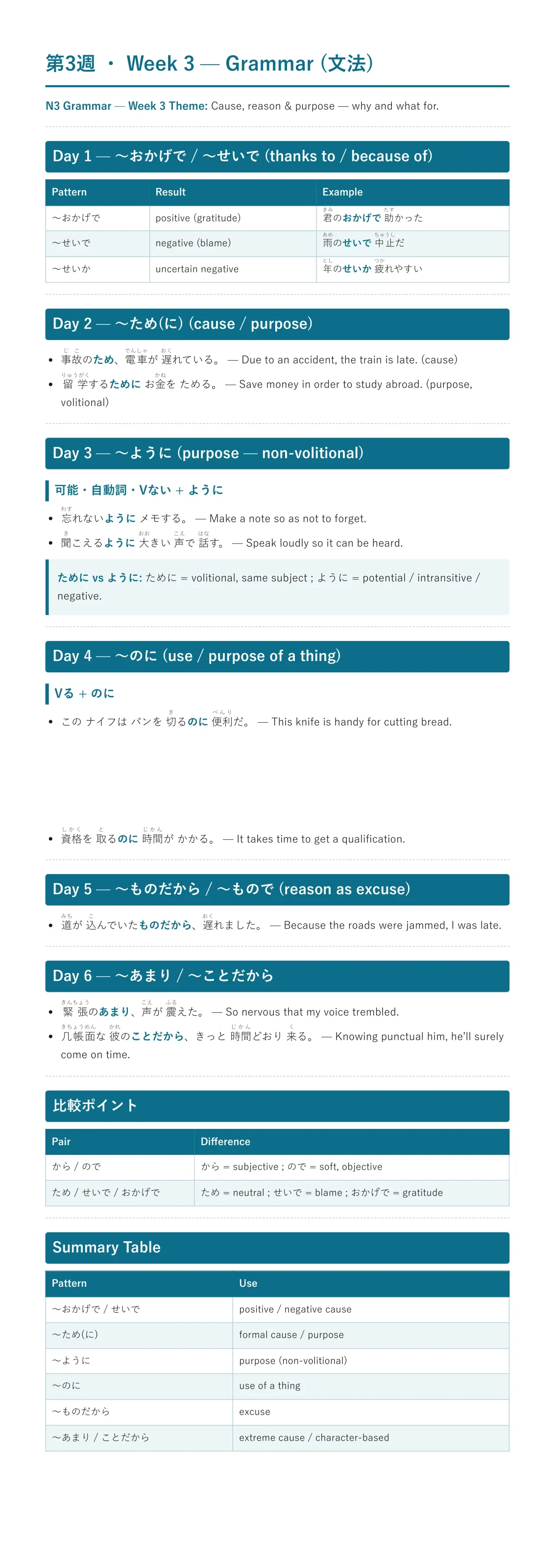
Lesson 16
Covers: Day 1 — 〜おかげで / 〜せいで (thanks to / because of) · Day 2 — 〜ため(に) (cause / purpose) · Day 3 — 〜ように (purpose — non-volitional) · 可能・自動詞・Vない + ように · Day 4 — 〜のに (use / purpose of a thing) · Vる + のに · Day 5 — 〜ものだから / 〜もので (reason as excuse) · Day 6 — 〜あまり / 〜ことだから · 比較ポイント · Summary Table · Example Sentences (例文) · Short Reading (読解) · Practice (練習) · ために vs ように drill · Mini Production (作文)
Lesson 17
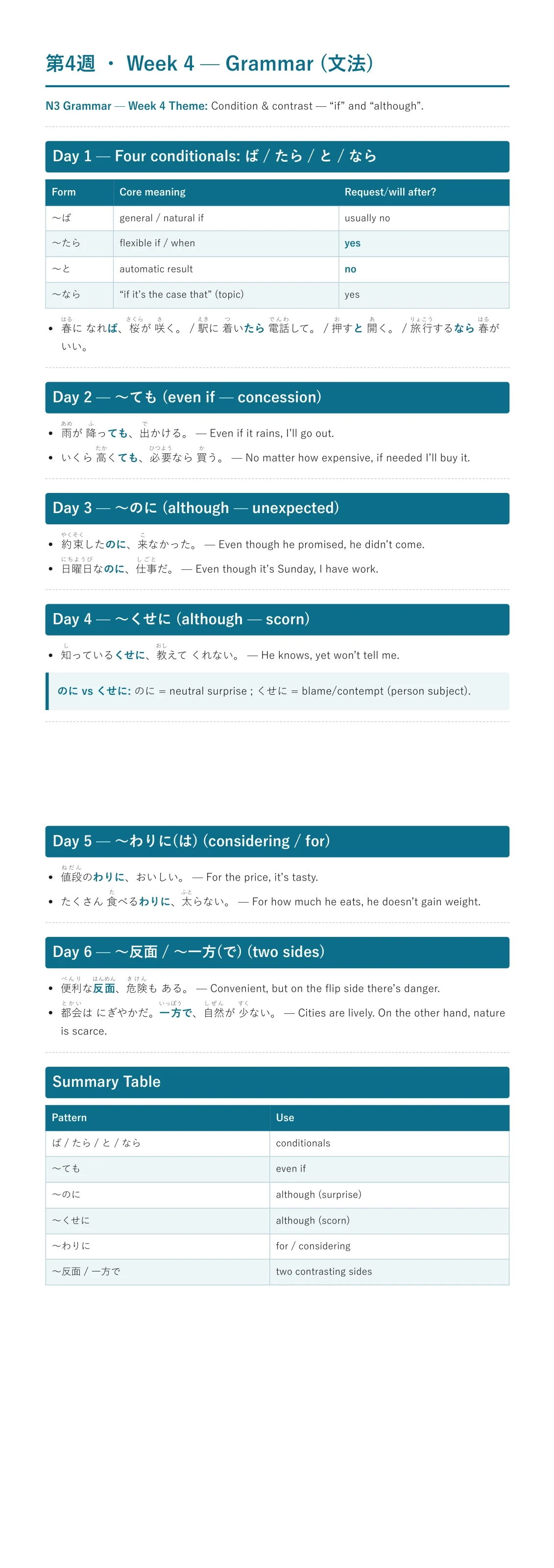
Covers: Day 1 — Four conditionals: ば / たら / と / なら · Day 2 — 〜ても (even if — concession) · Day 3 — 〜のに (although — unexpected) · Day 4 — 〜くせに (although — scorn) · Day 5 — 〜わりに(は) (considering / for) · Day 6 — 〜反面 / 〜一方(で) (two sides) · Summary Table · Example Sentences (例文) · Short Reading (読解) · Practice (練習) · のに vs くせに drill · Mini Production (作文)
Lesson 18
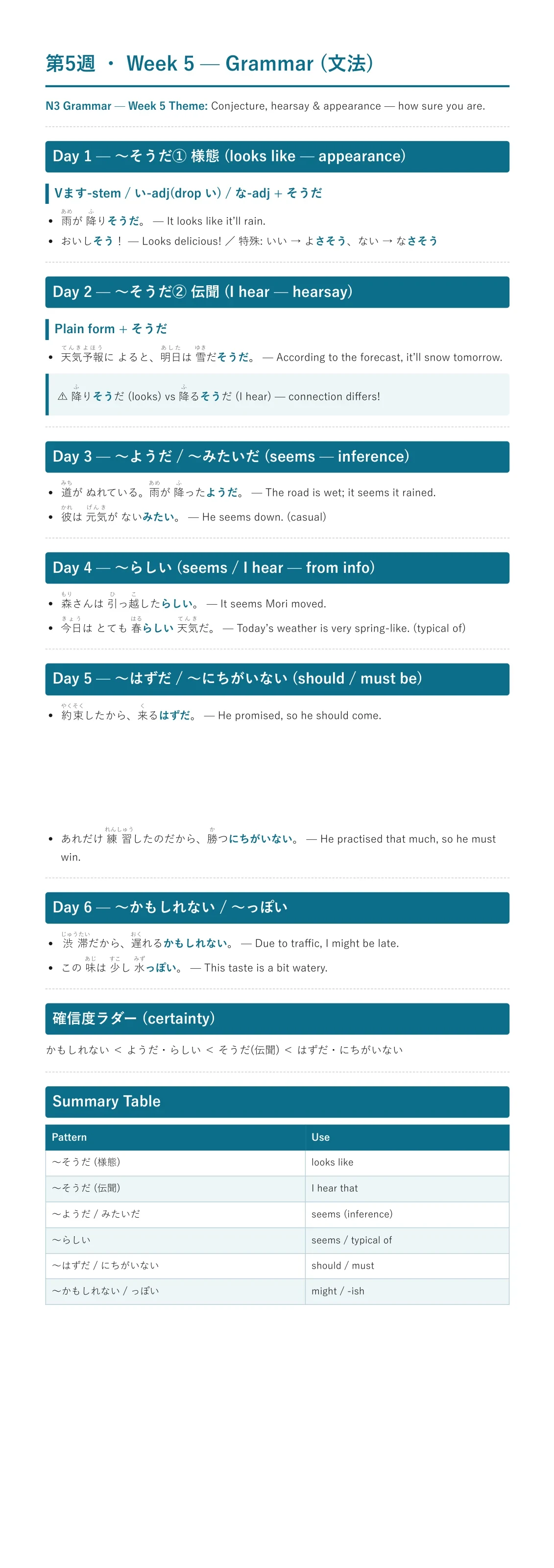
Covers: Day 1 — 〜そうだ① 様態 (looks like — appearance) · Vます-stem / い-adj(drop い) / な-adj + そうだ · Day 2 — 〜そうだ② 伝聞 (I hear — hearsay) · Plain form + そうだ · Day 3 — 〜ようだ / 〜みたいだ (seems — inference) · Day 4 — 〜らしい (seems / I hear — from info) · Day 5 — 〜はずだ / 〜にちがいない (should / must be) · Day 6 — 〜かもしれない / 〜っぽい · 確信度ラダー (certainty) · Summary Table · Example Sentences (例文) · Short Reading (読解) · Practice (練習) · 様態 vs 伝聞 drill (接続で見分ける) · Mini Production (作文)
Lesson 19
You've covered the core N3 grammar set across 6 weeks. Next steps: pair this with Summary Grammar 漢字・語彙・読解・聴解 volumes, and review weak weeks using the comparison (比較) tables.
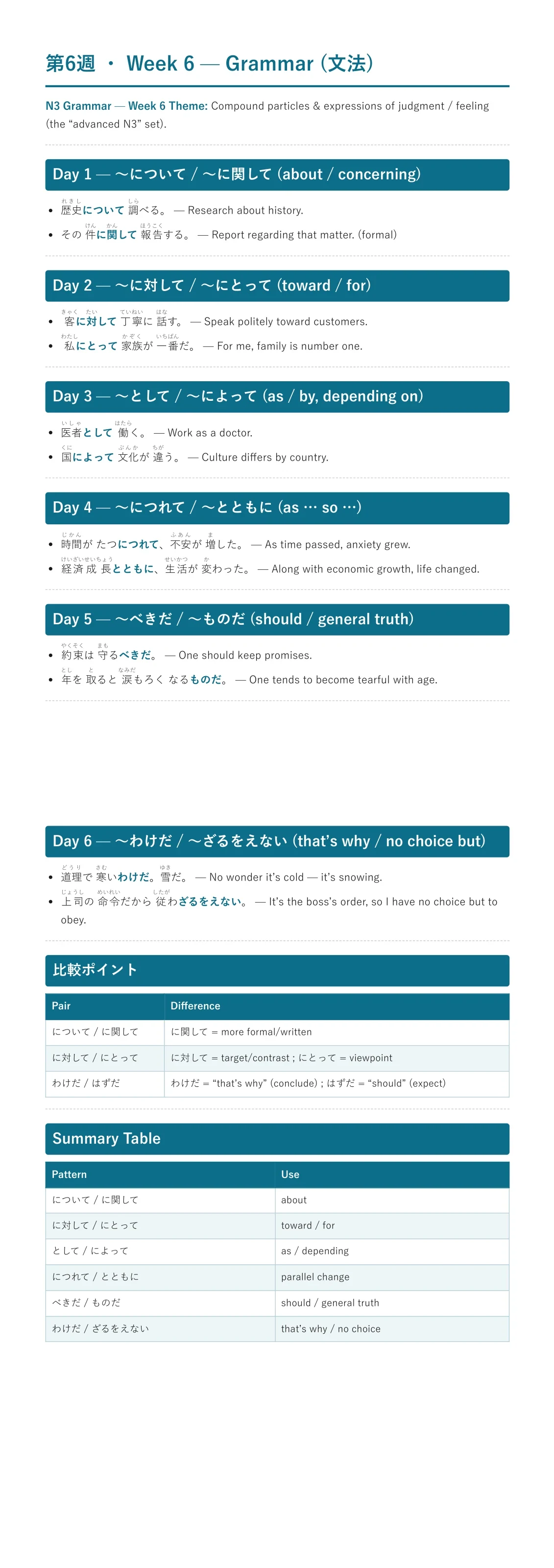
Covers: Day 1 — 〜について / 〜に関して (about / concerning) · Day 2 — 〜に対して / 〜にとって (toward / for) · Day 3 — 〜として / 〜によって (as / by, depending on) · Day 4 — 〜につれて / 〜とともに (as … so …) · Day 5 — 〜べきだ / 〜ものだ (should / general truth) · Day 6 — 〜わけだ / 〜ざるをえない (that's why / no choice but) · 比較ポイント · Summary Table · Example Sentences (例文) · Short Reading (読解) · Practice (練習) · に対して vs にとって drill · Mini Production (作文) · 🎉 6週間 修了 (Course complete!)