
JLPT N4 notes prepared and maintained by the NihongoDoya Editorial Team.
Lesson summaries and study cards last reviewed 17 July 2026. These are independent learning materials, not official examination content. Report a correction.
Introduction
This page covers the full JLPT N4 grammar syllabus from the standard Beginner 2 syllabus (lessons 26–50) — from 〜んです and polite requests through the passive, causative and keigo — each with worked examples, comparison tables and practice on the lesson card.
What you will learn
- 〜んです for reasons and 〜ていただけませんか for polite requests
- Potential verbs (読めます) and volitional 〜よう + つもり / 予定
- 〜ているところ states, 〜てある / 〜ておく and 〜てしまう
- Conditionals 〜ば / 〜なら and purpose 〜ように / 〜ようになる
- The passive (受身), causative (使役) and giving/receiving favours (やりもらい)
- Hearsay 〜そうだ vs appearance 〜そう, and 〜ようだ / 〜らしい
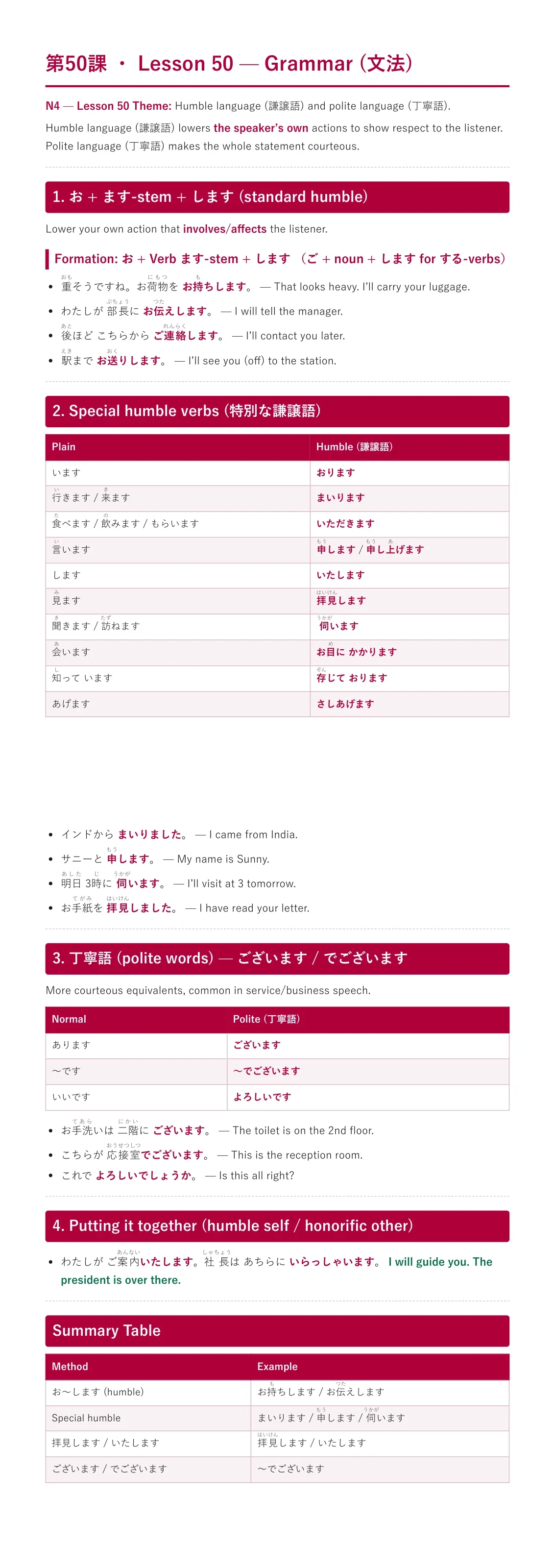
- Respectful (尊敬語) and humble (謙譲語) language for everyday situations
Who this level is for
Best for learners who have finished N5 and want a structured path through intermediate-beginner grammar toward the JLPT N4 exam.
A weekly routine for N4 grammar
- Read the lesson card and copy the conjugation table (te-form, plain, passive) in full.
- Transform five verbs through the new form until the change feels automatic.
- Build three of your own sentences using the pattern in a real situation.
- Contrast easily-confused pairs (てある vs ている, 様態 vs 伝聞 そう).
- Review the previous lesson and re-test any conjugation you slowed down on.
Common mistakes to avoid
- Confusing 自動詞+ている (state) with 他動詞+てある (intentional result).
- Mixing the two 〜そうだ: stem+そう (looks) vs plain+そうだ (I hear).
- Forgetting the particle が with potential verbs (日本語が話せます).
- Over-using plain forms in situations that call for 尊敬語 or 謙譲語.
Related study materials
Build a joined-up study cycle by combining this page with the matching JLPT N4 grammar guide, the JLPT N4 Japanese word list
Frequently asked questions
What grammar does JLPT N4 add over N5?
N4 introduces 〜んです, potential and volitional verbs, conditionals (ば/なら), the passive and causative, nominalisation (のは/のが/のを) and keigo — all covered across the standard Beginner 2 syllabus, lessons 26–50.
Do I need to memorise keigo for N4?
Yes — lessons 49–50 cover 尊敬語 and 謙譲語. Learn the special verbs (いらっしゃる, 召し上がる, 申す, 伺う) and the お〜になる / お〜する patterns.
How is N4 grammar tested?
Mostly sentence-completion and ordering. Each card's summary table and practice questions mirror that format.
Can I jump straight to N3 after N4?
Yes, but review the passive, causative and conditional patterns first — N3 builds heavily on them.
What should I do after finishing this level?
Move to the JLPT N3 grammar guide, which groups grammar by function (time, cause, condition, contrast) using the comprehensive track and the weekly-summary track.
JLPT N4 lesson-by-lesson syllabus
Every lesson on this page includes handwritten study cards with full written explanations. Here is what each lesson covers:
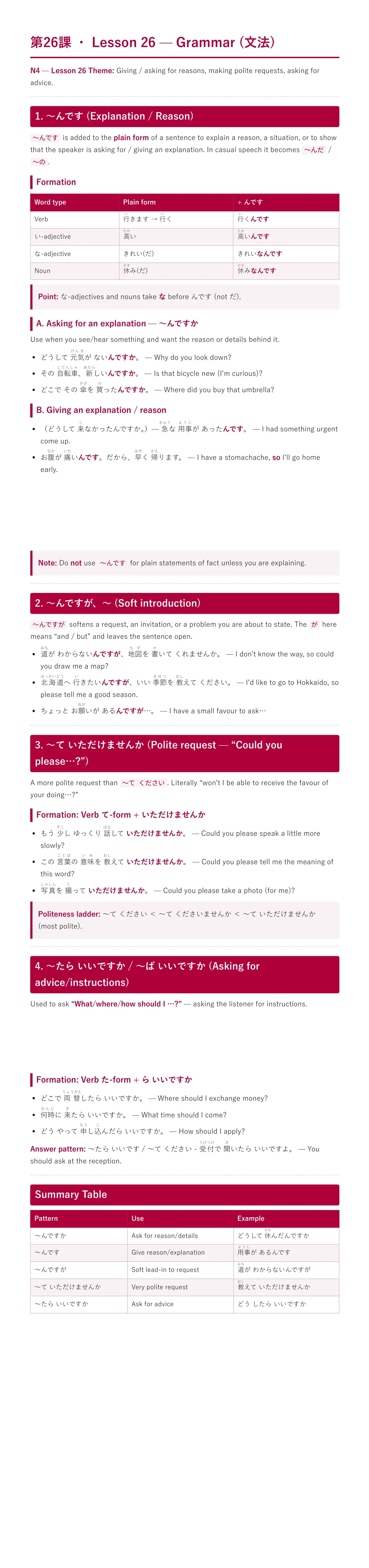
Lesson 26
Use when you see/hear something and want the reason or details behind it.
Covers: 〜んです (Explanation / Reason) · Formation · A. Asking for an explanation — 〜んですか · B. Giving an explanation / reason · 〜んですが、〜 (Soft introduction) · 〜て いただけませんか (Polite request — "Could you please…?") · Formation: Verb て-form + いただけませんか · 〜たら いいですか / 〜ば いいですか (Asking for advice/instructions) · Formation: Verb た-form + ら いいですか · Summary Table · Key Vocabulary (単語) · Example Sentences (例文) · 〜んです (reason / explanation) · 〜て いただけませんか (polite request) · 〜たら いいですか (asking advice) · Model Conversation (会話) — 祭りの相談 · Mini Practice (練習)
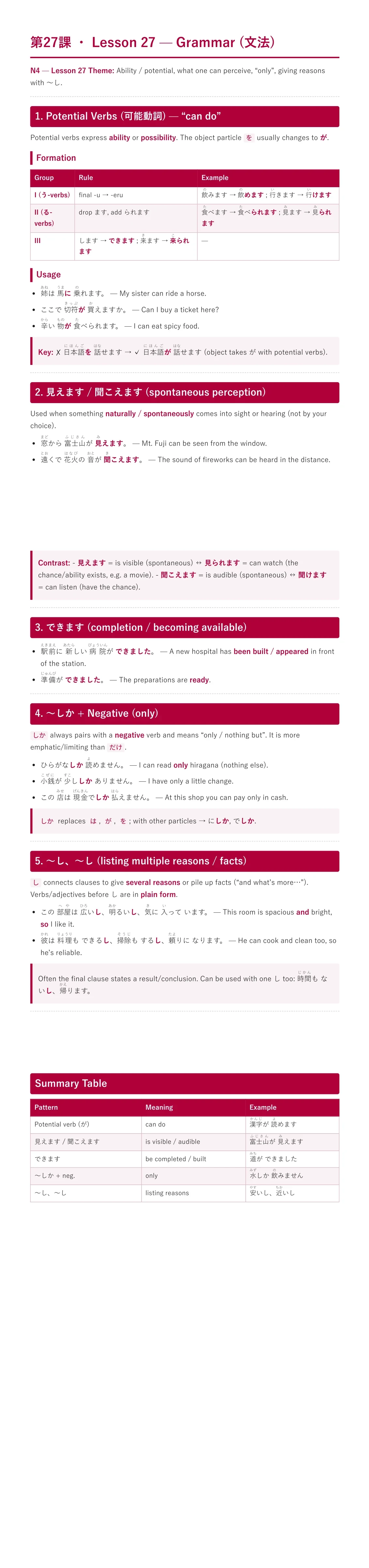
Lesson 27
Potential verbs express ability or possibility. The object particle を usually changes to が.
Covers: Potential Verbs (可能動詞) — "can do" · Formation · Usage · 見えます / 聞こえます (spontaneous perception) · できます (completion / becoming available) · 〜しか + Negative (only) · 〜し、〜し (listing multiple reasons / facts) · Summary Table · Key Vocabulary (単語) · Example Sentences (例文) · Potential verbs · 見えます / 聞こえます · できます (completed) · 〜しか / 〜し · Model Conversation (会話) — 引っ越し · Mini Practice (練習)
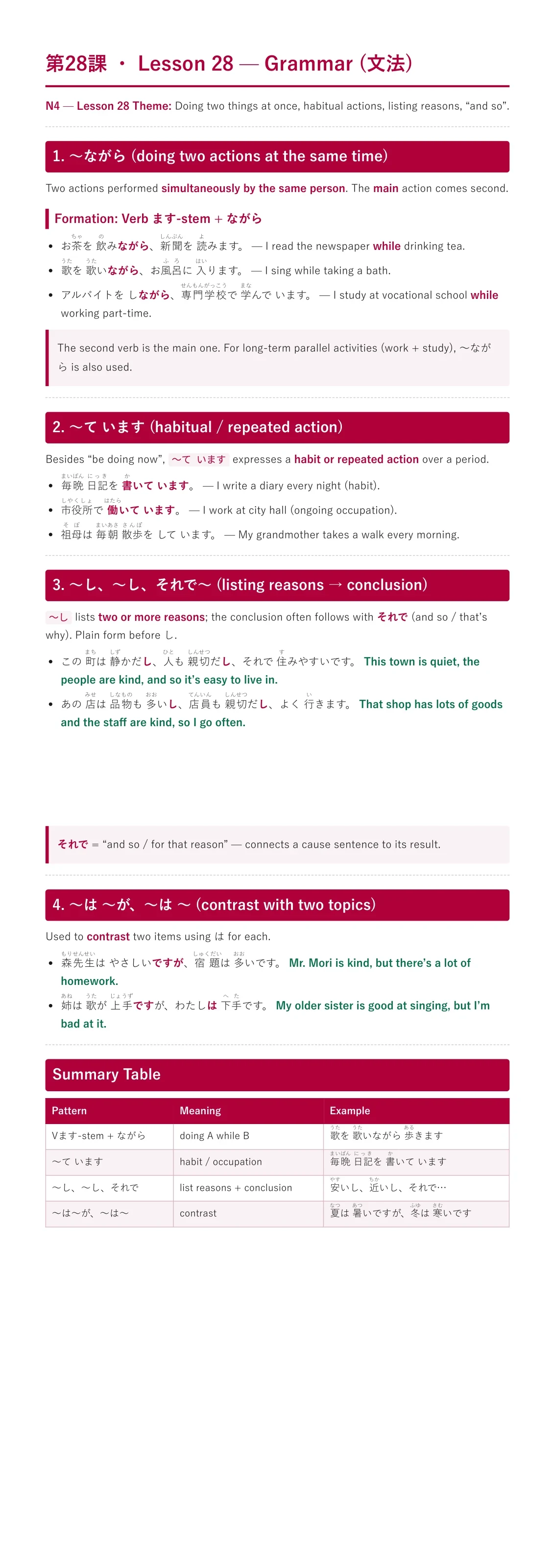
Lesson 28
Two actions performed simultaneously by the same person. The main action comes second.
Covers: 〜ながら (doing two actions at the same time) · Formation: Verb ます-stem + ながら · 〜て います (habitual / repeated action) · 〜し、〜し、それで〜 (listing reasons → conclusion) · 〜は 〜が、〜は 〜 (contrast with two topics) · Summary Table · Key Vocabulary (単語) · Example Sentences (例文) · 〜ながら · 〜て います (habit) · 〜し、〜し、それで · Model Conversation (会話) — 勉強の仕方 · Mini Practice (練習)
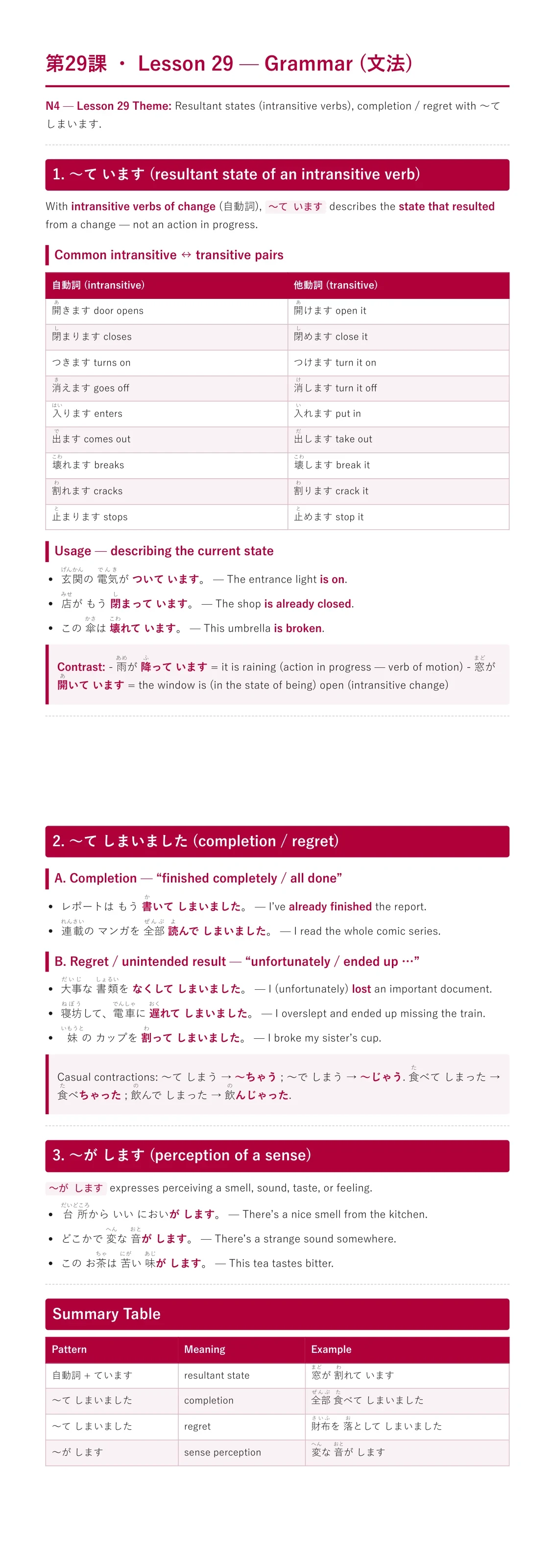
Lesson 29
With intransitive verbs of change (自動詞), 〜て います describes the state that resulted from a change — not an action in progress.
Covers: 〜て います (resultant state of an intransitive verb) · Common intransitive ↔ transitive pairs · Usage — describing the current state · 〜て しまいました (completion / regret) · A. Completion — "finished completely / all done" · B. Regret / unintended result — "unfortunately / ended up …" · 〜が します (perception of a sense) · Summary Table · Key Vocabulary (単語) · Example Sentences (例文) · Resultant state (自動詞 + ています) · 〜て しまいました · 〜が します · Model Conversation (会話) — 忘れ物 · Mini Practice (練習)
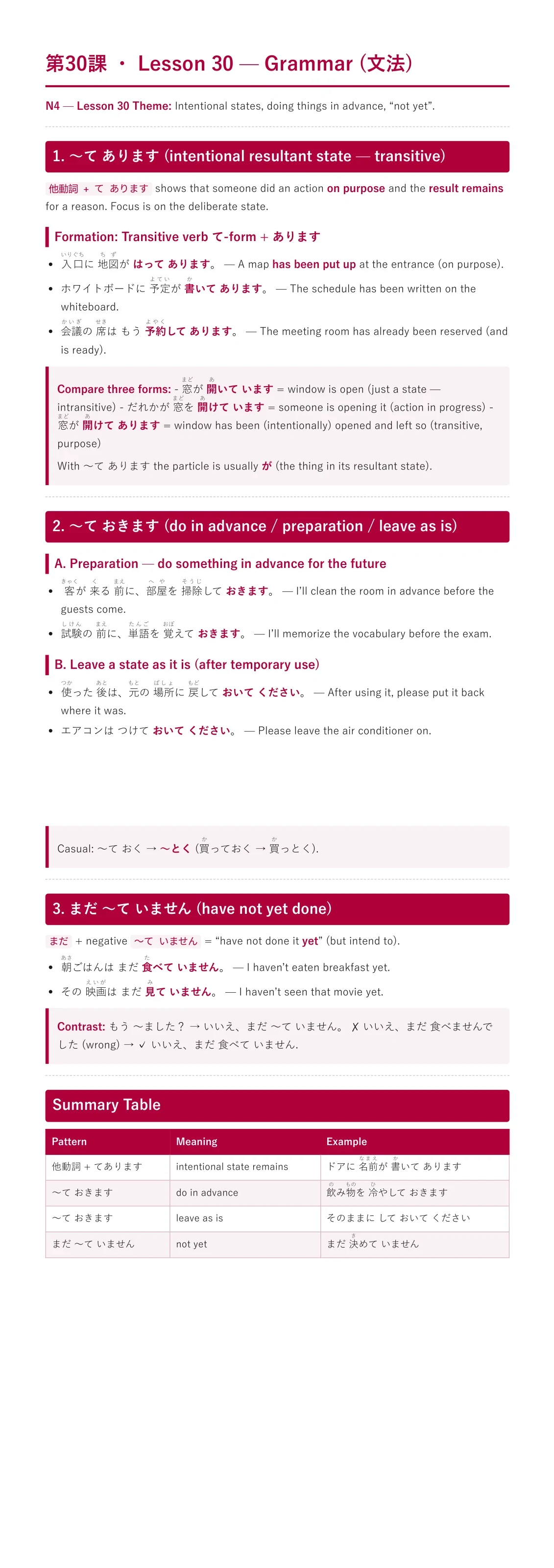
Lesson 30
B: I've put the tea in the fridge in advance. But I haven't bought fruit yet.
Covers: 〜て あります (intentional resultant state — transitive) · Formation: Transitive verb て-form + あります · 〜て おきます (do in advance / preparation / leave as is) · A. Preparation — do something in advance for the future · B. Leave a state as it is (after temporary use) · まだ 〜て いません (have not yet done) · Summary Table · Key Vocabulary (単語) · Example Sentences (例文) · 〜て あります · 〜て おきます · まだ 〜て いません · Model Conversation (会話) — パーティーの準備 · Mini Practice (練習)
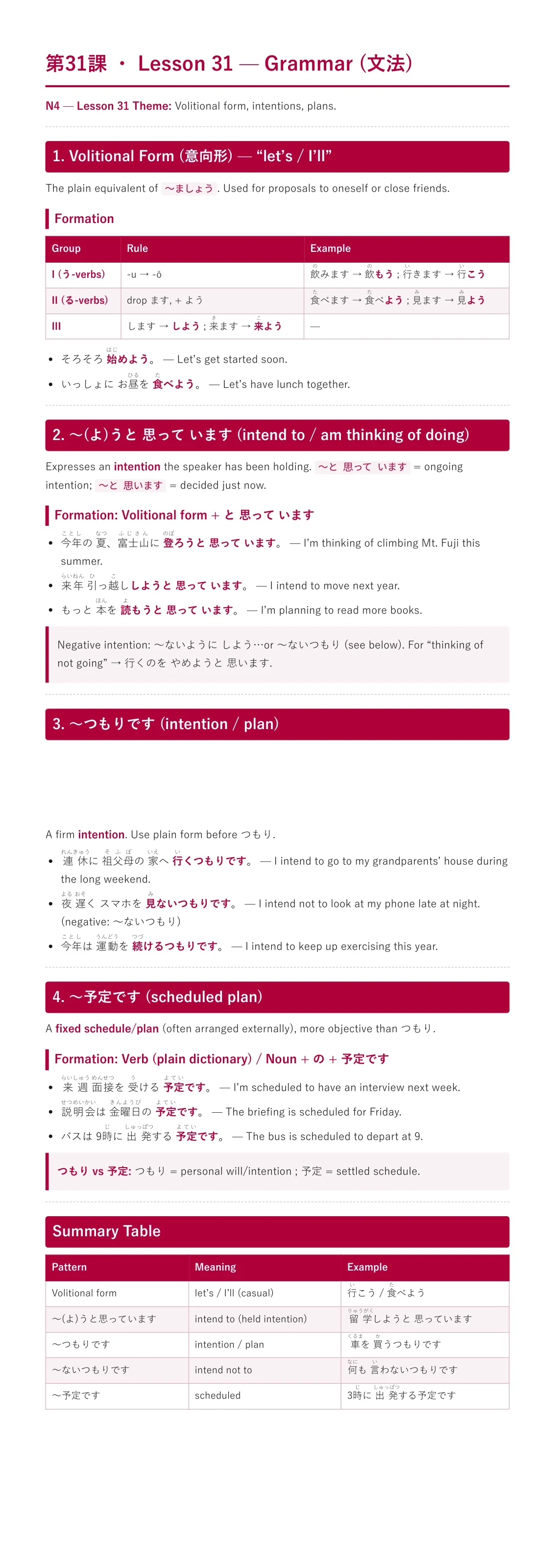
Lesson 31
The plain equivalent of 〜ましょう. Used for proposals to oneself or close friends.
Covers: Volitional Form (意向形) — "let's / I'll" · Formation · 〜(よ)うと 思って います (intend to / am thinking of doing) · Formation: Volitional form + と 思って います · 〜つもりです (intention / plan) · 〜予定です (scheduled plan) · Formation: Verb (plain dictionary) / Noun + の + 予定です · Summary Table · Key Vocabulary (単語) · Example Sentences (例文) · Volitional form · 〜(よ)うと思っています · 〜つもりです · 〜予定です · Model Conversation (会話) — 将来の計画 · Mini Practice (練習)
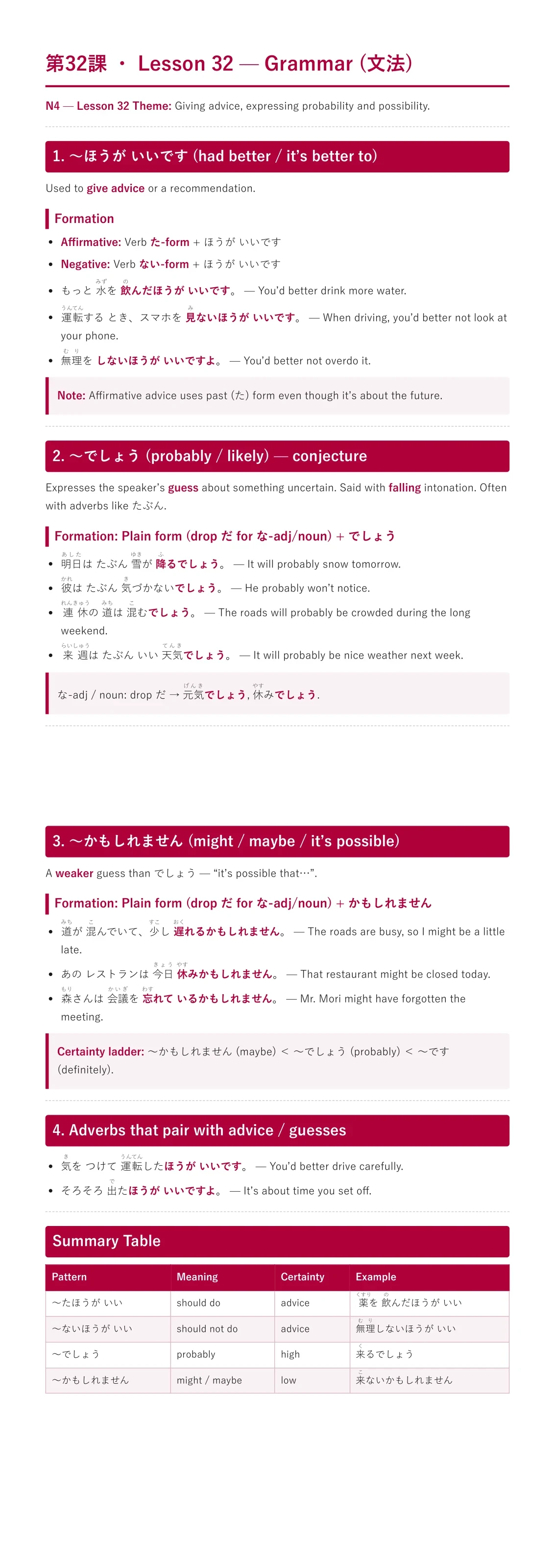
Lesson 32
Used to give advice or a recommendation.
Covers: 〜ほうが いいです (had better / it's better to) · Formation · 〜でしょう (probably / likely) — conjecture · Formation: Plain form (drop だ for な-adj/noun) + でしょう · 〜かもしれません (might / maybe / it's possible) · Formation: Plain form (drop だ for な-adj/noun) + かもしれません · Adverbs that pair with advice / guesses · Summary Table · Key Vocabulary (単語) · Example Sentences (例文) · 〜ほうが いいです · 〜でしょう · 〜かもしれません · Model Conversation (会話) — 健康 · Mini Practice (練習)
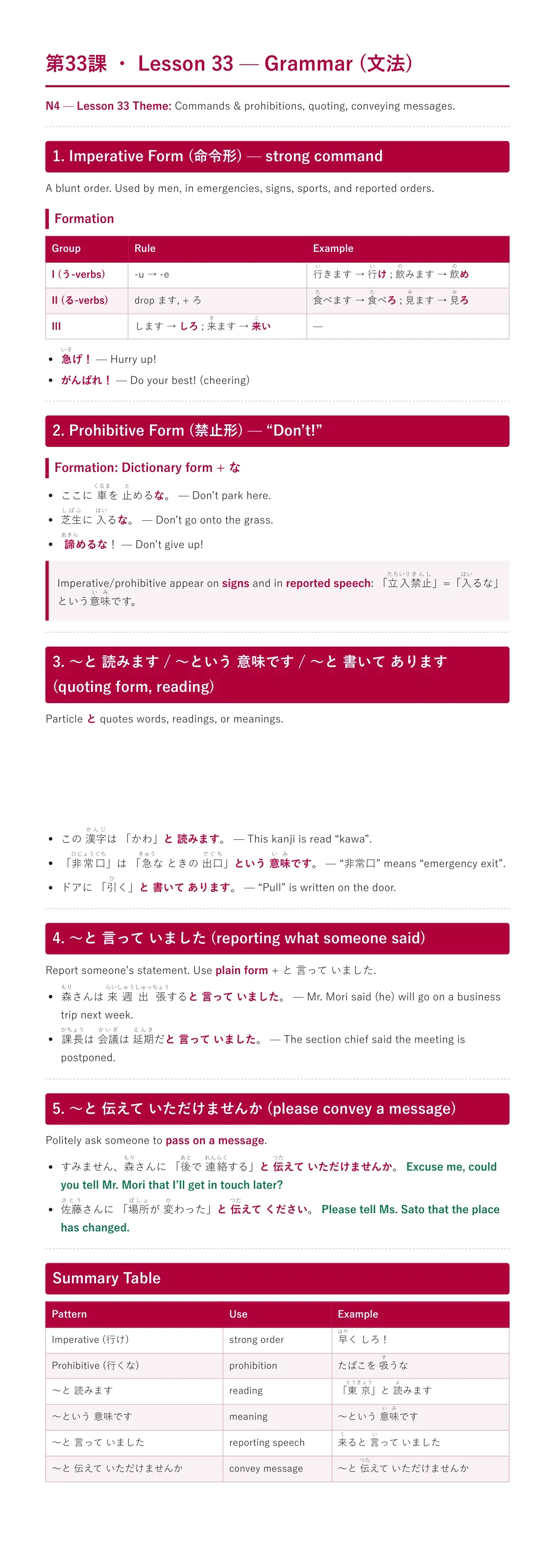
Lesson 33
A blunt order. Used by men, in emergencies, signs, sports, and reported orders.
Covers: Imperative Form (命令形) — strong command · Formation · Prohibitive Form (禁止形) — "Don't!" · Formation: Dictionary form + な · 〜と 読みます / 〜という 意味です / 〜と 書いて あります (quoting form, reading) · 〜と 言って いました (reporting what someone said) · 〜と 伝えて いただけませんか (please convey a message) · Summary Table · Key Vocabulary (単語) · Example Sentences (例文) · Imperative / Prohibitive · Reading / meaning · Reporting speech · Conveying a message · Model Conversation (会話) — 伝言 · Mini Practice (練習)
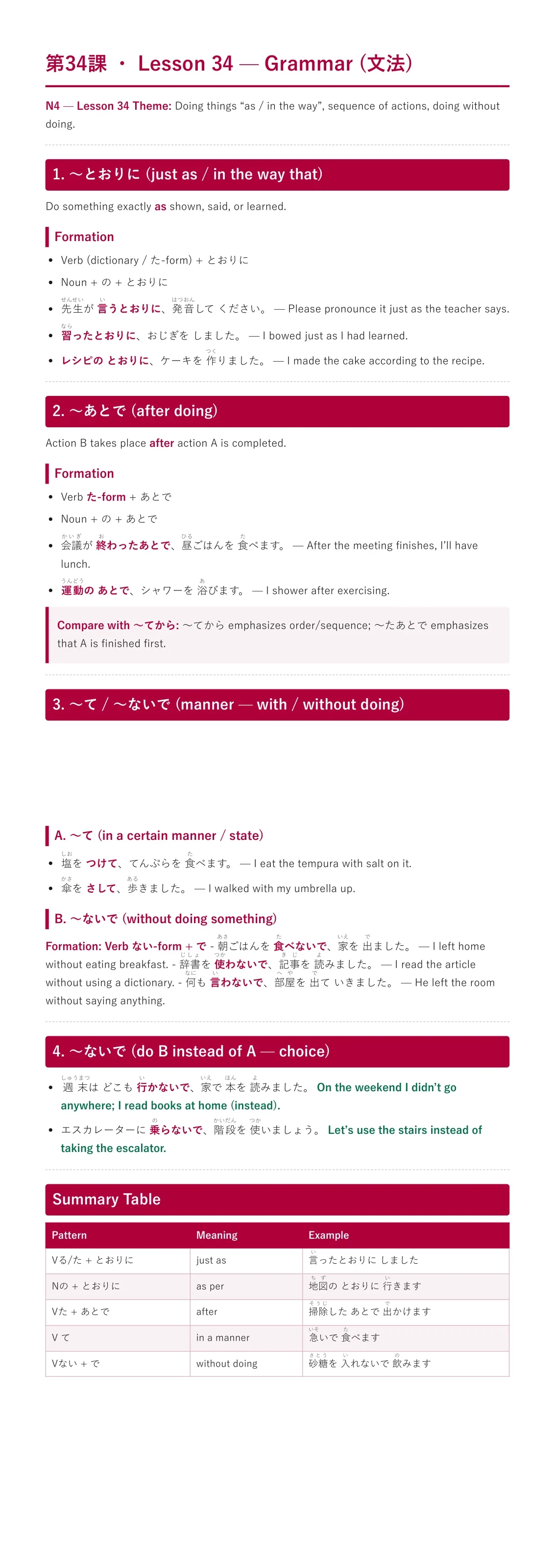
Lesson 34
Do something exactly as shown, said, or learned.
Covers: 〜とおりに (just as / in the way that) · Formation · 〜あとで (after doing) · 〜て / 〜ないで (manner — with / without doing) · A. 〜て (in a certain manner / state) · B. 〜ないで (without doing something) · 〜ないで (do B instead of A — choice) · Summary Table · Key Vocabulary (単語) · Example Sentences (例文) · 〜とおりに · 〜あとで · 〜て / 〜ないで · Model Conversation (会話) — 料理の作り方 · Mini Practice (練習)
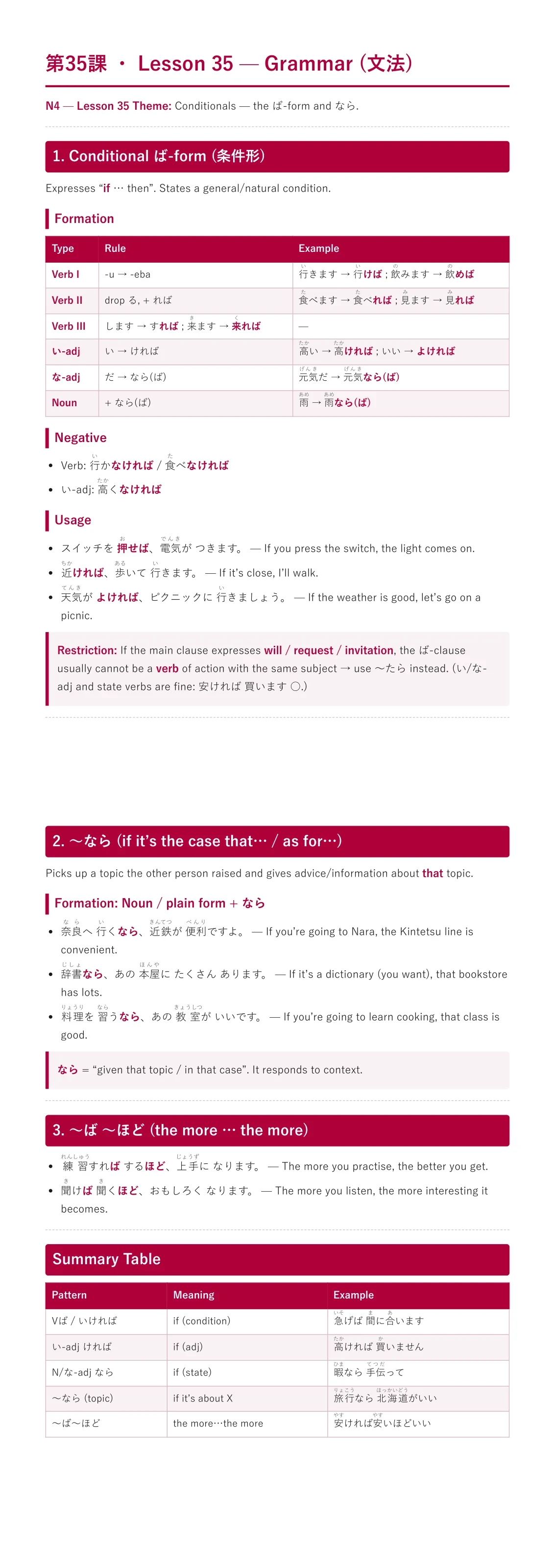
Lesson 35
Expresses "if … then". States a general/natural condition.
Covers: Conditional ば-form (条件形) · Formation · Negative · Usage · 〜なら (if it's the case that… / as for…) · Formation: Noun / plain form + なら · 〜ば 〜ほど (the more … the more) · Summary Table · Key Vocabulary (単語) · Example Sentences (例文) · ば-form conditional · 〜なら · 〜ば〜ほど · Model Conversation (会話) — 旅行の相談 · Mini Practice (練習)
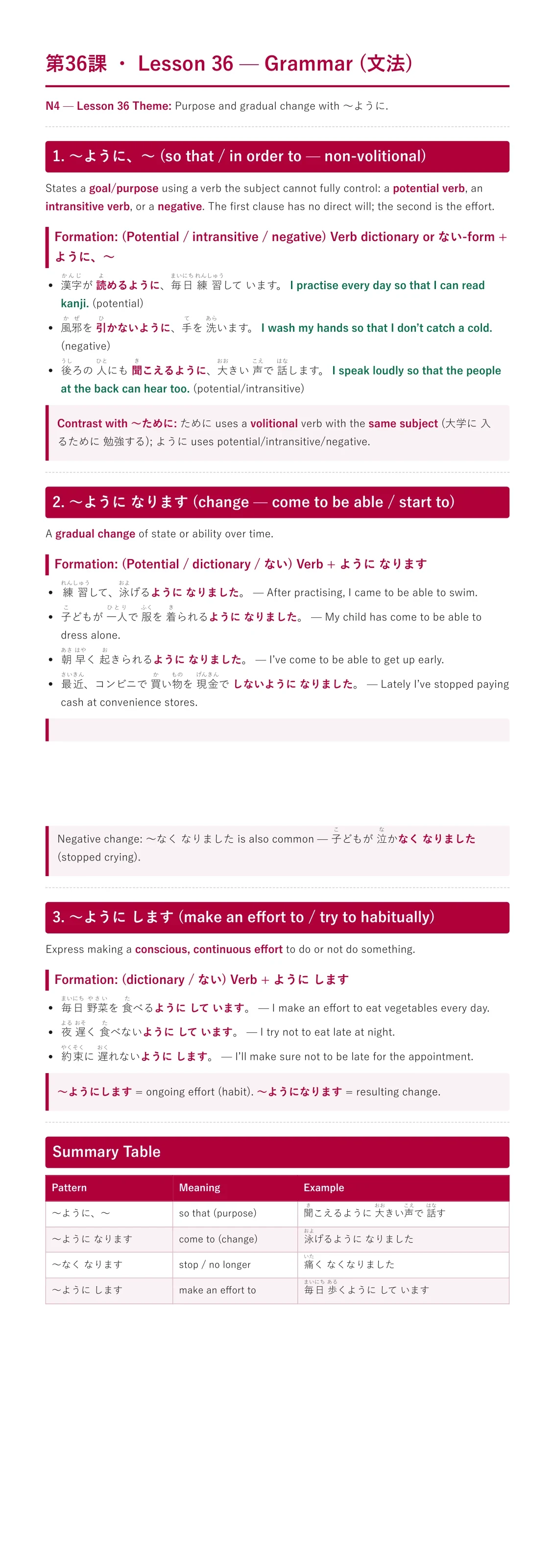
Lesson 36
States a goal/purpose using a verb the subject cannot fully control: a potential verb, an intransitive verb, or a negative. The first clause has no direct will; the second is the effort.
Covers: 〜ように、〜 (so that / in order to — non-volitional) · Formation: (Potential / intransitive / negative) Verb dictionary or ない-form + ように、〜 · 〜ように なります (change — come to be able / start to) · Formation: (Potential / dictionary / ない) Verb + ように なります · 〜ように します (make an effort to / try to habitually) · Formation: (dictionary / ない) Verb + ように します · Summary Table · Key Vocabulary (単語) · Example Sentences (例文) · 〜ように (purpose) · 〜ようになります · 〜ようにします · Model Conversation (会話) — 日本語の上達 · Mini Practice (練習)
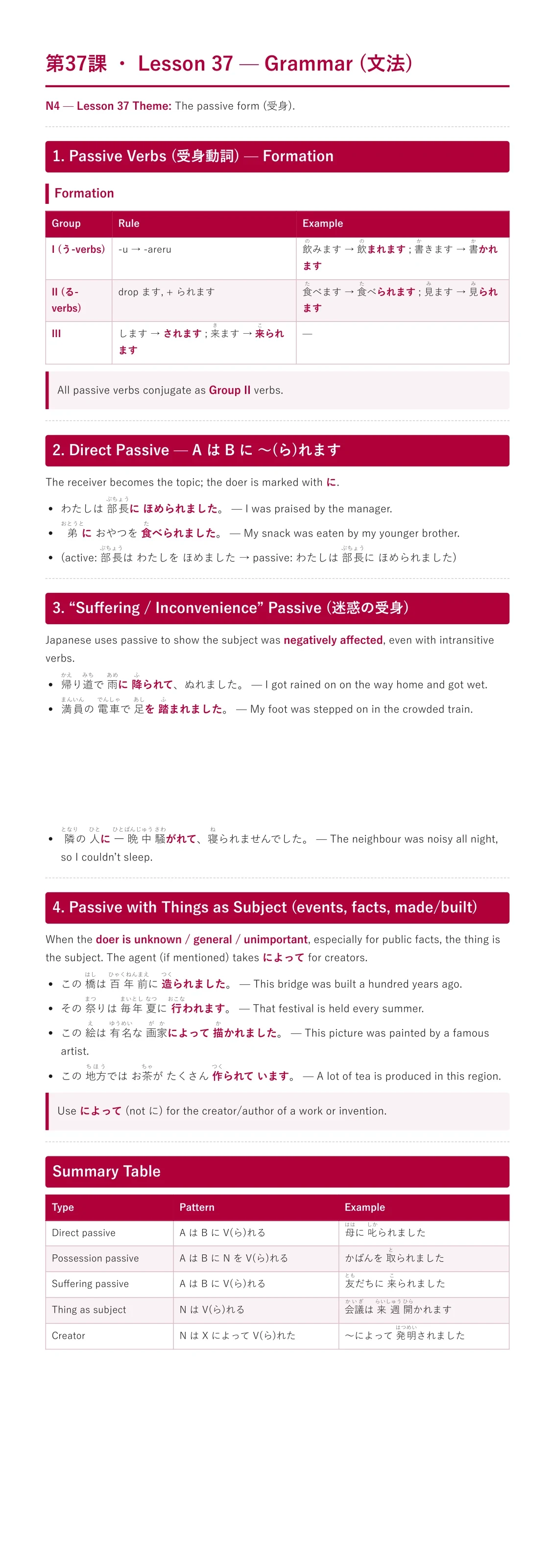
Lesson 37
The receiver becomes the topic; the doer is marked with に.
Covers: Passive Verbs (受身動詞) — Formation · Formation · Direct Passive — A は B に 〜(ら)れます · "Suffering / Inconvenience" Passive (迷惑の受身) · Passive with Things as Subject (events, facts, made/built) · Summary Table · Key Vocabulary (単語) & Passive Forms · Example Sentences (例文) · Direct passive · Possession / suffering passive · Thing as subject · Model Conversation (会話) — 災難 · Mini Practice (練習)
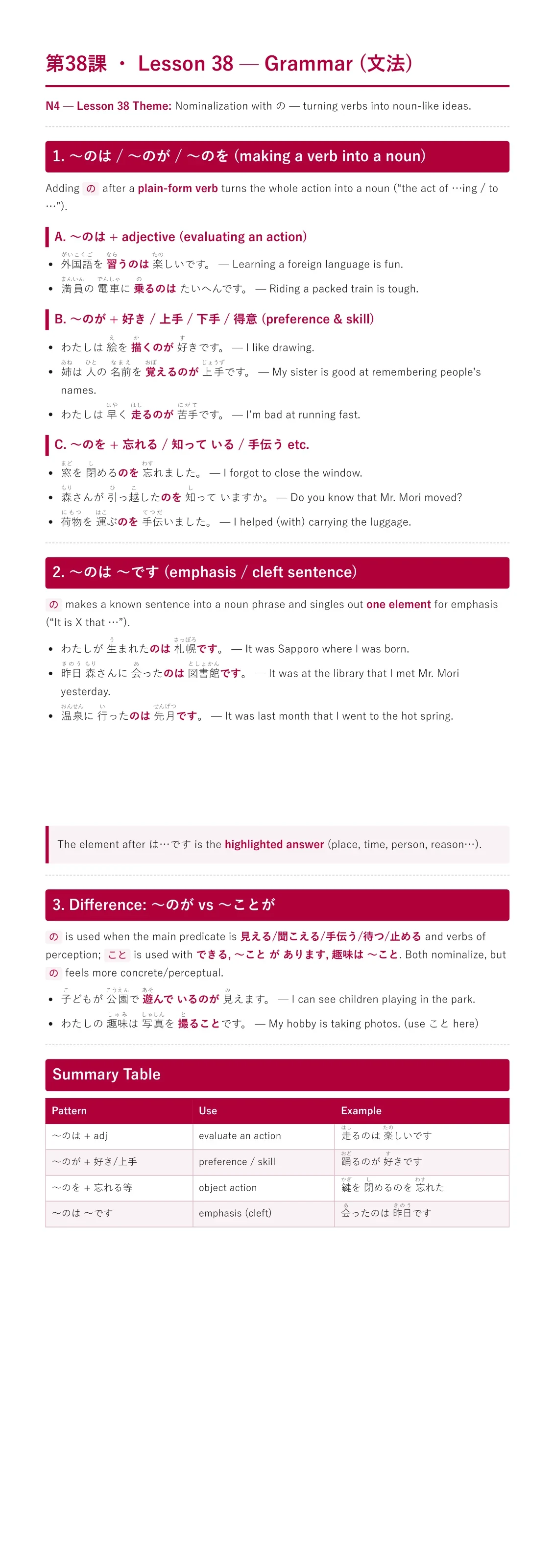
Lesson 38
Adding の after a plain-form verb turns the whole action into a noun ("the act of …ing / to …").
Covers: 〜のは / 〜のが / 〜のを (making a verb into a noun) · A. 〜のは + adjective (evaluating an action) · B. 〜のが + 好き / 上手 / 下手 / 得意 (preference & skill) · C. 〜のを + 忘れる / 知って いる / 手伝う etc. · 〜のは 〜です (emphasis / cleft sentence) · Difference: 〜のが vs 〜ことが · Summary Table · Key Vocabulary (単語) · Example Sentences (例文) · 〜のは / 〜のが / 〜のを · 〜のは 〜です (emphasis) · Model Conversation (会話) — 趣味の話 · Mini Practice (練習)
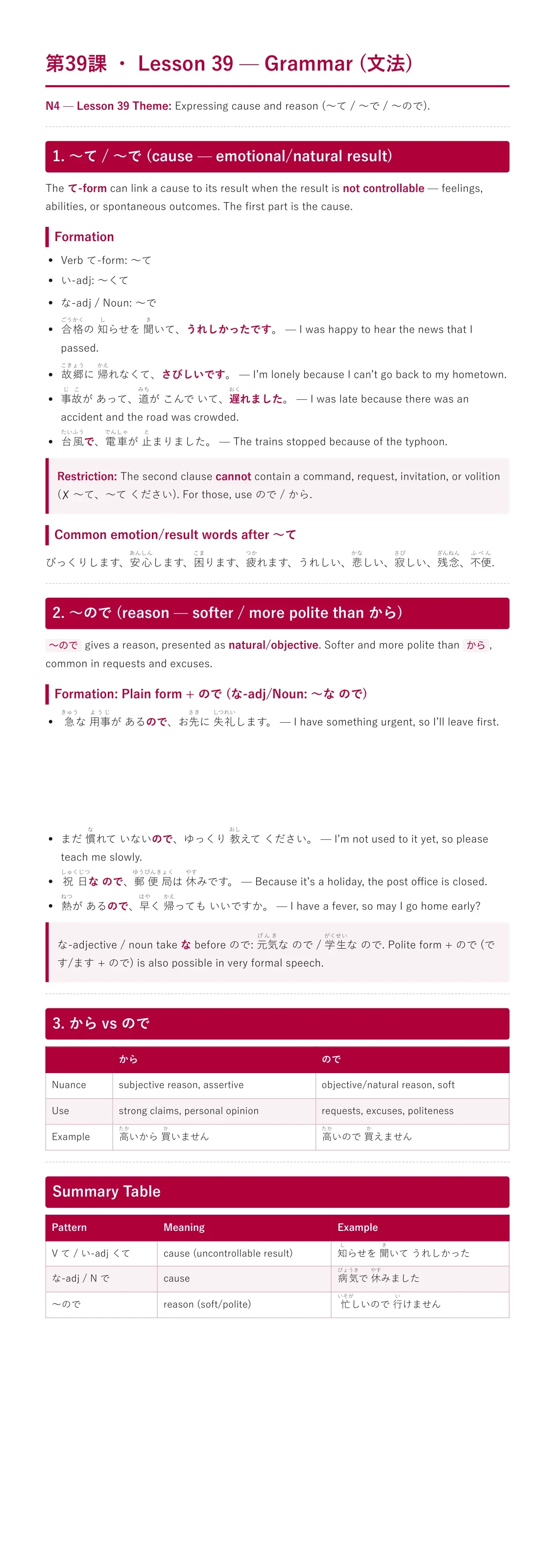
Lesson 39
The て-form can link a cause to its result when the result is not controllable — feelings, abilities, or spontaneous outcomes. The first part is the cause.
Covers: 〜て / 〜で (cause — emotional/natural result) · Formation · 〜ので (reason — softer / more polite than から) · Formation: Plain form + ので (な-adj/Noun: 〜な ので) · から vs ので · Summary Table · Key Vocabulary (単語) · Example Sentences (例文) · 〜て / 〜で (cause) · 〜ので · Model Conversation (会話) — 遅刻の言い訳 · Mini Practice (練習)
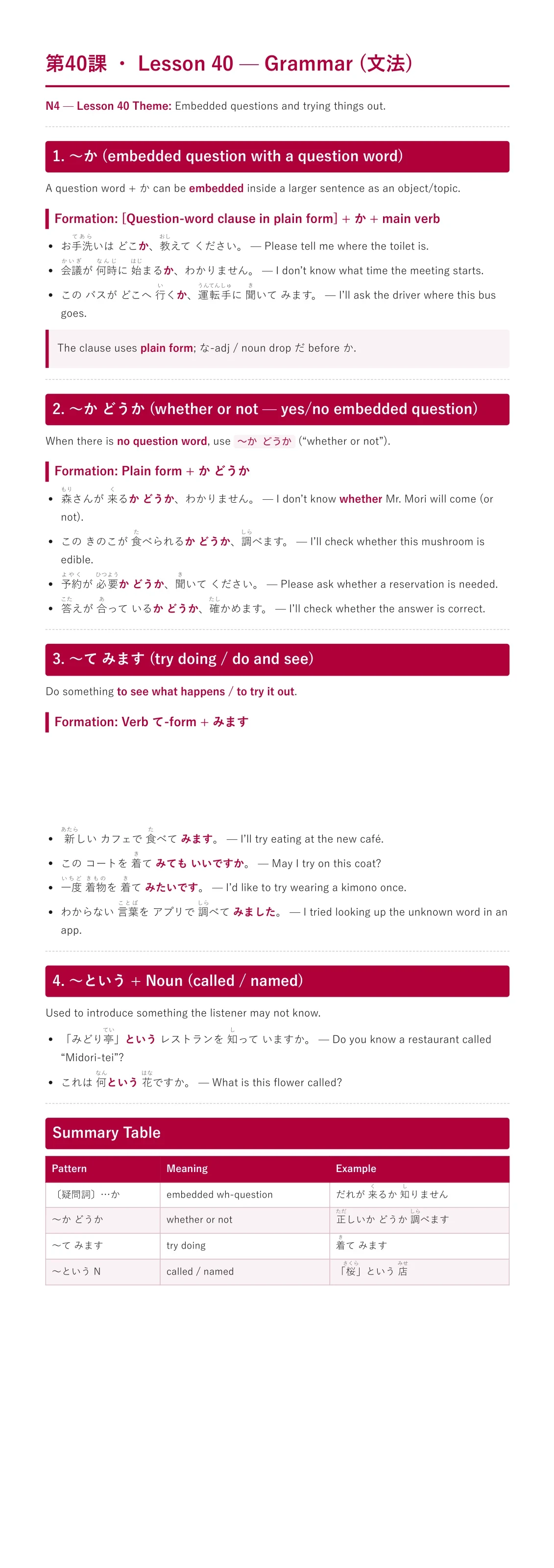
Lesson 40
A question word + か can be embedded inside a larger sentence as an object/topic.
Covers: 〜か (embedded question with a question word) · Formation: [Question-word clause in plain form] + か + main verb · 〜か どうか (whether or not — yes/no embedded question) · Formation: Plain form + か どうか · 〜て みます (try doing / do and see) · Formation: Verb て-form + みます · 〜という + Noun (called / named) · Summary Table · Key Vocabulary (単語) · Example Sentences (例文) · Embedded question (〜か) · 〜か どうか · 〜て みます · Model Conversation (会話) — 試験の結果 · Mini Practice (練習)
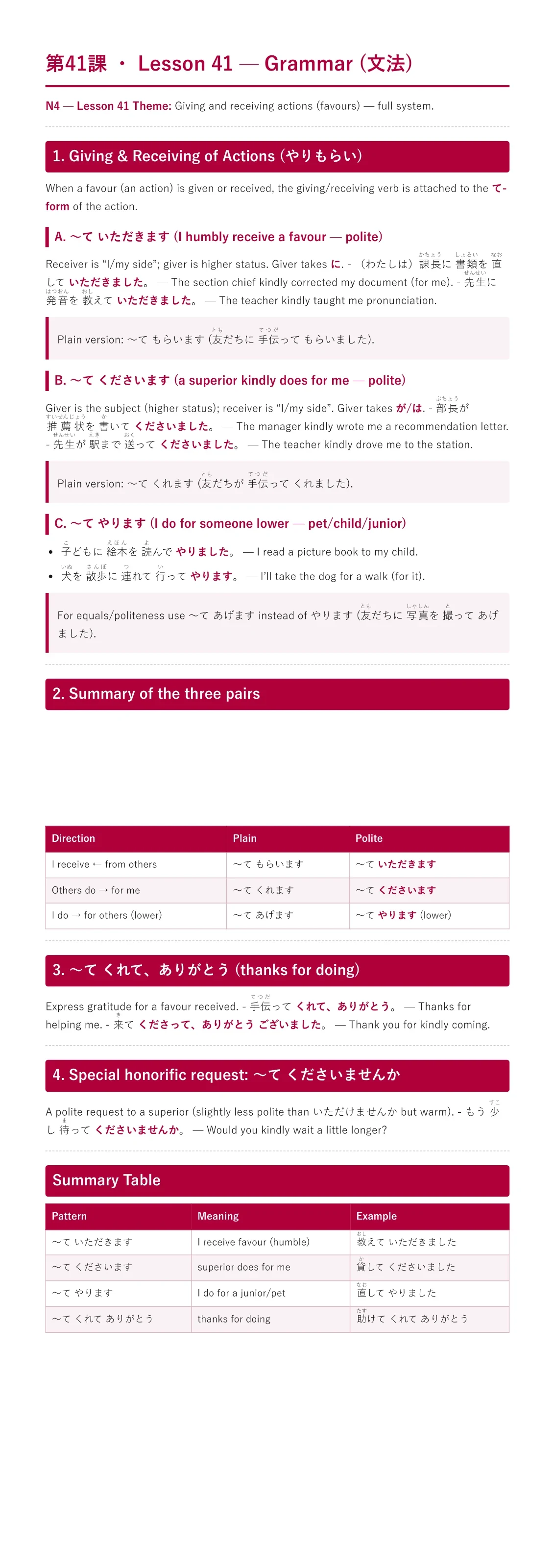
Lesson 41
When a favour (an action) is given or received, the giving/receiving verb is attached to the て-form of the action.
Covers: Giving & Receiving of Actions (やりもらい) · A. 〜て いただきます (I humbly receive a favour — polite) · B. 〜て くださいます (a superior kindly does for me — polite) · C. 〜て やります (I do for someone lower — pet/child/junior) · Summary of the three pairs · 〜て くれて、ありがとう (thanks for doing) · Special honorific request: 〜て くださいませんか · Summary Table · Key Vocabulary (単語) · Example Sentences (例文) · 〜て いただきます · 〜て くださいます · 〜て やります / あげます · 〜て くれて ありがとう · Model Conversation (会話) — お礼 · Mini Practice (練習)
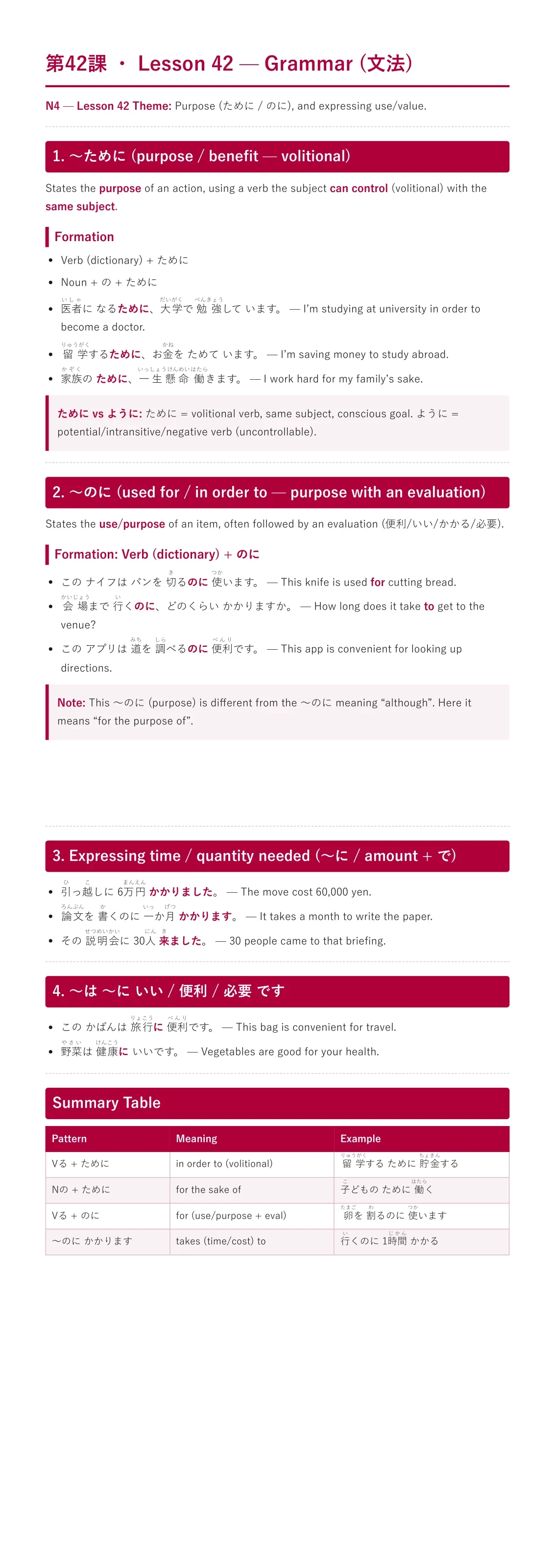
Lesson 42
States the purpose of an action, using a verb the subject can control (volitional) with the same subject.
Covers: 〜ために (purpose / benefit — volitional) · Formation · 〜のに (used for / in order to — purpose with an evaluation) · Formation: Verb (dictionary) + のに · Expressing time / quantity needed (〜に / amount + で) · 〜は 〜に いい / 便利 / 必要 です · Summary Table · Key Vocabulary (単語) · Example Sentences (例文) · 〜ために (purpose) · 〜のに (purpose / use) · Quantity / value · Model Conversation (会話) — 将来の目標 · Mini Practice (練習)
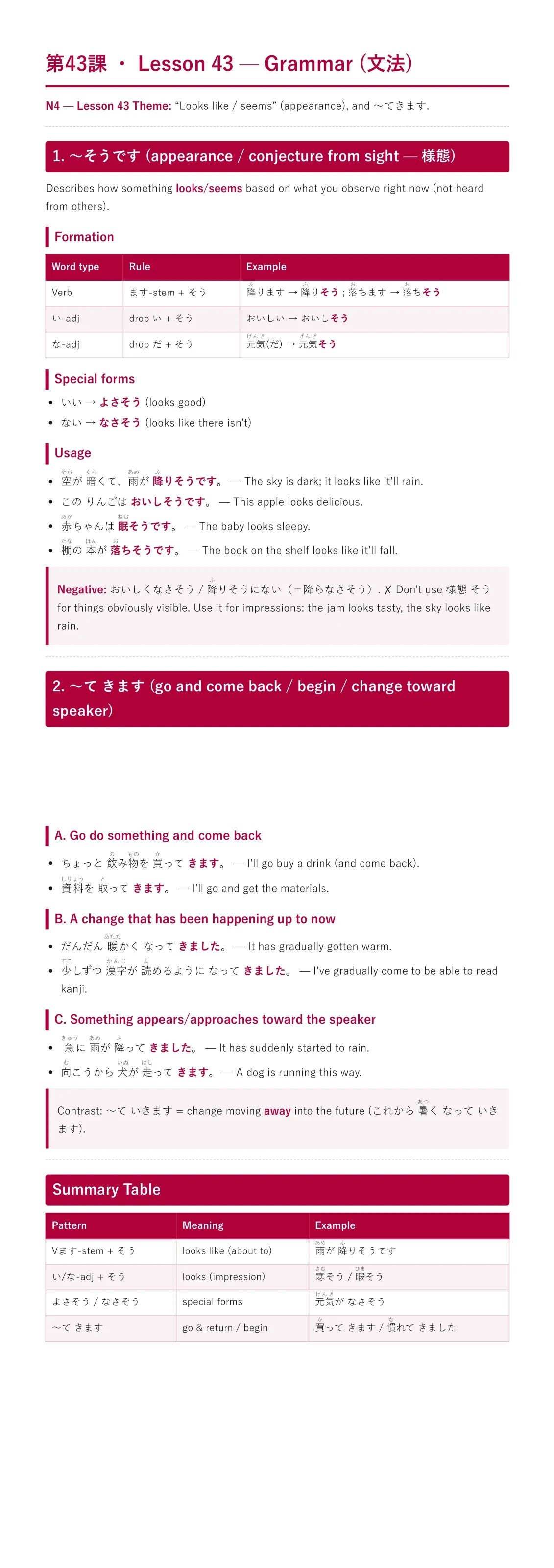
Lesson 43
Describes how something looks/seems based on what you observe right now (not heard from others).
Covers: 〜そうです (appearance / conjecture from sight — 様態) · Formation · Special forms · Usage · 〜て きます (go and come back / begin / change toward speaker) · A. Go do something and come back · B. A change that has been happening up to now · C. Something appears/approaches toward the speaker · Summary Table · Key Vocabulary (単語) · Example Sentences (例文) · 〜そうです (appearance) · 〜て きます · Model Conversation (会話) — お天気 · Mini Practice (練習)
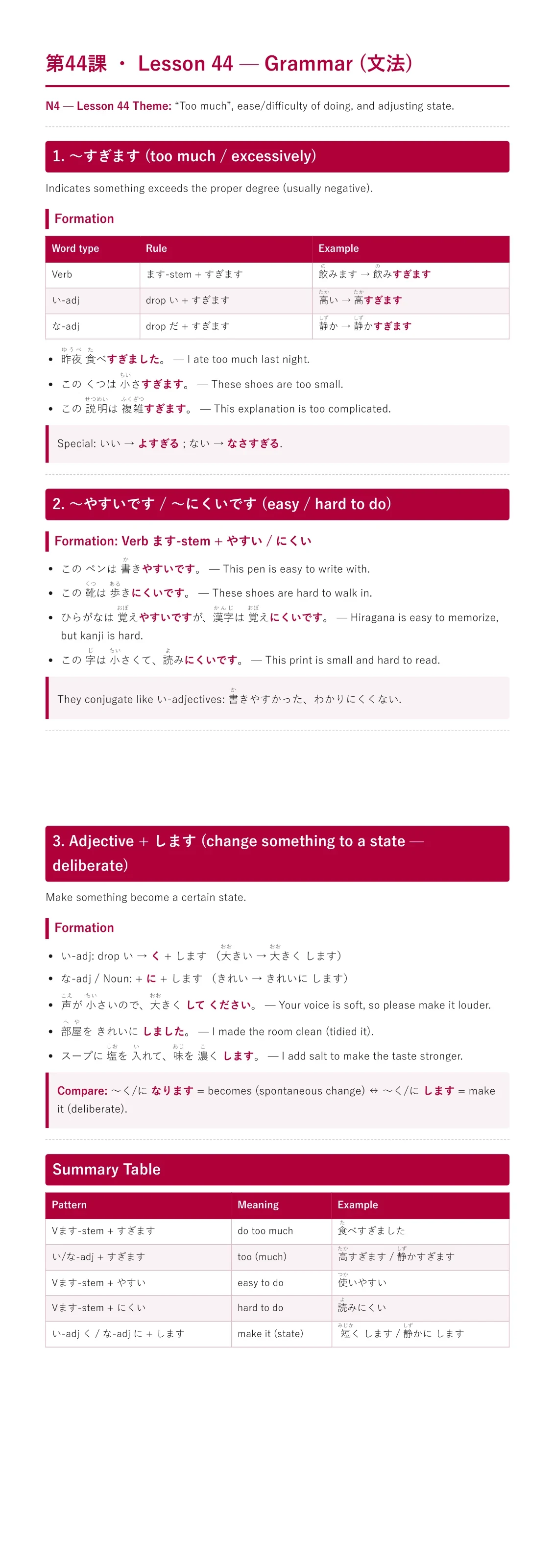
Lesson 44
Indicates something exceeds the proper degree (usually negative).
Covers: 〜すぎます (too much / excessively) · Formation · 〜やすいです / 〜にくいです (easy / hard to do) · Formation: Verb ます-stem + やすい / にくい · Adjective + します (change something to a state — deliberate) · Summary Table · Key Vocabulary (単語) · Example Sentences (例文) · 〜すぎます · 〜やすい / 〜にくい · Adjective + します · Model Conversation (会話) — 美容院で · Mini Practice (練習)
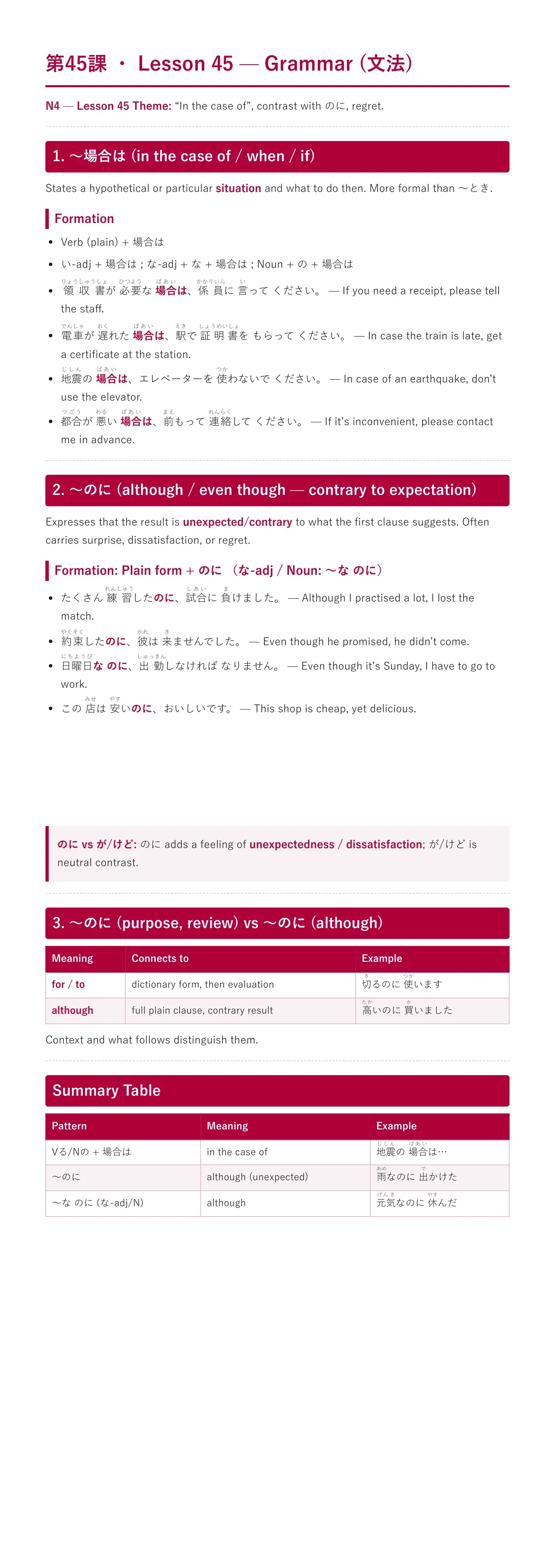
Lesson 45
States a hypothetical or particular situation and what to do then. More formal than 〜とき.
Covers: 〜場合は (in the case of / when / if) · Formation · 〜のに (although / even though — contrary to expectation) · Formation: Plain form + のに (な-adj / Noun: 〜な のに) · 〜のに (purpose, review) vs 〜のに (although) · Summary Table · Key Vocabulary (単語) · Example Sentences (例文) · 〜場合は · 〜のに (although) · Model Conversation (会話) — 試験の結果 · Mini Practice (練習)
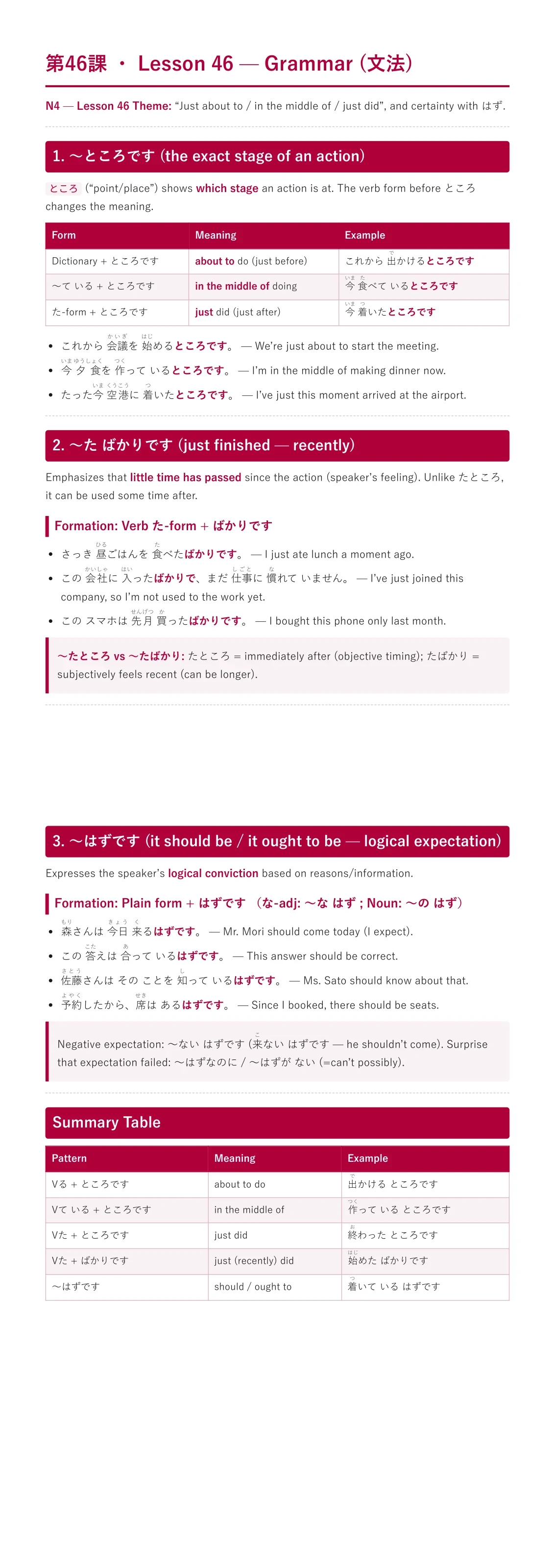
Lesson 46
Emphasizes that little time has passed since the action (speaker's feeling). Unlike たところ, it can be used some time after.
Covers: 〜ところです (the exact stage of an action) · 〜た ばかりです (just finished — recently) · Formation: Verb た-form + ばかりです · 〜はずです (it should be / it ought to be — logical expectation) · Formation: Plain form + はずです (な-adj: 〜な はず ; Noun: 〜の はず) · Summary Table · Key Vocabulary (単語) · Example Sentences (例文) · 〜ところです · 〜た ばかりです · 〜はずです · Model Conversation (会話) — 電話で · Mini Practice (練習)
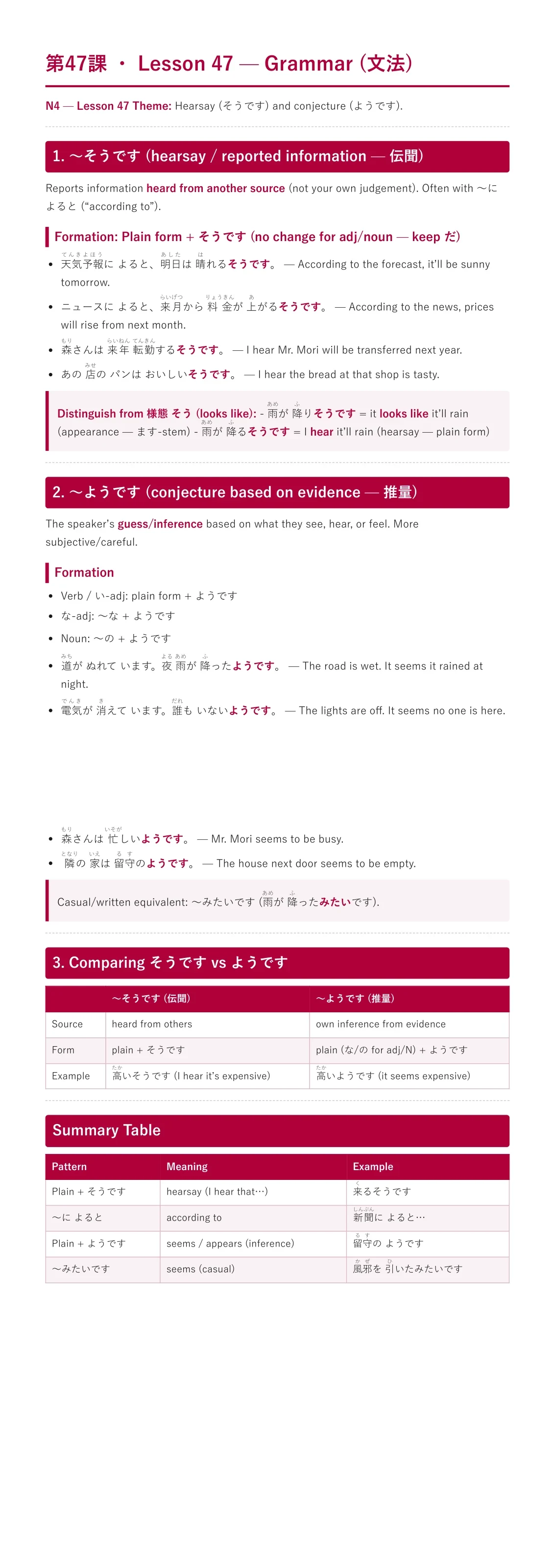
Lesson 47
Reports information heard from another source (not your own judgement). Often with 〜に よると ("according to").
Covers: 〜そうです (hearsay / reported information — 伝聞) · Formation: Plain form + そうです (no change for adj/noun — keep だ) · 〜ようです (conjecture based on evidence — 推量) · Formation · Comparing そうです vs ようです · Summary Table · Key Vocabulary (単語) · Example Sentences (例文) · 〜そうです (hearsay) · 〜ようです (conjecture) · Model Conversation (会話) — うわさ話 · Mini Practice (練習)
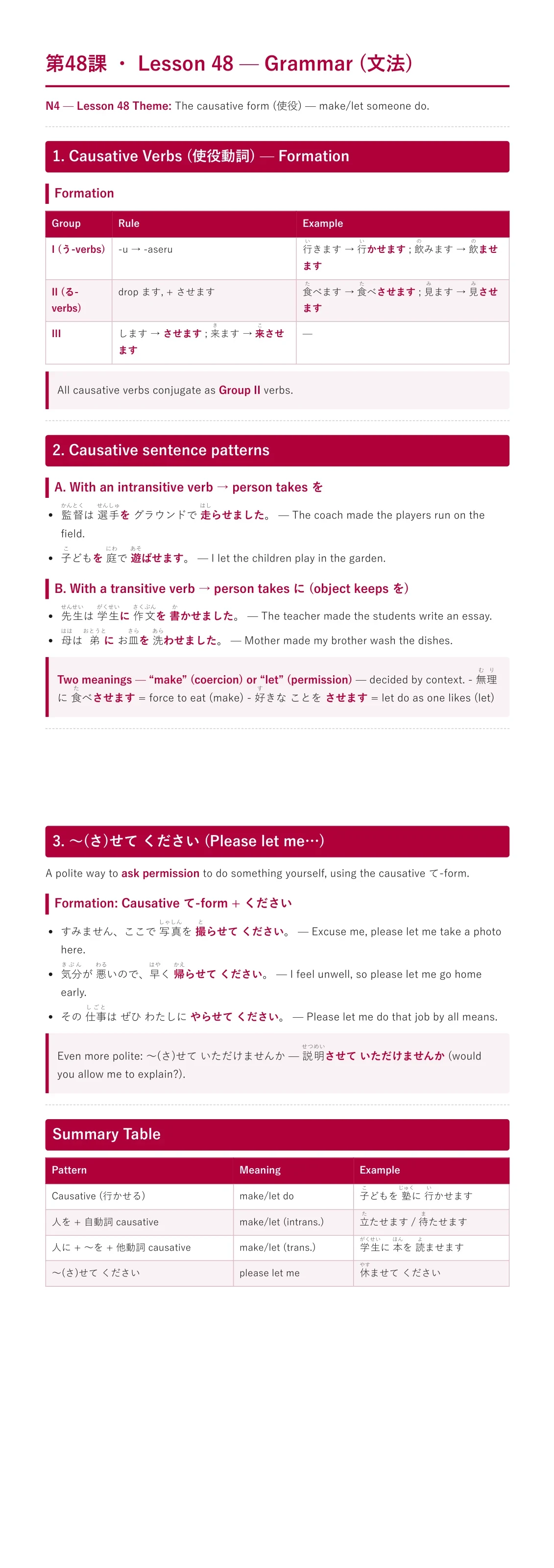
Lesson 48
A polite way to ask permission to do something yourself, using the causative て-form.
Covers: Causative Verbs (使役動詞) — Formation · Formation · Causative sentence patterns · A. With an intransitive verb → person takes を · B. With a transitive verb → person takes に (object keeps を) · 〜(さ)せて ください (Please let me…) · Formation: Causative て-form + ください · Summary Table · Key Vocabulary (単語) & Causative Forms · Example Sentences (例文) · Causative — make / let · 〜(さ)せて ください · Model Conversation (会話) — 休みのお願い · Mini Practice (練習)
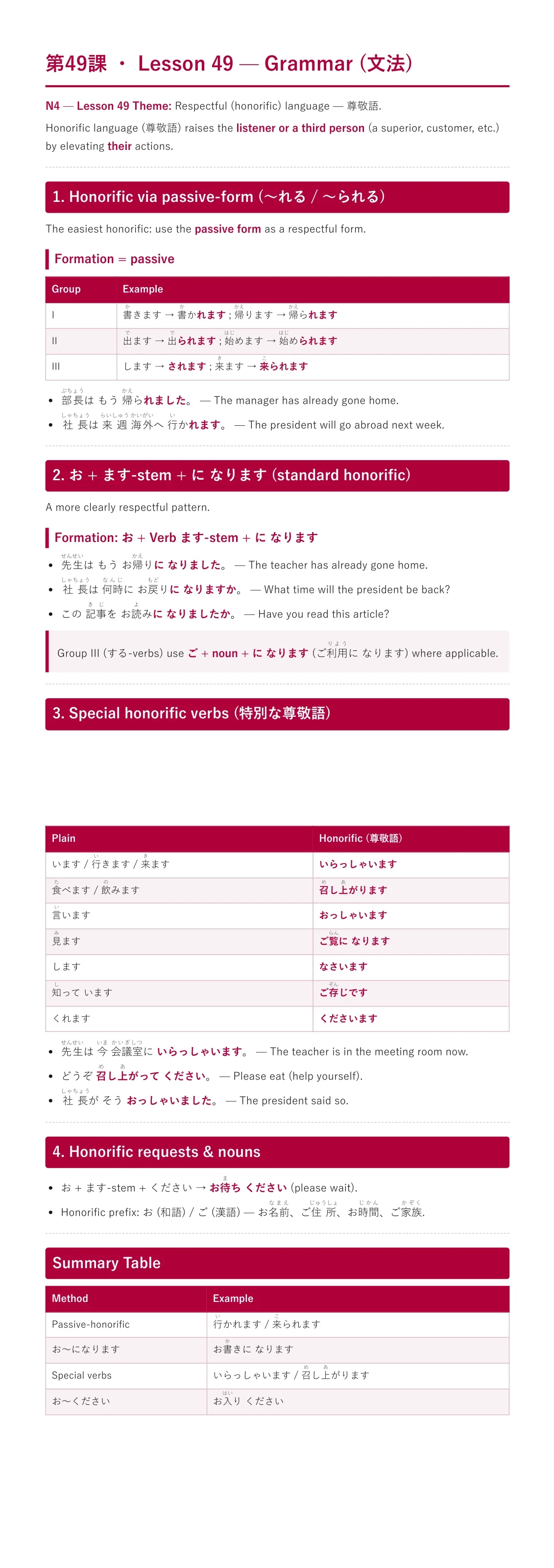
Lesson 49
Honorific language (尊敬語) raises the listener or a third person (a superior, customer, etc.) by elevating their actions.
Covers: Honorific via passive-form (〜れる / 〜られる) · Formation = passive · お + ます-stem + に なります (standard honorific) · Formation: お + Verb ます-stem + に なります · Special honorific verbs (特別な尊敬語) · Honorific requests & nouns · Summary Table · Key Vocabulary (単語) · Example Sentences (例文) · Passive-honorific / お〜になります · Special honorific verbs · Honorific request · Model Conversation (会話) — 受付で · Mini Practice (練習)
Lesson 50
Humble language (謙譲語) lowers the speaker's own actions to show respect to the listener. Polite language (丁寧語) makes the whole statement courteous.
Covers: お + ます-stem + します (standard humble) · Formation: お + Verb ます-stem + します (ご + noun + します for する-verbs) · Special humble verbs (特別な謙譲語) · Putting it together (humble self / honorific other) · Summary Table · Key Vocabulary (単語) · Example Sentences (例文) · お〜します (humble) · Special humble verbs · 丁寧語 (polite) · Model Conversation (会話) — スピーチ・自己紹介 · Mini Practice (練習)